Quick Answer: Makeup wipes are not dangerous, but they are a poor daily cleanser. They smear product around rather than removing it, require friction on delicate skin, and leave surfactants and preservatives sitting on your face.Dermatologists generally recommend a cleansing balm or micellar water followed by a gentle water-based cleanser instead. Makeup wipes are fine occasionally: travel, festivals, or nights when the alternative is sleeping in your makeup.
I kept a pack of makeup wipes in my bedside drawer for about six years. My reasoning was airtight: a wipe at midnight beats falling asleep in foundation. I still think that reasoning holds. But somewhere in year four I noticed my under-eyes had gotten permanently pink and slightly crepey, and it took an embarrassingly long time to connect that to the nightly tugging.
So, are makeup wipes bad for your skin? The honest answer is more nuanced than the beauty internet lets on. They are not toxic and they are not going to ruin your face. They are a bad daily cleanser for one structural reason that has nothing to do with the ingredient list, and once you see it you cannot unsee it.
What follows is what is actually going on with makeup wipes, what the research says, when they are fine, and what to use the other 360 nights of the year.
The core problem: makeup wipes don’t rinse
Every other cleansing method ends the same way. You rinse, and the emulsified makeup, oil, dirt and cleanser go down the drain.
Makeup wipes have no rinse step. You dissolve makeup with surfactants, spread it around your face, and then leave both the makeup residue and the surfactant sitting on your skin overnight.
That is the whole thing. Every other item on this list is downstream of it.
The American Academy of Dermatology’s face-washing guidance is built around a gentle cleanser and lukewarm water for exactly this reason. Cleansing is a two-part process, and makeup wipes only do the first part.
8 things makeup wipes actually do to your skin
1. They leave residue behind
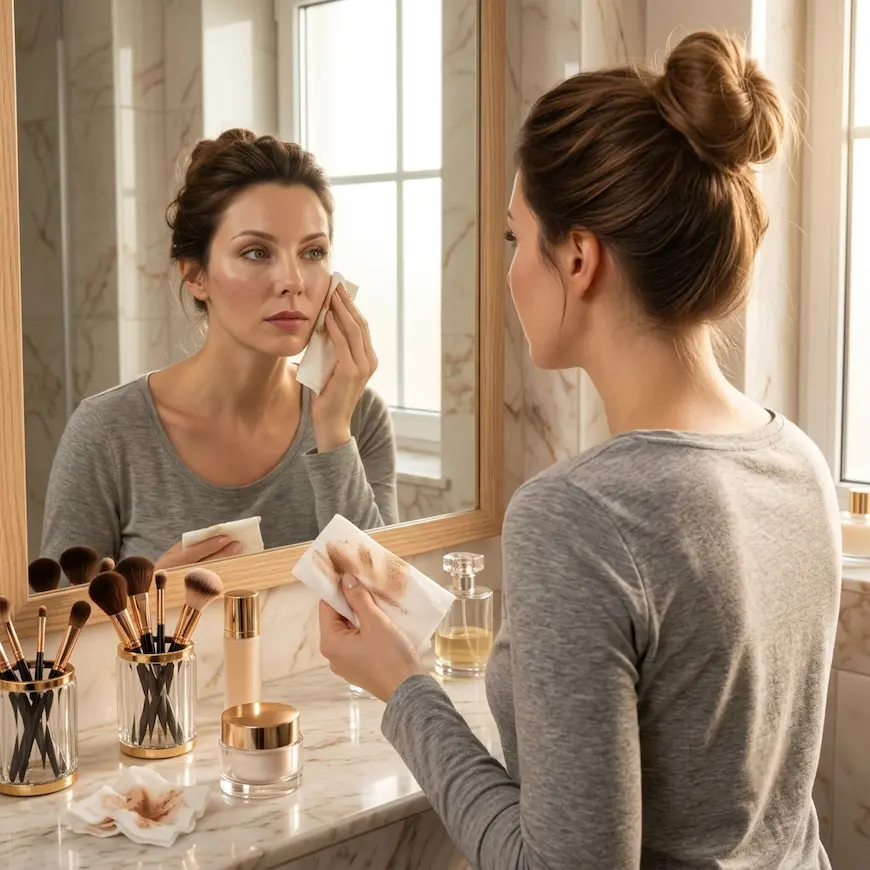
The most consequential one. Makeup wipes are designed to lift product onto the cloth, but a meaningful amount gets pushed around and left behind, especially foundation settled into pores and anything long-wear or transfer-proof.
Do the test yourself. Wipe your face until the wipe comes away clean, then follow with a cotton pad and micellar water. There will be more makeup on the pad. There always is.
Residual foundation sitting in pores overnight is how “I cleanse every night but still break out” happens.
2. The friction is the real damage
Makeup wipes require mechanical force. You press, drag, and repeat, and around the eyes that skin is roughly a third the thickness of the skin on your cheeks.
Repeated tugging in that area contributes to irritation, redness, and over years, laxity. It is also why sensitive-skin types often react and assume it was an ingredient when it was the rubbing.
If you wear waterproof formulas, this compounds fast. Waterproof mascara does not dissolve in a water-based wipe, so you scrub harder, which is precisely how lashes get sparse. There is a gentler method in how to remove waterproof mascara without damaging your lashes.
3. The preservatives are a documented allergen
This is the part that surprised me when I went looking for research.
Wipes are wet products, so they need strong preservatives to stop bacterial growth. For years the industry’s preservative of choice was methylisothiazolinone (MI), and it turned out to be a significant contact allergen. A survey of MI as an emergent allergen in pediatric skin care products found MI in 30 of 152 products aimed at babies and children, with facial and body wipes among the worst categories. A case series in Pediatrics documented six children who developed allergic contact dermatitis from wet wipes containing MI.
Worth being precise here: both studies looked at baby wipes, not makeup wipes. The connection is the preservative, which appears across the whole wet-wipe category, so the concern carries over by ingredient rather than by direct evidence.
The clinically important detail: this kind of reaction is frequently misdiagnosed as eczema. In that Pediatrics series, all six children had rashes that had resisted rounds of topical and oral antibiotics and corticosteroids, and four of them had no history of eczema at all. People treat the rash for months without removing the cause.
The counterintuitive finding from the first study is the one worth remembering: products marketed as “gentle,” “sensitive,” “organic,” or “hypoallergenic” frequently contained MI anyway. The label on the front tells you nothing. The ingredient list does.
Many brands have since reformulated or reduced MI concentrations, and regulations tightened in the EU. But if you use makeup wipes daily and have a persistent, unexplained facial or eyelid rash, they are worth eliminating for two weeks as a test.
4. They can leave the skin drier than they found it
Makeup wipes contain surfactants, the cleansing agents that bind to oil. Without a rinse, those surfactants stay on the skin and keep working, which means they keep pulling at your natural lipids after you have walked away.
Combine that with alcohol in some formulas and the outcome is skin that feels tight and squeaky. Squeaky skin is stripped skin, not clean skin.
5. They disrupt your skin’s pH
Healthy skin sits slightly acidic, around pH 4.7–5.75. That acidity is functional. It supports the enzymes that maintain your barrier and discourages the bacteria you do not want.
Alkaline cleansing agents raise skin pH temporarily. Rinsing lets it recover quickly. Leaving them on your face extends the disruption, and repeated nightly, that is a barrier under low-grade constant stress.
6. They can worsen acne
Two mechanisms, both already covered: residue clogs pores, and friction inflames existing lesions. Together they make makeup wipes a poor choice for acne-prone skin.
The AAD lists a number of routine habits that quietly worsen acne, and the theme running through them is the same: over-handling the skin and leaving product on it.
7. Eye-area irritation is common
Fragrance and preservatives sit on some of the most reactive skin on your body, and the removal method involves rubbing it. The FDA’s eye cosmetic safety guidance is worth reading if you are prone to irritation or wear contacts. The FDA is blunt that eye cosmetics can introduce bacteria and that infections there are occasionally serious, so residue in the eye is a genuine route, not a hypothetical one.
If you wear contacts, remove them before removing eye makeup, every time.
8. The environmental cost is real
Most makeup wipes are made with plastic-containing nonwoven fabrics: polyester, polypropylene, viscose blends. They are not biodegradable, they are not recyclable, and despite the labelling on some packs, they should never be flushed.
Wipes are a well-documented contributor to sewer blockages and to plastic pollution in waterways, and the EPA’s trash-free waters work covers the broader problem. One person’s nightly wipe is roughly 365 pieces of plastic textile a year, which is a startling number the first time you do the arithmetic.
When makeup wipes are actually fine
Because the honest answer is not “never.”
Use makeup wipes without guilt when:
- The alternative is sleeping in your makeup. This is the big one. Sleeping in a full face is worse for your skin than a wipe, full stop. A wipe at 1am is the right call.
- You’re traveling. Airplanes, campsites, festivals, anywhere without reliable running water.
- You’re at the gym or post-workout and need makeup off quickly before sweat drives it into your pores.
- You have limited mobility, chronic illness, or fatigue that makes a sink routine difficult. Accessibility beats optimization, and beauty advice is often thoughtless about this.
- You’re doing a first pass on heavy or theatrical makeup before a proper cleanse.
How to use makeup wipes better when you do:
- Press, don’t drag. Hold the wipe against the area for 10 seconds and let the solvents work, then lift. Especially around the eyes.
- Always follow with a rinse. Cleanser and water if available, micellar water and a cotton pad if not.
- Read the ingredient list, not the front of the pack. Check for MI or MCI if you are reaction-prone, and remember that “gentle” and “hypoallergenic” on the label do not mean it is absent.
- Moisturize afterwards. You have stripped. Put something back.
That is it. Makeup wipes followed by an actual cleanse is a perfectly reasonable routine.
What to use instead of makeup wipes: 5 better options
Ranked by how well they work, not by price.
1. Cleansing balm, best overall
A solid balm that melts on contact with skin, dissolves everything including waterproof formulas, then emulsifies with water and rinses clean. No rubbing required, because the balm does the work.
This is what changed my routine. Massage in for 30 seconds, add water, rinse. Even long-wear foundation comes off without force.
2. Micellar water, best for low-effort nights
Micelles are tiny oil molecules suspended in water that grab onto makeup and lift it away. Saturate a cotton pad, press and hold for a few seconds, then wipe once.
It is the closest thing to makeup wipes in convenience while being significantly gentler, and dermatologists routinely recommend it for sensitive skin. Technically it still needs a rinse, though it leaves far less residue than a wipe.
3. Cleansing oil, best for heavy or waterproof makeup
Same principle as a balm in liquid form. Oil dissolves oil, which is why it handles waterproof mascara and long-wear foundation that water-based products cannot touch.
4. Reusable makeup remover cloths, best for the environment and your budget
A microfiber cloth and warm water removes most everyday makeup with no product at all. Wash it with your towels. One set replaces years of makeup wipes.
They will not handle waterproof formulas alone, so pair with an oil or balm for those.
5. Double cleansing, best result, most effort
The full method: an oil-based cleanser first to break down makeup and sunscreen, then a gentle water-based cleanser to clean the skin underneath.
Two steps and about ninety seconds. If you wear heavy makeup or SPF daily, it is the most thorough option there is, and it is the reason it stays popular through every cycle of skincare trends.
Quick comparison
| Method | Removes waterproof? | Needs rinsing | Gentle on eyes | Cost per month |
|---|---|---|---|---|
| Makeup wipes | Poorly | Should, but doesn’t | ✗ Friction required | $8–$15 |
| Cleansing balm | ✓ Yes | ✓ Yes | ✓ Yes | $2–$5 |
| Micellar water | Partially | Recommended | ✓ Yes | $2–$4 |
| Cleansing oil | ✓ Yes | ✓ Yes | ✓ Yes | $2–$5 |
| Reusable cloths | ✗ Not alone | Water only | ✓ Yes | Under $1 |
| Double cleanse | ✓ Yes | ✓ Yes | ✓ Yes | $4–$8 |
The cost column is the one that surprises people. Makeup wipes are the most expensive option on the list per month, not the cheapest.
The 60-second nightly routine that replaces makeup wipes
- Balm or oil, 30 seconds. Dry hands, dry face. Massage in circles, spend extra time on the eyes and lips.
- Add water, emulsify, rinse. The product turns milky and lifts everything off.
- Gentle cleanser, 20 seconds. Lukewarm water. Pat dry rather than rubbing.
- Moisturize on slightly damp skin.
Sixty seconds. Barely longer than a wipe, and it actually cleans your face.
If you are wondering what goes on after this, I have mapped out the correct order to layer your skincare products, and order matters more than most people expect. If you are rebuilding your routine from scratch, the whole thing can be done for less than you would think: best drugstore skincare routine under $50.
One more thing worth saying. The less makeup you wear, the less there is to remove. My 5-minute everyday makeup routine uses six products, and it comes off in one pass with a balm.
Frequently asked questions
Do I need to wash my face after using a makeup wipe?
Yes. A wipe loosens and redistributes makeup rather than removing it completely. Following with a gentle cleanser and water is what actually cleans your skin, and it removes the leftover surfactants from the wipe itself.
Do makeup wipes cause acne?
They can contribute. Residue left in pores plus friction on inflamed skin is a poor combination for acne-prone faces. If you break out despite cleansing nightly with makeup wipes, switching to a balm-and-rinse routine is a reasonable thing to try for a month.
Are makeup wipes or micellar water better?
Micellar water, in most cases. It is gentler, leaves less residue, requires less rubbing if you press and hold rather than drag, and generates far less waste. Neither fully replaces a proper cleanse, but micellar water comes closer.
Can makeup wipes cause allergic reactions?
Yes. Preservatives used in wet wipes, methylisothiazolinone in particular, are documented causes of allergic contact dermatitis, and cases are often initially misdiagnosed as eczema. If you have a persistent facial or eyelid rash, eliminating makeup wipes for two weeks is a cheap diagnostic test.
Is it bad to use makeup wipes every day?
Daily use is where the problems accumulate: residue, repeated friction, ongoing preservative exposure, and a barrier that never fully recovers. Occasional use is fine. Daily use is worth replacing.
What’s the gentlest way to remove eye makeup?
Press an oil-based product or a soaked cotton pad against closed lids and hold for 15–20 seconds before wiping once. Let the product dissolve the makeup instead of using force. This matters most with waterproof mascara.
The bottom line
Makeup wipes are not the villain the beauty internet makes them out to be. They are a convenience product being used as a cleanser, and they are bad at that specific job because they cannot rinse.
Keep a pack for travel and 1am emergencies. For every other night, a cleansing balm and sixty seconds will do more for your skin than any serum you buy this year, and it costs less than the makeup wipes did.

Hi, I’m Marwa ✅
I test skincare, haircare, and makeup on real skin and a real budget, and writes the honest reviews to prove it.