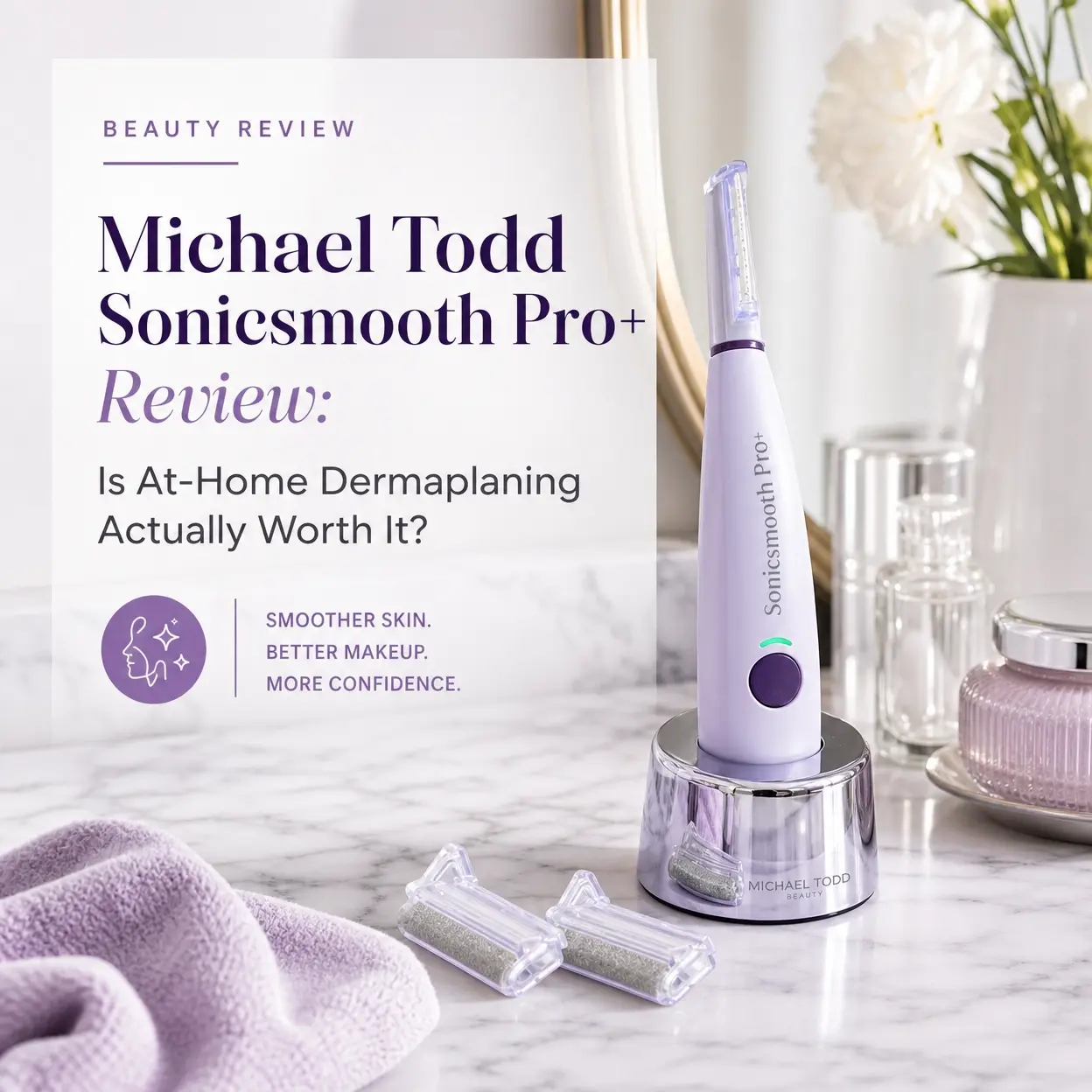
I bought the Michael Todd Sonicsmooth Pro+ after seven TikTok videos convinced me that peach fuzz was “ruining” my foundation. I want to be upfront: I did not, in fact, have peach fuzz ruining anything. But the moment I held the device, switched on the LED light, and ran the blade across my cheek for the first time, I understood why this thing has gone viral.
Two months in. Cut myself once (my fault). Smoothest skin of my adult life. This Michael Todd Sonicsmooth review is the no-affiliate-script version — what it actually does, what it doesn’t, who should buy one, and who’s better off saving the $159.
If you’ve been looking for an at-home dermaplaning device that doesn’t feel like a glorified shaving razor, the Michael Todd Sonicsmooth is probably your answer. There are caveats. Let’s get into them.
Quick verdict
| Category | Verdict |
|---|---|
| Smoothness after one use | Genuinely excellent |
| Peach fuzz removal | Works exactly as advertised |
| Microdermabrasion exfoliation | Better than expected |
| Learning curve | Easy after the first 2 uses |
| Worth $159? | Yes, if you’d otherwise pay for facials |
| Best for | Makeup wearers, anti-aging-curious users |
| Skip if | Active acne, eczema, or very sensitive skin |
➤ Check the current price on Amazon
As an Amazon Associate I earn from qualifying purchases. If you buy through a link on this page I may receive a small commission at no extra cost to you. I bought this mask myself, and this review says plainly which of its claims I think do not hold up.
What is the Michael Todd Sonicsmooth Pro+?
The Michael Todd Sonicsmooth Pro+ is an at-home dermaplaning device that combines two treatments in one: dermaplaning (a fine blade that removes peach fuzz and dead skin from the surface of your face) and a microdermabrasion attachment (a softer tip for more delicate polishing).
What sets it apart from the dozen similar tools floating around Amazon is the build quality. The handle produces sonic vibration that helps the blade glide instead of drag — which is the main reason people cut themselves with cheap drugstore razors. There’s also a built-in LED light that genuinely matters when you’re trying to spot fine hair on your cheekbones.
In the box: the device itself, 16 dermaplaning blade refills, 2 microsmooth exfoliation tips for the microdermabrasion function, a USB-C charging cable, a small storage pouch, and an eyebrow trimmer attachment I ended up using more than expected.
What dermaplaning actually does (and why people keep buying these)
Short version: dermaplaning is controlled exfoliation using a fine blade to remove two things at once — vellus hair (peach fuzz) and the top layer of dead skin on your face.
The payoff isn’t really a hair removal result. It’s an exfoliation result. That smoothness you feel is mostly because you just lifted off a layer of dead skin that was diffusing light and dulling your complexion. Skincare absorbs better. Foundation goes on the way it does in tutorials. Your skin photographs differently. That’s the draw.
Professional dermaplaning runs $75–150 per appointment in most U.S. cities. A dermatologist or esthetician does it monthly. If you’re spending more than $80 every six weeks on those appointments, the Michael Todd Sonicsmooth pays for itself inside two months.
There are also real (if modest) anti-aging benefits. Removing the dead skin barrier helps serums and retinols penetrate better, which compounds over time. It doesn’t replace retinol or sunscreen. But alongside a solid routine, it raises the ceiling on what your skincare can do.
My honest 30-day Michael Todd Sonicsmooth review
I committed to 30 days before forming an opinion — sessions every 10 days, no exceptions. I have normal-to-combination skin, no active acne, mild texture, and the standard amount of peach fuzz a person has but never thinks about. My question was simple: does the Michael Todd Sonicsmooth actually deliver the “smoother skin, better makeup” claim, or is it a fancy razor?
Session 1 (Day 1): I cut myself. Small nick on the jawline from holding the device at about 70 degrees instead of the recommended 45. Corrected the angle, slowed down, finished the session fine. Skin felt noticeably softer that evening. Applied The Ordinary Hyaluronic Acid right after and my moisturizer absorbed in seconds instead of sitting on the surface.
Session 2 (Day 11): More confident. No nicks. I tried the microdermabrasion attachment across my forehead and chin — gentler than the blade, more like a polish. The combination left my skin looking lit the next morning. Foundation that week was the best it’s been all year.
Session 3 (Day 21): Retinol started absorbing differently in the days after dermaplaning — more effective, no extra irritation. The cumulative texture improvement became obvious around here. Friends asked what I was doing differently. I said “drinking more water.”
Session 4 (Day 30): Smooth, even, and the peach fuzz I genuinely hadn’t noticed before is gone. Foundation now sits cleanly across my whole face instead of catching slightly along the hairline. This is exactly what TikTok was talking about. They weren’t wrong.
After 30 days: the Michael Todd Sonicsmooth Pro+ does what it claims. The sonic vibration is not a gimmick. It’s the difference between a relaxing session and a stressful one.
Before and after (realistic expectations)
A lot of dermaplaning before-and-after photos online are taken under wildly different lighting. Here’s what’s actually true:
- Immediately after: Skin looks brighter and feels glassy-smooth for 3–4 days
- At one week: Foundation absorbs more cleanly, especially in peach-fuzz areas
- At one month: Texture is visibly more even; fine lines look slightly less pronounced
- At two months: Other people start noticing without being told
What the device does not do: shrink pores, eliminate hyperpigmentation, fix active acne, or replace retinol. Anyone selling those claims is exaggerating.
How to use the Michael Todd Sonicsmooth at home (step-by-step)
Follow this if it’s your first time. The mistakes that cause cuts are all in the first two minutes.
1. Start with completely clean, completely dry skin. Wet skin and wet blades don’t mix. Cleanse, towel dry, let it air out for two minutes.
[Use: CeraVe Hydrating Cleanser]
2. Turn on the LED light and inspect. The built-in LED reveals exactly where peach fuzz sits, so you can avoid the eye area and lip line confidently.
3. Hold the skin taut. Use your free hand to pull the section tight. Non-negotiable — slack skin bunches under the blade and causes nicks.
4. Glide at a 45° angle in short downward strokes. Don’t press. The sonic vibration does the work. If you feel like you’re scraping, you are.
5. Skip the eye area, lip border, and any active blemish. Always.
6. Use the microdermabrasion attachment last. Gentle polish across forehead, cheeks, and chin. Two minutes is enough.
7. Apply a hydrating serum and moisturizer immediately. Freshly dermaplaned skin absorbs everything. Use it.
[Use: The Ordinary Hyaluronic Acid 2% + CeraVe Daily Moisturizing Lotion]
8. Wear SPF the next day, religiously. Your skin is newly exposed and more sun-sensitive for 48 hours.
[Use: CeraVe Hydrating Mineral Sunscreen SPF 30]
A full session takes me 7–10 minutes. Every 10–14 days is the right cadence for most people. More frequent than weekly risks over-exfoliating.
Read also: Best Drugstore Skincare Routine Under $50 (2026 Guide)
Who the Michael Todd Sonicsmooth is worth it for
After two months, here’s who I’d recommend this to without hesitation:
- Anyone already paying for professional dermaplaning facials. This tool pays for itself in two appointments.
- Makeup wearers who want their base to look skin-like. Peach fuzz removal genuinely transforms how foundation sits.
- People with mild texture or dullness that no serum seems to fix — often the issue is dead skin that needs lifting, not another product.
- Anyone using retinol or vitamin C who wants their actives to penetrate better.
- Anti-aging-curious users in their late 20s through 40s looking for a no-downtime addition to their routine.
If even two of these describe you, the Michael Todd Sonicsmooth is one of the better at-home skincare device investments out there.
Who should skip it
I’d actively talk these people out of buying it:
- Active acne, especially cystic or inflamed. Dermaplaning over breakouts spreads bacteria and makes things worse.
- Eczema, psoriasis, or rosacea-prone skin. The friction is too much for a compromised barrier.
- Very sensitive or reactive skin that flares from basic exfoliants. Patch-test first, but be honest with yourself.
- People who don’t have $159 to spend. A cheaper alternative exists and does about 70% of the job.
Michael Todd Sonicsmooth vs Dermaflash Luxe vs Schick Hydro Silk
Three of the most-searched dermaplaning tools, compared:
| Feature | Michael Todd Sonicsmooth | Dermaflash Luxe | Schick Hydro Silk Touch-Up |
|---|---|---|---|
| Price | ~$159 | ~$199 | ~$5 (3 pack) |
| Sonic vibration | ✓ | ✓ | ✗ |
| Microdermabrasion attachment | ✓ | ✗ | ✗ |
| LED light | ✓ | ✗ | ✗ |
| Replacement blades included | 16 | 12 | Single-use |
| Eyebrow trim attachment | ✓ | ✗ | ✗ |
| Cumulative cost per year | $159 | $199+ blade refills | ~$60 |
Honest take on each:
The Schick Hydro Silk Touch-Up (check on Amazon) is unbeatable for the price. If you want to try dermaplaning before committing to anything, start here. It won’t give spa results, but it’ll tell you whether you enjoy the process.
The Michael Todd Sonicsmooth Pro+ wins on overall value: better blade quality, sonic vibration, a microdermabrasion bonus, and a lower price than Dermaflash. For most people, this is the right call.
The Dermaflash Luxe (check on Amazon) is well-built, but you’re paying $40 more for less. Buy it only if you’re already locked into their replacement-blade ecosystem.
Frequently asked questions
Will hair grow back thicker after dermaplaning?
No. Vellus hair (peach fuzz) doesn't become terminal hair (darker, coarser) just because it was cut. It grows back at the same thickness and color. It feels slightly different for 2–3 days as the blunt edge grows in, then returns to normal.
Can I dermaplane if I use retinol?
Yes, but space them out. Don't dermaplane the same week you start a new retinol, and don't apply retinol within 48 hours of a session. Once your skin is acclimated to both, they work well together — retinol absorbs more effectively into freshly dermaplaned skin.
Is the Michael Todd Sonicsmooth Pro+ worth $159?
For anyone who'd otherwise pay for professional dermaplaning ($80–$150 per session), yes — it pays for itself in two visits. For occasional users, it's worth it if you plan to be consistent. For complete beginners, the $5 Schick Hydro Silk is a smarter first step.
How do I clean it between uses?
Rinse the blade head under warm water, brush gently with a soft cleaning brush, dry thoroughly, store in the included pouch. Replace the blade every 2–3 uses — with 16 included, that's 4–6 months of use minimum.
The bottom line
The Michael Todd Sonicsmooth Pro+ does what it says on the box. Best at-home dermaplaning device I’ve tested, it pays for itself compared to professional facials, and the smooth-skin result is real.
It won’t fix acne. It won’t replace your retinol. It won’t turn your skin into something it’s not. What the Michael Todd Sonicsmooth will do is give you the smoothest version of your own skin — softer to the touch, brighter in photographs, and dramatically better as a makeup base.
If you fit the audience described above, this is one of the rare $159 beauty purchases I’d back without hesitation.
➤ Check current price on Amazon
Have you tried the Michael Todd Sonicsmooth? Drop a comment — I’m always curious which tools people swear by.

Hi, I’m Marwa ✅
I test skincare, haircare, and makeup on real skin and a real budget, and writes the honest reviews to prove it.