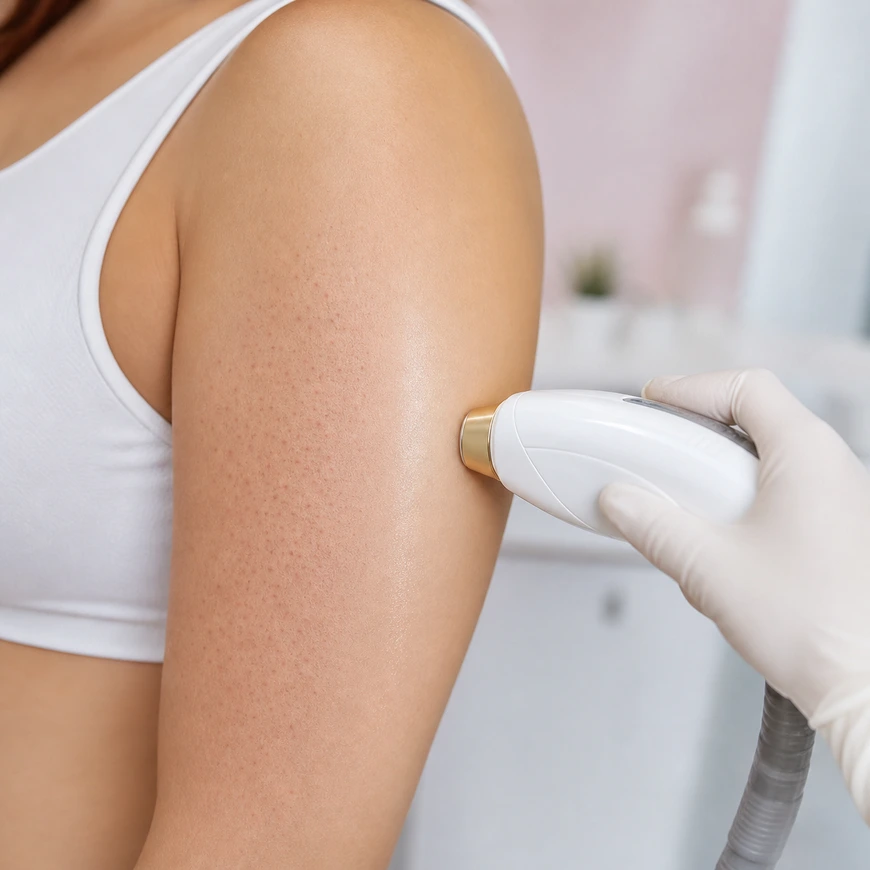
Quick Answer: Yes, with caveats. Laser hair removal for keratosis pilaris has one good trial behind it: a split-body randomised study found a long-pulsed 755 nm alexandrite laser, a standard hair-removal wavelength, significantly improved both roughness and redness compared with moisturiser alone after four sessions. The evidence base as a whole is small, though. A systematic review of every published light and laser study for KP found 17 studies covering 175 patients in total. It is not a cure, the results are not permanent, and the AAD frames lasers as the fallback for when creams and prescription treatments have not worked. Start with lactic or salicylic acid. The evidence rates those just as highly and they cost a fraction as much.
Keratosis pilaris is a follicle problem. Laser hair removal targets follicles. It is an obvious enough idea that a lot of people have wondered about it, and unusually for a beauty trend, there is published research behind it.
There just is not very much of that research, and the honest version of what it says is more useful than the confident version you will find on clinic websites.
What keratosis pilaris actually is
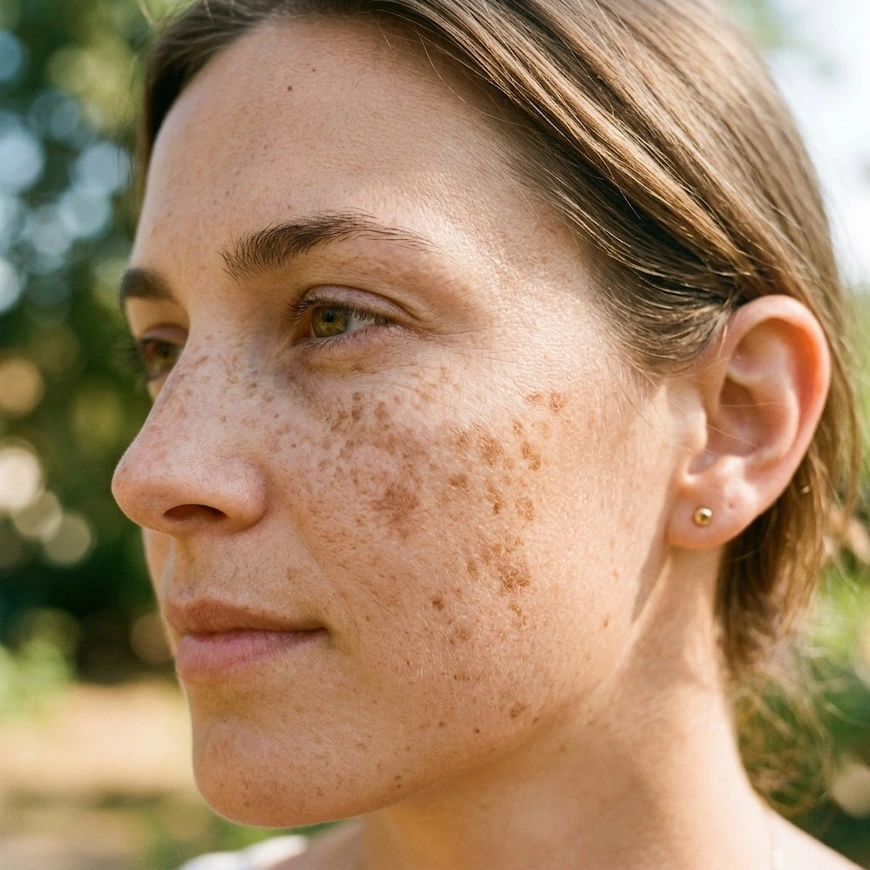
The AAD describes the bumps plainly. They are plugs of dead skin cells. Keratin, the protein that makes up the outer skin layer, builds up and blocks the opening of the hair follicle. You get a rough, goosefleshy texture, usually with redness around each plug.It turns up on the upper arms and the front of the thighs most often. Children may get it on the cheeks. It also appears on the buttocks and forearms.It is not acne, not an infection, not contagious, and not the result of poor hygiene. It is genetic and it is harmless.Here is the part almost nobody mentions: it is seasonal. The AAD notes that plenty of people find the bumps clear in summer and come back in winter. So if yours are worse in January, that is the condition behaving exactly as it should rather than your routine failing. Dry air makes the plugs more visible. If you want the full picture of what keratosis pilaris is before deciding on treatment, start there.
How laser hair removal for keratosis pilaris is supposed to work
The logic is sound. Laser hair removal targets the pigment in the hair shaft and uses it to conduct heat down into the follicle, damaging the structures that produce hair.KP is a disorder of that same follicle. Take the hair out of the equation and the theory says you reduce the plugging.Except the mechanism is probably not the one usually given. KP bumps mostly form around vellus follicles, the fine barely-pigmented hairs on your upper arms, and those are exactly the hairs that laser hair removal performs worst on, because there is so little pigment for the laser to find.What the research points to instead is broader. The laser energy appears to cause thermal remodelling in and around the follicle, which reduces the plug, calms the inflammation around it and fades the pigment left behind. That is why lasers help KP even in places where they would be poor at removing the hair.The distinction matters when you are deciding whether to pay. “Will laser hair removal work on my arms?” and “will laser help my KP?” are two different questions with two different answers.
What the research actually shows
This is the part worth reading slowly. Almost everything written about laser hair removal for keratosis pilaris skips straight past the numbers, and the numbers are the whole story.
The strongest single study
A split-body randomised trial published in 2022 treated 22 patients with KP on both arms. Each patient had one arm lasered with a long-pulsed 755 nm alexandrite, a standard hair-removal wavelength, over four sessions three weeks apart. Both arms got the same daily moisturiser.The split-body design is what makes it useful. Each patient is their own control, so you are seeing the laser’s effect rather than the moisturiser’s.Four weeks after the final session, the lasered arm scored significantly better on overall severity, by both physician and patient assessment, and on roughness and redness separately. On imaging, the proportion showing excellent improvement was markedly higher on the treated side.
| Measure | Laser side | Control side |
|---|---|---|
| Follicular plugs | 57.1% | 14.3% |
| Redness around follicles | 52.4% | 9.5% |
| Pigmentation around follicles | 47.6% | 14.3% |
The safety finding matters just as much, and it is the number most write-ups skip. Three patients developed post-inflammatory hyperpigmentation. It reversed, but that is roughly one in seven, and it is precisely the risk that falls hardest on people with medium and deeper skin tones.
The scale of the whole evidence base
Now the context that keeps this honest.A systematic review in Dermatologic Surgery gathered every published light and laser study for KP and its variants. It found 17 studies. The total number of patients treated across all of them was 175. The authors called light and laser devices promising but emerging, for a condition that still has no effective long-term treatment.Promising. Emerging. 175 patients. That is the accurate picture: not a proven treatment, not snake oil, and worth knowing before you commit to a six-session package.One caveat on that number, since nobody else seems to mention it. The review’s literature search closed in January 2017, so its 175 patients do not include the 2022 alexandrite trial above or anything else published since. The evidence base is a little larger now than 175. It is still nowhere near large.
Where laser ranks against the cheap options
A 2022 review in Skinmed assessed the intervention studies and named three things as the most effective and safe options for patients aged 12 and over: lactic acid, salicylic acid, and the 1064 nm Nd:YAG laser. The authors added the usual and entirely fair caveat that high-quality randomised trials with long-term outcomes are still needed.Read that list again. Lactic acid and salicylic acid sit alongside laser in the same sentence, as the treatments with the best evidence behind them.None of which argues against laser. It argues for trying a £12 lotion consistently for three months before you spend on a six-session course, which is roughly what the AAD suggests when it frames lasers as an option “when moisturizer and medicine fail.”
Which laser, for which problem
Not all lasers do the same job here, and this is where a lot of money gets wasted. The AAD is clear that a dermatologist might pick one device to bring down swelling and redness and a different one to improve texture and fade discoloration. Those are separate goals with separate machines.
| Laser | Best for | Notes |
|---|---|---|
| Long-pulsed 755 nm alexandrite | Roughness and redness together | The split-body trial above. Not for deeper skin tones |
| Long-pulsed 1064 nm Nd:YAG | Texture, and safest for deeper skin tones | Named in the Skinmed review alongside lactic and salicylic acid |
| Pulsed dye (595 nm) | Redness only, meaning KP rubra | Targets blood vessels rather than follicles. Will not touch the bumps |
| Diode (810 nm) | General hair removal | Most common in salons; least KP-specific evidence |
If your KP is mostly red rather than mostly bumpy, a hair-removal laser is the wrong purchase and a vascular laser is what you want. Ask which device the clinic uses before you book. The word “laser” on a price list tells you nothing.
Who should not have this
Most pages recommending this procedure carry no safety information at all, which is a strange thing to leave out. Here is what belongs on one.Laser hair removal for keratosis pilaris is a medical procedure, not a facial. Skip it, or postpone it, if any of the following applies to you:
- You have taken isotretinoin in the past six months. Check the exact interval with the clinic
- You are pregnant. Treatment is normally deferred, not because of proven harm but because it has not been studied
- You have tanned, sunbathed or used a sunbed in the past two to four weeks. This is the most common cause of laser burns, and it is why summer is the wrong season to start
- You are taking a photosensitising medication, such as doxycycline and other tetracyclines, some diuretics, some antidepressants, or St John’s wort
- You have an active infection, broken skin or a cold sore in the treatment area
- You have a history of keloid scarring
- You have a seizure disorder, because of the flashing light exposure
On skin tone, be specific rather than vague. Hair-removal lasers work by targeting pigment, so on deeper skin tones the device can end up targeting the pigment in the skin rather than only in the hair. That is how burns and pigment changes happen. The 1064 nm Nd:YAG is the wavelength considered safest for deeper skin tones, and alexandrite generally is not appropriate.Treat all of that as a prompt to ask what device a clinic uses and to choose a practitioner experienced with your skin tone. A clinic that cannot answer that question is not the right clinic.The post-inflammatory hyperpigmentation risk is real too, at three patients in the alexandrite trial. If you are prone to dark marks, factor that in before you book.
What a course actually involves
The trial used four sessions, three weeks apart. Clinics typically sell packages of six to eight. Either way, expect a minimum of four before you judge anything.It feels like a rubber band snapping against the skin. Most current devices have a cooling tip that takes the edge off considerably. Afterwards you get redness and slight swelling around the follicles for a few hours to a day, and a cool compress plus a bland moisturiser is all it needs.Aftercare is where people undo the results:
- Sunscreen on the treated area, daily, without exception. Freshly treated skin pigments easily, and this is what prevents the dark marks
- No sun exposure or sunbeds between sessions
- Pause exfoliants for about a week, then resume gently
- Keep moisturising. The trial’s control arm got moisturiser too, and moisturiser alone still improved things
And it is not permanent. Hair regrows, follicles resume plugging, and maintenance sessions are part of the deal. Anyone selling laser hair removal for keratosis pilaris as a one-off cure is overselling it.
Start here instead: the cheap things that work
Given the evidence ranks lactic and salicylic acid alongside laser, this is where to begin.
Moisturise properly, and at the right moment. The AAD is specific about how to moisturise properly: put it on within about five minutes of getting out of the bath or shower while your skin is still damp, and repeat two or three times a day. Most people moisturise once, on dry skin, and conclude it does not work.
Add a keratolytic lotion. Three ingredient families have evidence behind them. Lactic acid is the best evidenced and gentler than it sounds. Salicylic acid dissolves keratin inside the follicle. Urea softens and hydrates at once, at 10 to 20% for KP.
Give it twelve weeks. KP responds slowly and most people quit at four.
Try a retinoid if that is not enough. Body retinol or adapalene speeds up turnover so keratin does not sit around long enough to plug. Start twice a week and build. These are actual retinoids, by the way. A 2% BHA lotion is not one, whatever the shelf position suggests.
Put sunscreen on exposed areas. KP leaves dark marks and UV deepens them.What not to do: scrub. Physical scrubs and loofahs on inflamed KP make the redness worse without shifting the plugs, which sit inside the follicle rather than on the surface.And be honest with yourself about the target. The goal is smoother and calmer, not gone. KP is genetic and lifelong. Every treatment on this page, laser included, manages it rather than cures it.
Frequently asked questions about laser hair removal for keratosis pilaris
How many sessions of laser hair removal for keratosis pilaris do I need?
The trial that showed the clearest benefit used four, spaced three weeks apart. Clinics usually sell packages of six to eight. Do not judge it before four, and expect maintenance sessions afterwards, because the effect fades as follicles go back to normal behaviour.
Is laser hair removal safe for KP on darker skin?
With the right device, yes, but the device matters enormously. Hair-removal lasers target pigment, so on deeper skin tones there is a risk of the laser going after skin pigment and causing burns or pigment changes. The 1064 nm Nd:YAG is the wavelength generally considered safest here. Ask the clinic which device they use, and choose a practitioner experienced with your skin tone.
What causes keratosis pilaris?
Excess keratin plugging the hair follicles. It is genetic, harmless, not contagious, and nothing to do with hygiene. The AAD describes the bumps as plugs of dead skin cells. It is often worse in winter, and many people find it clears in summer and returns once the air dries out.
What is the best cream for keratosis pilaris?
The evidence points to lactic acid, salicylic acid and urea. A 2022 review named lactic and salicylic acid alongside the Nd:YAG laser as the options with the best evidence. Apply within five minutes of showering while skin is still damp, two or three times daily, and give it twelve weeks before deciding.
Will laser work on my arms if my hair is fine and light?
Probably not well for hair removal. Lasers need pigment to target and fine light vellus hair gives them very little. That said, the KP benefit seems to come from thermal effects in and around the follicle rather than from hair removal itself, which is why lasers can improve KP even where they are poor at clearing hair. Two separate outcomes. Be clear with the clinic which one you are paying for.
Can I do laser hair removal for keratosis pilaris at home?
At-home IPL devices are far weaker than clinic lasers and there is no evidence for them in KP specifically. They carry the same skin-tone limitations, and most are unsuitable for the deepest tones. If you want to try something at home, a keratolytic lotion has better evidence and no burn risk.
Does keratosis pilaris go away?
It often improves with age, and many people find it largely settles by their thirties or forties. It fluctuates seasonally too, usually easing in summer. There is no cure, but it is manageable, and it is harmless, which is worth remembering when the internet is selling you urgency.

Hi, I’m Marwa ✅
I test skincare, haircare, and makeup on real skin and a real budget, and writes the honest reviews to prove it.