Quick Answer: Purple shampoo for blonde hair works by depositing violet pigment to cancel yellow tones, because violet sits opposite yellow on the colour wheel. Use it once or twice a week rather than every wash, and start at two minutes, not five. Very light, porous or freshly bleached hair grabs pigment fast and can turn lilac or grey, so build up rather than guessing. If your brassiness is orange instead of yellow, which is usual on brunettes, darker blondes and lifted-but-not-blonde hair, you need blue shampoo. Purple will do nothing for orange.
Purple shampoo is simple in theory and easy to get wrong in practice. Most of the bad outcomes, whether that is hair turning grey-lilac, hair staying stubbornly brassy, or hair ending up dry and squeaky, come down to three variables nobody explains: how long you leave it on, how porous your hair is, and whether purple is even the right colour for your problem.
Why blonde hair goes brassy
Before you can pick the right purple shampoo for blonde hair, it helps to know what you are actually correcting. Brassiness is not something that lands on your hair from outside. It is what was underneath all along.
Every hair contains two pigments, eumelanin (brown-black) and pheomelanin (red-yellow). Lightening removes them in order, darkest first. So as bleach lifts, hair passes through red, then orange, then yellow, then pale yellow, then near-white. Wherever your colourist stops is the level you end up with.
Warm tone is therefore the natural state of lifted hair. What makes it look cool and ashy is a toner or gloss laid over the top afterwards, and toner is semi-permanent. It washes out over four to eight weeks, revealing the underlying warmth again.
That is brassiness. Your hair is not turning yellow. Your toner is leaving.
Three things speed it up.
Bleach damage makes hair porous. A 2018 study using electron microscopy and redox proteomics found that peroxide bleaching causes substantial damage to both the cuticle and the cortex, with protein loss increasing as bleaching gets more severe. The authors noted “extensive melanin granule degradation” even after the mildest treatment they tested. Damaged cuticles do not lie flat, so toner escapes faster and purple pigment absorbs faster. The same porosity causes both problems.
Hard water leaves mineral deposits. A study of hair washed in hard water under a scanning electron microscope found roughly three times the calcium and four times the magnesium compared with distilled water, along with a rougher, ruffled surface and slightly reduced thickness. Worth knowing what that study did and did not show: it soaked 15 volunteers’ shed strands rather than testing hair on heads, and it measured minerals and surface texture, not colour. So mineral buildup is real and measurable, and it plausibly contributes to blonde looking dull and flat, but nobody has demonstrated that it yellows hair specifically. Either way, no purple shampoo removes it. A chelating shampoo does.
UV and heat styling oxidise the remaining pigment, which pushes it warmer.
How purple shampoo for blonde hair actually works
Basic colour theory. On the colour wheel, violet sits opposite yellow. Lay one over the other and they neutralise toward grey.
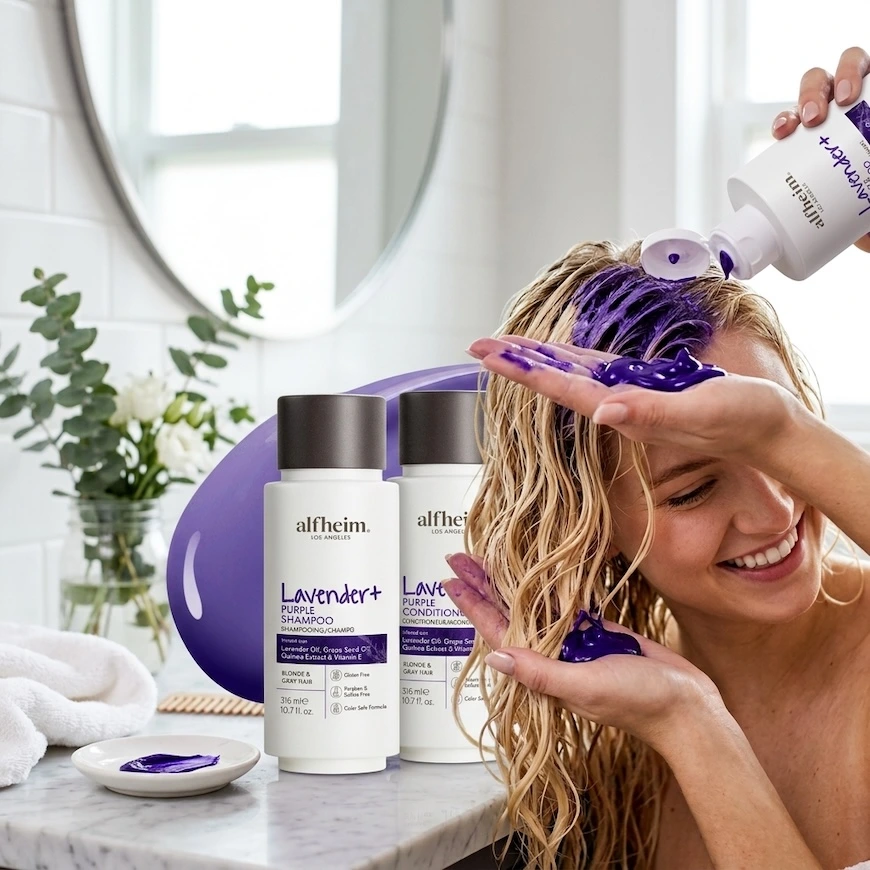
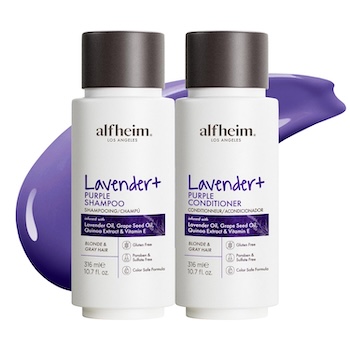
Purple shampoo is shampoo carrying a violet direct dye. It deposits a small amount of pigment on the hair surface with each wash, cancelling yellow visually. It does not remove the yellow. It masks it optically.
Two consequences follow, and between them they explain almost every complaint people have about this stuff.
- It is a deposit, so it builds up. Use it too often or leave it on too long and you are layering violet on violet. That is how blonde goes lilac.
- It only cancels yellow. If your brass is orange, violet does essentially nothing, because orange’s opposite is blue.

Purple or blue? The question most people get wrong
| Your hair | Unwanted tone | Use |
|---|---|---|
| Platinum, icy, very light blonde | Pale yellow | Purple, briefly. You stain easily |
| Medium to light blonde, balayage | Yellow / gold | Purple, the classic case |
| Dark blonde, bronde, caramel | Yellow-orange | Either, or alternate them |
| Brown hair with highlights | Orange | Blue. Purple will not touch it |
| Lifted brunette, ombre roots | Orange / red-orange | Blue |
| Grey, silver, white | Yellow, from UV, smoke, minerals, product | Purple, but the gentlest one you can find |
The quick test: hold a strand up to daylight. Yellow like straw means purple. Orange like a copper coin means blue. If you cannot tell, photograph it in daylight and look at the picture, because the camera is more objective than your bathroom mirror.
How long to leave it on
This is where purple shampoo for blonde hair goes wrong most often. The advice you will see everywhere is two to five minutes. That range is too wide to be useful, because the right answer depends entirely on your hair, and the wrong answer is what turns people lilac.
Start at two minutes. Always. Even if the bottle says five.
You can add time next wash. You cannot subtract pigment once it is in.
| Your hair | Start with | Frequency |
|---|---|---|
| Freshly bleached, platinum, very porous | 60 to 90 seconds | Once a week at most |
| Fine, light blonde | 2 minutes | Once a week |
| Medium blonde, healthy | 3 minutes | Once or twice a week |
| Coarse, resistant, or barely brassy | 5 minutes | Twice a week |
| Grey or silver | 2 minutes | Every other week |
Never leave it on as a mask. People do this hoping for stronger results, and it is the most common route to grey-lilac hair.
Wear gloves if your hair is very light. The pigment stains fingertips and, at high concentrations, can tint a pale scalp and hairline. If you have a history of scalp irritation from hair products, patch test behind your ear first.
And this is worth being blunt about: any product claiming to tone without staining is describing a marketing wish rather than chemistry. A pigmented shampoo deposits pigment. That is how it works. The variable you control is contact time.
How to use purple shampoo for blonde hair properly
- Wash first with a normal shampoo if your hair is greasy or coated in product. Purple shampoo used as the first wash spends its pigment on buildup instead of on your hair.
- Wring out excess water. Soaking wet hair dilutes the pigment unevenly, which is how you get patchy toning.
- Apply where the brass actually is, usually mid-lengths and ends rather than roots. Roots on a recent colour are often the coolest part of your head and do not need it.
- Emulsify properly. Work it through so every section is coated. Patchy application gives patchy results.
- Time it. Actually set a timer. Two minutes feels like five in a shower.
- Rinse thoroughly, then condition afterwards. Purple shampoos tend to be drying and this step is not optional.
- Alternate with your regular shampoo the rest of the week.
One myth to retire: rinsing with cold water does not seal the cuticle. The cuticle is not a valve and temperature does not operate it. Cool water is more comfortable and slightly less drying, which is reason enough to use it, but it is doing nothing to your colour.
Help, my hair went purple
Common, fixable, and rarely as bad as it looks on day one. Overdoing purple shampoo for blonde hair is a reversible mistake. In order, from gentlest:
- Wash with a clarifying shampoo, twice, leaving it a minute each time. This lifts most surface deposit and is enough in the majority of cases.
- Add about a teaspoon of baking soda to the clarifying shampoo for one wash. Effective and drying, so follow with a deep conditioner. Once only.
- Use a dandruff shampoo containing selenium sulfide or zinc pyrithione, which strips direct dye well. Again, once. Expect some flaking, if you use a dandruff shampoo on hair that does not need one.
- Apply a deep conditioning mask with heat, since heat opens the cuticle and releases some of the pigment.
- Try a clarifying or chelating treatment if you also have mineral buildup.
Do not reach for bleach, a colour remover, or dish soap. You will damage the hair far more than the tint is damaging your appearance, and violet direct dye fades on its own within a few washes anyway.
Prevention is just shorter contact time, less often.
If your hair is grey or silver
Grey hair behaves differently, and advice written for blondes does not quite fit it.
Grey and white hair has no pigment at all, which makes it highly porous and very absorbent. It takes up violet faster than bleached blonde does, and it shows every deposit.
The yellowing on grey hair also comes from different sources: UV, smoke, air pollution, mineral-heavy water and residue from styling products, rather than a fading toner.
So use the gentlest purple shampoo you can find, two minutes maximum, and only every other week. A chelating shampoo once a month often does more for yellowed grey hair than any amount of purple, because it removes the deposit rather than covering it.
If your grey has gone lilac, it fades. Grey just shows it more starkly, which makes it feel worse than it is.
What to buy, and in what order
Most roundups hand you six near-identical bottles of purple shampoo for blonde hair. The more useful way to think about it is by which problem you actually have, because at least two of these categories matter more than another purple bottle would.
A strong pigment toning shampoo is for yellow you genuinely need to fight. Short contact time only, and probably not your everyday wash.
A gentle everyday purple shampoo covers weekly maintenance and suits fine or fragile hair.
A purple conditioner or mask tones while conditioning and is far less drying than a shampoo. If your blonde is dry, start here rather than with a shampoo.
A blue shampoo is the one almost nobody stocks and a lot of people need. If your brass reads orange rather than yellow, this is your product and purple is a waste of money. Check the strand test above before you buy anything else.
A purple shampoo made for grey and silver should be the gentlest formula you can find.
A chelating or clarifying shampoo handles hard water, mineral buildup, and fixing over-toning. If you have limescale on your taps, this belongs in your bathroom regardless of what colour your hair is.
A bond-building treatment addresses the damage underneath the brassiness. Toning changes how blonde looks. This changes how it holds up.
A few things worth doing alongside all of that: read what’s actually in your shampoo rather than trusting the front of the bottle, look after your scalp as well as the lengths, use argan oil on dry ends between washes, and protect it overnight with satin, since friction on porous bleached hair does real damage while you sleep. If you want fuller-looking blonde, volume comes from technique and cut rather than from toning.
The AAD’s guidance on caring for lightened hair and its notes on damage from styling are worth reading if you colour regularly, and the FDA maintains a plain-language page on hair colour products and how they are regulated.
Frequently asked questions
How long should I leave purple shampoo on?
Start at two minutes regardless of what the bottle says, then adjust upward next wash if you need more. Freshly bleached or platinum hair should start at 60 to 90 seconds. You can always add contact time. You cannot remove pigment once it is deposited.
Can purple shampoo stain my hair?
Yes, despite what a lot of packaging implies. A pigmented shampoo deposits pigment, and that is the mechanism. Very light, porous, freshly bleached or grey hair takes it up fastest and can turn lilac or grey-tinged. It fades over a few washes, and a clarifying shampoo speeds that up.
Does purple shampoo work on brown hair?
Usually not, because brown hair that has been lifted goes orange rather than yellow, and violet only cancels yellow. Use blue shampoo for orange tones. Purple is the right choice for brown hair only if the highlights in it have lifted all the way to pale yellow.
Purple or blue shampoo, how do I tell?
Look at a strand in daylight. Straw yellow means purple. Copper orange means blue. Somewhere in between, which is common on dark blonde and bronde, means either will help, and alternating them works well.
Can I use purple shampoo for blonde hair every day?
No. Once or twice a week is right for most people, and every other week for grey or silver. Daily use builds pigment up and is drying too, since toning shampoos tend to be more stripping than regular ones.
How do I get purple shampoo out of my hair?
Clarifying shampoo, twice, a minute each time. That is enough in most cases. If it is not, a dandruff shampoo containing selenium sulfide or zinc pyrithione strips direct dye effectively, once. Follow either with a deep conditioner. Do not use bleach or colour remover for a tint that will fade on its own.
Does purple shampoo damage hair?
The pigment does not, but the formulas often do. Many are more stripping than regular shampoo, and blonde hair is already compromised. Bleaching causes measurable protein loss from both the cuticle and the cortex, so the hair you are toning is fragile to start with. Always condition afterwards, and consider a purple conditioner instead of a shampoo if your hair is dry.
Why does my blonde keep going brassy so fast?
Three usual culprits. Your toner is fading, which is normal at four to eight weeks. Or your hair is porous from bleachingand does not hold toner. Or your water is hard, in which case mineral buildup is dulling your blonde in a way purple shampoo for blonde hair cannot fix, and you need a chelating shampoo instead. If you have limescale on your taps, that is your answer.
Hi, I’m Marwa ✅
I test skincare, haircare, and makeup on real skin and a real budget, and writes the honest reviews to prove it.