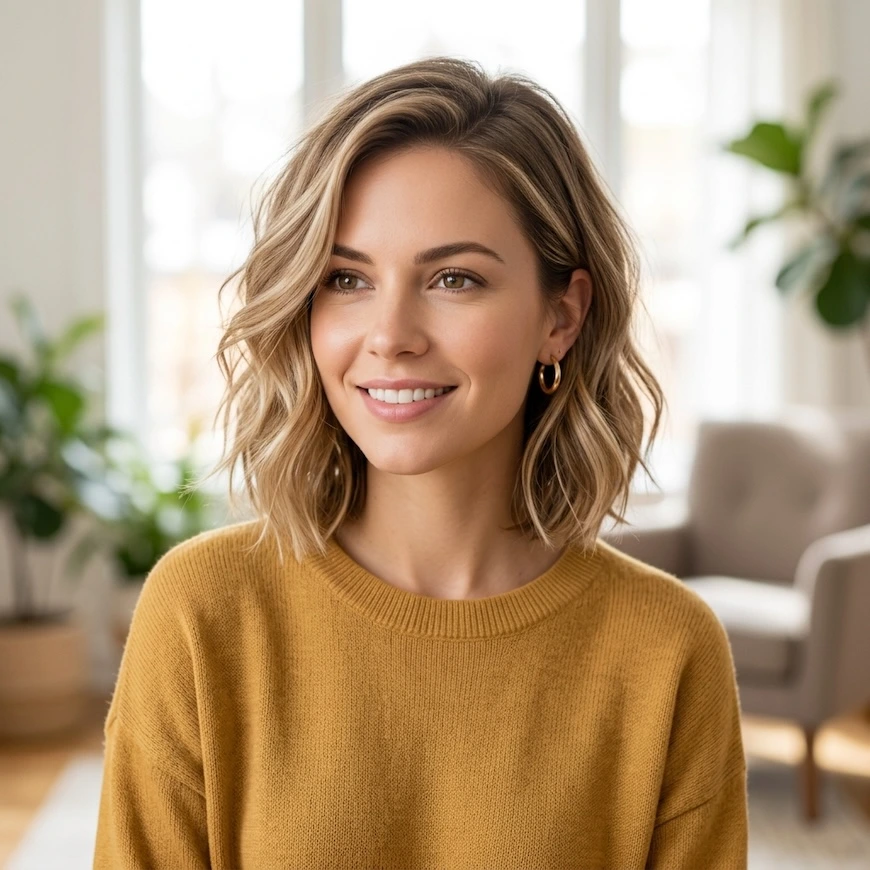
Quick Answer: Find your face shape by measuring four things, forehead, cheekbones, jawline and face length. If your length is about 1.5× your width and your jaw is softly rounded, you have an oval face, the most versatile shape. Oval suits almost any cut, which is why the real question isn’t your face shape but your hair texture and density, those determine whether a style will actually behave the way it does in the photo.
Face shape is the standard starting point for choosing a haircut, and it’s useful. It’s also less decisive than the internet suggests. Your hair’s texture and density determine whether a cut behaves the way it looked in the salon photo far more than the outline of your face does.
That said, it’s a genuinely helpful filter, and searches for hairstyles for oval face outnumber the other five shapes put together. So let’s work out yours properly first.
How to find your face shape in 60 seconds
Pull your hair back, face a mirror, and take four measurements with a soft tape. Write them down, because guessing by eye is where most people go wrong.
- Forehead, across the widest point, roughly halfway between your brows and hairline
- Cheekbones, from the outer corner of one eye across the bridge of your nose to the other
- Jawline, from below one ear to the point of your chin, then doubled
- Face length, centre of the hairline straight down to the tip of your chin
Now match your numbers.
| Shape | The measurements say… |
|---|---|
| Oval | Length is roughly 1.5× the width. Forehead slightly wider than jaw, jaw softly rounded |
| Round | Length and cheekbone width are similar. Soft jaw, fullest at the cheeks |
| Square | Forehead, cheekbones and jaw are close in width. Angular jaw |
| Heart | Forehead widest, narrowing to a pointed chin |
| Diamond | Cheekbones widest, with a narrower forehead and chin |
| Oblong | Like oval, but noticeably longer. More than 1.5× the width |
If you’re between two shapes, you’re probably oval or a blend. Most faces are. Use the shape you’re closest to as a guide rather than a rule. It’s also why advice on hairstyles for oval face applies to more people than the label suggests.
A note on the AI face shape apps: they’re fun and often approximately right, but they’re working from one photo, at one angle, in whatever lighting you happened to have. A tape measure and two minutes beats them, and it’s free.
Best hairstyles for oval face shapes
Oval is the most versatile shape, which is why any list of hairstyles for oval face reads like a catalogue of everything. Balanced proportions mean most cuts sit well, and it’s the shape stylists use as the reference point for all the others.
What works, roughly in order of how often it turns up in hairstyles for oval face recommendations:
- Pixie cuts. An oval face has the proportions to carry very short hair, which is the cut most limited by face shape.
- Blunt bobs. A chin-length blunt bob frames beautifully.
- Lobs. Arguably the single most flattering of all the hairstyles for oval face options.
- Long layers, which add movement without disrupting the balance.
- Soft waves, for texture and volume without widening. If that’s the direction you’re going, how to get voluminous hair at home covers the technique.
- Sleek and straight with a centre part, which plays to the natural symmetry.
Worth considering rather than avoiding:
Because oval faces suit almost everything, the “styles to avoid” lists tend to be invented, and most guides to hairstyles for oval face pad this section out badly. Two genuine considerations. Very heavy blunt full fringes cover the forehead entirely and can shorten the face visually. Not wrong, just a bigger change than it looks. And long, entirely unlayered hair can read as flat, particularly on fine hair, which is a texture issue rather than a face shape one.
The honest version: choose based on your hair texture, how much styling time you have, and what you actually like. Your face shape isn’t going to rule much out, so the real constraint on hairstyles for oval face isn’t the face at all. If you want to sharpen the features themselves rather than the frame around them, makeup to define your features does more in five minutes than a haircut does in three months.
The other face shapes
If you measured out as something else, the logic behind hairstyles for oval face still applies. You’re adjusting towards those proportions from a different starting point.
Round. The goal is length and angles. Long layers, lobs that hit below the chin, side parts, and long side-swept fringes. Volume at the crown helps. Chin-length blunt bobs and very heavy straight fringes tend to emphasise width.
Square. Soften the jaw. Soft layers, waves, curtain bangs, side parts, and length below the jawline. Blunt cuts that land exactly at the jaw echo the angle rather than softening it.
Heart. Balance a wider forehead against a narrower chin. Chin-length bobs, curtain bangs, side-swept fringes, and volume around the jaw. Very short cuts with height on top exaggerate the top-heavy proportion.
Diamond. Soften prominent cheekbones. Chin-length cuts, side parts, curtain bangs, and volume at the forehead and jaw. Slicked-back styles emphasise the cheekbone width.
Oblong. The aim is width, not length. Blunt cuts, waves, curtain or full fringes, and volume at the sides. Very long straight hair and centre parts add length you don’t need.
The pattern behind all of it: you’re adding volume where the face is narrow and softening where it’s wide. Once you see that, you can work it out yourself without a chart.
Curtain bangs, butterfly bangs and French bangs
Bangs are the highest-stakes hair decision most people make, since you can’t undo them for months, which is why they get researched so heavily. Here’s the difference.
| Style | What it is | Best for |
|---|---|---|
| Curtain bangs | Parted in the middle, sweeping outward to frame the face. Shortest at the centre | Almost everyone. Especially round, square, heart and diamond. The most forgiving fringe there is |
| Butterfly bangs | A heavily layered curtain fringe blending into face-framing layers. More volume, more movement | Longer hair, medium to thick density. Needs styling to sit right |
| French bangs | Short, softly textured, sitting above the brow with visible gaps. Deliberately undone | Oval and heart shapes. Best on straight to wavy hair |
| Side-swept | Longer, angled across the forehead | Round and oblong, since it adds a diagonal line |
| Blunt full fringe | Straight across, covering the forehead | Oblong and oval. The biggest commitment of the lot |
Curtain bangs are the safe answer if you’re unsure. They turn up on every list of hairstyles for oval face and on every list for every other shape, which tells you something. They grow out into face-framing layers rather than an awkward stage, which is the single best argument for them.
One thing nobody warns you about: bangs on a cowlick, or on very curly hair, will not behave the way they do in the reference photo. Ask your stylist before, not after.
Styling them: blow-dry the fringe first, while it’s wettest, with a round brush directing it back and away from your face. Do it before the rest of your hair or it’ll set the wrong way.
Why texture matters more than face shape
This is the thing guides to hairstyles for oval face consistently underplay.
A cut behaves according to your hair, not your face. The same lob looks entirely different on fine straight hair, thick coarse hair, and 3C curls, and that gap is far bigger than the gap between an oval and a heart-shaped face. The best hairstyles for oval face are whichever ones your texture will actually hold. If your hair is coily or tightly curled, the AAD’s textured hair care guidance is a better starting point than any face shape chart.
What actually determines whether a cut works:
| Factor | Why it matters more than you think |
|---|---|
| Texture | Curly hair shrinks. A cut that hits your collarbone wet can hit your chin dry |
| Density | Heavy layers on fine hair leave it looking sparse at the ends |
| Growth pattern | Cowlicks and a strong natural part will fight a fringe indefinitely |
| Damage | Damaged ends won’t hold a blunt line, and layers hide it better |
| Styling time | The most flattering cut is worthless if it needs 30 minutes daily |
Two of those are worth checking before you book. Work out whether your hair is damaged first, because a stylist will spot it in thirty seconds and it changes what’s realistic. And be honest with yourself about the habits that damage hair, since most of what people blame on a bad cut is what happened to it afterwards. Even choosing a shampoo for your hair typeaffects how a cut sits more than the shape of your jaw does.
Then ask yourself honestly how long you’ll spend on your hair each morning. That single answer narrows a list of hairstyles for oval face faster than any chart, and rules out more cuts than your face shape ever will, and it’s the question stylists say clients answer least honestly.
Tools that make these styles work
The cut is half of it, and none of the hairstyles for oval face above survive a bad blow-dry. These are the tools that decide whether day three looks like the salon did.
- A good dryer with a nozzle. Direction matters more than heat, and the nozzle is what lets you aim airflow along the hair rather than at it.
- A round brush, essential for fringes and lobs. Two inches for medium and long hair, one inch for a fringe.
- A curling iron in the right barrel size. One inch for classic curls, 1¼ to 1½ for soft waves. Barrel size decides your curl more than anything else does.
- Sectioning clips, which are the difference between styling and fighting.
- Texturising spray, for grip and volume on fine hair, and for making layers read as intentional.
- Claw clips and satin scrunchies, for updos and for being gentler on hair than elastics.
Two things to get right before any of these touch your head. Handle wet hair carefully, since that’s when it breaks, so detangling before you style with a wide-tooth comb comes first. And dermatologists are blunt about heat: lowest setting, limit how long a hot tool sits on any one section, and use them less often than you probably do. The AAD suggests aiming for once a week or less, which is stricter than most of us manage but worth knowing as the target. Their broader guidance on healthy hair is short and worth five minutes.
On the other end of the day, protect your style overnight and you’ll spend far less time redoing it in the morning.
Frequently asked questions
What are the best hairstyles for oval face shapes?
Almost all of them, since oval is the most versatile shape. Pixies, blunt bobs, lobs, long layers and soft waves all work well. Because so little is ruled out, choose based on your hair texture, density and how much styling time you have rather than on your face shape.
Are curtain bangs good for all face shapes?
They're the most universally flattering fringe, and they particularly suit round, square, heart and diamond shapes because the outward sweep softens width and angles. They also grow out into face-framing layers rather than an awkward stage, which makes them the lowest-risk fringe to try.
What’s the difference between curtain bangs and butterfly bangs?
Curtain bangs part in the middle and sweep outward, shortest at the centre. Butterfly bangs are a heavily layered version that blends into face-framing layers, with more volume and movement. Butterfly bangs need longer hair, more density, and more daily styling to sit properly.
Do face shape hairstyle rules actually matter?
Somewhat, but less than the internet suggests. Face shape is a useful filter rather than a rule, and your hair's texture, density and growth pattern affect how a cut behaves far more than the outline of your face. A cut drawn from any list of hairstyles for oval face will still disappoint you if it fights your texture.
What hairstyles should oval faces avoid?
Very few, which is the short answer to most of what gets written about hairstyles for oval face. Heavy blunt full fringes cover the forehead and visually shorten the face, and long unlayered hair can look flat on fine textures, but neither is a rule. Oval is the reference shape stylists work from, so treat any suggestion as a consideration rather than a prohibition.
Which face shape is best for a pixie cut?
Oval, primarily, since very short cuts leave nothing to balance the face and oval proportions carry that best. Heart shapes also suit them well with a little length left at the front. Round faces can wear a pixie with height at the crown, which adds the length the shape lacks. It's the one case where hairstyles for oval face advice transfers almost unchanged.
How do I stop my bangs separating or sticking up?
Usually a cowlick or a strong growth pattern. Blow-dry the fringe first, while it's at its wettest, using a round brush to direct it back and forth across your forehead, which trains it away from the natural split. Doing your fringe after the rest of your hair is the most common mistake.
Does hair length depend on face shape?
Loosely. Round and oblong faces benefit most from length choices, since length adds a vertical line to a round face while an oblong face usually looks better with mid-length and width. For oval, square, heart and diamond, the parting, layers and fringe make more difference than overall length.
Can a haircut change my face shape?
It can't change bone structure, but it genuinely changes how proportions read. Volume at the sides makes a long face look wider, height at the crown makes a round face look longer, and a fringe shortens the visible face length. That's why the same person can look noticeably different with two cuts.
Reviewed August 2026. Take a photo to your stylist rather than relying on a description, since the same cut name means different things in different salons.
Hi, I’m Marwa ✅
I test skincare, haircare, and makeup on real skin and a real budget, and writes the honest reviews to prove it.