Quick Answer: A satin bonnet works by reducing friction between your hair and your pillow, which means less breakage, less frizz, and styles that survive the night. It does not make hair grow faster; it helps you keep the length you already grow. On satin vs silk: silk is more breathable and costs five to ten times more, but the big win is moving away from cotton — that step matters far more than which of the two you choose.
Your pillowcase is probably working against you. Cotton is absorbent and slightly rough at a fibre level, so every time you turn over it pulls moisture out of your hair and drags against the cuticle. Multiply that by eight hours and a few thousand nights and you get a slow, invisible tax on your hair that nobody ever warned you about.
A satin bonnet fixes that with one property. It’s slippery. Everything else follows from there.
But there is a lot of overstated marketing around these, so here is what a satin bonnet does and what it doesn’t.
What a satin bonnet actually does
Real, and well established:
- Less breakage. Lower friction means fewer strands snapping as you move.
- Less frizz and fewer tangles. Hair glides instead of catching, so there’s less to fight through in the morning. If your mornings currently involve a comb and a lot of swearing, a satin bonnet is one half of the fix and detangling without breakage is the other.
- Better moisture retention. Satin absorbs far less than cotton, so your hair keeps its natural oils and whatever product you put on it.
- Style preservation. Curls, braids, blowouts and silk presses all last noticeably longer. A bonnet is the cheapest way to stop a set style collapsing overnight, and it pairs well with the ways to make a voluminous hair from your homeapproach of protecting root lift rather than rebuilding it every day.
Overstated:
- “It makes hair grow.” No. See the next section.
- “It repairs damage.” Nothing repairs damage. A satin bonnet prevents more of it.
- “It’s essential for everyone.” It matters most for textured, curly, long, fine or chemically treated hair. The AAD’s textured hair care guidance is a good read on why. If your hair is short, healthy and straight, the benefit is real but small.
The mechanism is friction. Only friction. That’s worth knowing because it tells you what to expect from a satin bonnet, and it stops you paying extra for claims that don’t follow from it.
Worth saying plainly: a satin bonnet is damage control, not a treatment. If your hair is already compromised, look at the habits that damage hair first. A bonnet at night won’t undo a flat iron at 220°C in the morning.
Does a bonnet help hair grow?
This is the most asked question about bonnets, and the answer hinges on a distinction most articles skip.
No. A satin bonnet does not make your hair grow faster.
Hair growth happens at the follicle, below the surface of your scalp, and it’s governed by genetics, hormones, health and nutrition. A piece of fabric on the outside of your head has no access to any of that.
Here’s why people are convinced otherwise.
Your hair is growing all the time, roughly half an inch a month. If the ends are snapping off at a similar rate, your hair never gets longer. It looks stuck. Reduce the breakage, and the growth that was always happening starts showing up as length.
That’s length retention, not growth, and it’s the single most useful idea in hair care. Most people who feel their hair “won’t grow past a certain point” don’t have a growth problem. They have a breakage problem, and the hair is snapping off as fast as it grows. This is the exact situation where a satin bonnet earns its money.
How to tell which one you have: look at the hairs on your pillow or in your brush and work out whether it shed or broke. A small white bulb at one end means the hair shed naturally, which is normal at 50 to 100 a day. No bulb, with a frayed or blunt end, means it broke. Breakage is what a satin bonnet actually helps with.
If breakage is your problem, the satin bonnet is the night shift. The day shift is not stacking damage on top: lower your heat tool temperature, and if you’ve bleached or relaxed, look at bond repair for damaged hair. Those three together do more than any one of them alone.
Satin vs silk bonnet: the honest comparison
Almost every article claiming silk is dramatically better is published by a company that sells silk. Here’s the version from someone who sells neither.
First, a definition that clears up most of the confusion. Satin is a weave, not a fibre. You can make satin out of silk, polyester or nylon. When a product is labelled “satin bonnet,” it almost always means polyester woven in a satin structure. When it says “silk,” it usually means mulberry silk. So the real satin vs silk bonnet question is polyester against silk, not satin against silk.
| Satin (polyester) | Silk (mulberry) | |
|---|---|---|
| Friction reduction | ✅ Excellent. This is the whole mechanism, and both do it | ✅ Excellent |
| Breathability | Lower, traps more heat | Better. Matters if you sweat at night or have a reactive scalp |
| Absorbency | Very low, so it takes almost nothing from your hair | Higher than polyester (silk absorbs around 11% of its weight) |
| Durability | Machine washable, hard wearing | Delicate. Hand wash or use a mesh bag |
| Price | Often under $15 | Commonly 5 to 10 times more |
The honest verdict:
Both work, because both are slippery, and slipperiness is the mechanism. The big improvement is leaving cotton behind. That’s where nearly all the benefit comes from, and whether you then spend $12 on a satin bonnet or $60 on silk is a much smaller decision than the marketing suggests.
Choose silk if you sleep hot, you have a sensitive or flaky scalp, or you want the most breathable option and don’t mind hand washing. Choose a satin bonnet if you want it machine washable, you want spares, or you’d rather spend the difference elsewhere.
One claim to be sceptical of: you’ll often read that silk holds your hair’s moisture better than polyester. Silk is actually the more absorbent of the two. Polyester takes almost nothing. The breathability argument for silk is sound. The moisture retention one is shakier than it’s usually presented.
Buy two, whichever you go with. One is in the wash roughly half the time, and a bonnet you can’t find at bedtime is a bonnet you don’t wear.
The best bonnet for sleeping: four worth buying
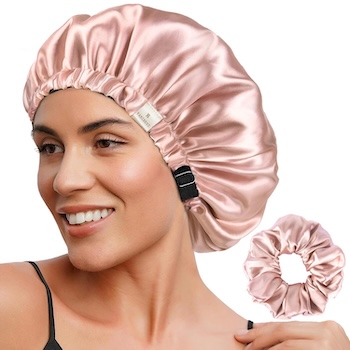
1. Best overall: an adjustable tie satin bonnet
A drawstring or tie closure rather than a fixed elastic band is the feature that matters most. You can loosen it, it won’t dig in, and it doesn’t create tension at your hairline. The YANIBEST Satin Bonnet is a widely available example with an adjustable tie and multiple sizes.
Skip it if your hair is very long or very thick. Size up, or go to the extra large below.

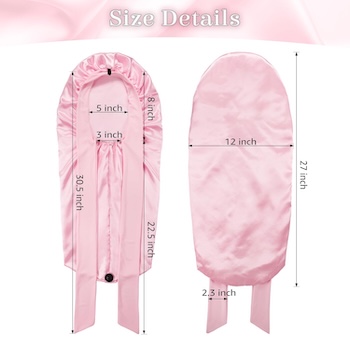
2. Best bonnet for long thick hair: an extra large or “jumbo” size
Standard bonnets are built for a lot less hair than you’d think. If yours is past your shoulders, dense, or in braids or locs, a standard satin bonnet will either not fit or slide off in the night. Look for XL or “long hair” in the listing specifically.
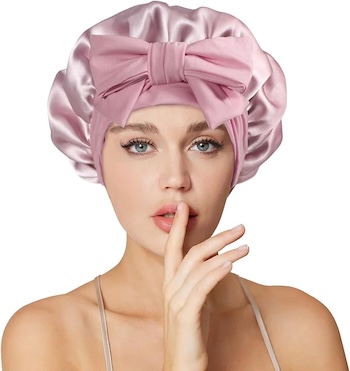
3. Best silk option: a mulberry silk bonnet
Worth it if you sleep hot or have a reactive scalp. Look for mulberry silk with a momme weight of 19 or higher, which is the standard density measure. Anything lower is thin. Hand wash, or use a mesh bag on a delicate cycle.
4. Best budget: a satin bonnet multipack
Two or three for the price of one branded bonnet. Perfectly adequate, because the mechanism is just a slippery surface. This is the sensible way to find out whether you’ll actually use one before spending more.
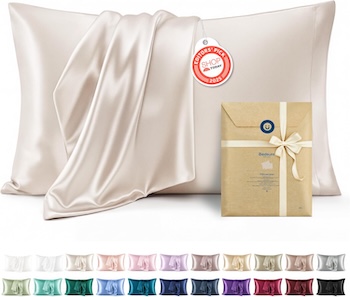
Also worth considering: a satin pillowcase instead. If you find bonnets uncomfortable or yours comes off in the night, a satin pillowcase gives you a large share of the same benefit with nothing on your head, and it protects your facial skin from the same friction. The trade off is that it only helps where your head touches the pillow, and it does nothing for a set style.
How to wear a satin bonnet so it actually stays on
The most common complaint is that it comes off overnight. Almost always, that’s fit or technique.
- Prep your hair first. A little leave in conditioner, or coconut oil before bed if your hair runs dry. The satin bonnet holds that moisture in rather than letting the pillow drink it.
- Gather your hair loosely at the crown, a loose bun or “pineapple,” if it’s long. This keeps volume at the roots and stops your hair being crushed flat.
- Tip your head forward and put the satin bonnet on from the front hairline backwards, sweeping all your hair inside as you go. Putting it on upright is why bits get left out.
- Check the edges. Tuck in your nape and around your ears. Those are the first areas to escape.
- Adjust the tie so it’s secure but not tight. You should be able to slide a finger underneath comfortably.
If it still comes off, it’s too small. That’s the usual cause, not technique. Size up.
Wash your satin bonnet weekly. It collects oil, sweat and product, then presses all of that against your scalp for eight hours a night. An unwashed bonnet can cause the breakouts and irritation people sometimes blame on the bonnet itself. If your scalp is already unhappy, a satin bonnet on its own won’t fix it, and a full scalp care routine is the better place to start.
When a satin bonnet is the wrong choice
Worth being straight about the caveats, because most bonnet content doesn’t mention any.
Don’t wear one over wet hair. Wet hair is at its weakest and most prone to stretching and snapping, which is why AAD guidance is to handle it gently, and a satin bonnet traps that moisture against your scalp for hours. That warm, damp environment isn’t good for your scalp and it isn’t good for the bonnet. Let hair dry to at least damp verging on dry first.
If the elastic is tight, stop wearing it. Sustained tension at the hairline causes traction alopecia, gradual hair loss along the front and temples that can become permanent if it continues for years. The AAD lists head coverings alongside tight ponytails and braids as a cause, so this isn’t theoretical. A satin bonnet should never leave a mark or feel like it’s pulling. Same logic applies to tight hair ties and tension during the day. This is the reason to prefer an adjustable tie over a fixed band.
If you have dandruff or a flaky scalp, watch what happens. This is the caveat you won’t read on a product page. Dandruff and seborrheic dermatitis involve Malassezia, a yeast that feeds on sebum, and a bonnet keeps sebum and sweat sitting against your scalp overnight instead of letting it air out. I want to be careful here, because the popular version of this claim overreaches. Warm humid conditions grow Malassezia in a dish, but plenty of people find their seborrheic dermatitis is better in summer and worse in cold dry weather, so “humidity makes dandruff worse” isn’t a safe blanket statement. What is fair to say: an unwashed satin bonnet worn nightly on an oily scalp is a plausible irritant, and it’s easy to test.
That doesn’t mean you can’t wear one. It means wash it weekly without fail, never wear it over damp hair, and consider silk for the breathability. If your flaking got worse after you started wearing a satin bonnet nightly, stop for two weeks and see. It’s also worth knowing the difference between dandruff vs dry scalp, because the two get treated very differently and people routinely misdiagnose themselves.
And if it’s uncomfortable, use a pillowcase. The friction problem has more than one solution, and the best one is the one you’ll actually keep doing.
Frequently asked questions
Is a satin bonnet as good as silk?
For the thing that matters most, reducing friction, yes. They're comparable. Silk is more breathable, which helps if you sleep hot or have a sensitive scalp, and it costs five to ten times more. The meaningful upgrade is moving away from cotton. The choice between a satin bonnet and silk after that is much smaller than it's usually presented.
Is a satin bonnet just polyester?
Usually, yes. Satin is a type of weave rather than a fibre, so satin bonnets are typically polyester woven in a satin structure. That's not a problem. The smooth surface is what reduces friction, and polyester satin delivers it while staying cheap and machine washable.
How often should you wash a bonnet?
About once a week, more if you use a lot of product or sweat at night. It collects oil, sweat and product residue and then holds all of it against your scalp for eight hours. Satin is usually machine washable. Silk should be hand washed, or put in a mesh bag on a delicate cycle.
Can you wear a bonnet on wet hair?
Better not to. Wet hair is weakest and stretches before it breaks, and a satin bonnet traps that moisture against your scalp for hours, which can lead to irritation. Let your hair dry to at least damp first. If you need to protect a wash day style overnight, get it as dry as you reasonably can before the bonnet goes on.
How often should you wash a bonnet?
About once a week, more if you use a lot of product or sweat at night. It collects oil, sweat and product residue and then holds all of it against your scalp for eight hours. Satin is usually machine washable. Silk should be hand washed, or put in a mesh bag on a delicate cycle.
Can wearing a bonnet cause hair loss?
The fabric can't, but a tight elastic can. Sustained tension at the hairline causes traction alopecia, which can become permanent if it goes on for years. A satin bonnet should never leave an indentation or feel like it's pulling. Choose an adjustable tie over a fixed elastic band, and size up if it feels snug.
What’s the difference between a bonnet and a satin pillowcase?
A satin bonnet moves with your head, so it protects your hair whichever way you turn and holds a style in place. A pillowcase only protects where your head rests, but it's more comfortable, it doesn't fall off, and it protects your facial skin too. If bonnets bother you, a pillowcase is a genuinely good alternative.
Are satin bonnets only for curly or textured hair?
No, though textured hair benefits most, because it's naturally drier and more prone to breakage. Anyone with long, fine, chemically treated or heat styled hair will notice a difference. If your hair is short, straight and healthy, the benefit is real but small.
Will a bonnet make my dandruff worse?
It might. A bonnet keeps sebum and sweat against your scalp overnight, and dandruff involves a yeast that feeds on sebum. The evidence that warmth and humidity worsen it clinically is weaker than most articles suggest, so treat this as worth testing rather than settled. Wash it weekly, avoid wearing it over damp hair, consider silk, and stop for two weeks if you want to know for sure.
How do I stop my bonnet falling off at night?
Nine times out of ten it's too small. Size up, especially if your hair is long, thick or in braids. Beyond that: tip your head forward and put the satin bonnet on from the front hairline back, tuck in your nape and ears, and choose one with an adjustable tie so you can get it secure without it being tight.
Reviewed August 2026. General information, not medical advice. See a dermatologist about persistent scalp irritation or hair loss along the hairline.

Hi, I’m Marwa ✅
I test skincare, haircare, and makeup on real skin and a real budget, and writes the honest reviews to prove it.