Quick Answer: Wearing a hair tie around your wrist is mostly harmless, but a tight one can abrade the skin, and broken skin can become infected. The bigger issue is what it does to your hair. The elastic stretches out, loses grip, and a stretched-out tie needs more wraps, which means more tension and more breakage. Keep it loose enough to slide freely, and replace ties when they stop springing back.
Somewhere along the way, “don’t wear hair ties on your wrist” became one of those things everyone repeats, usually with a story attached about a friend of a friend who ended up in hospital.
I went looking for what is actually true, because the version circulating online has picked up a claim that does not hold up, and the useful part has been lost underneath it.
The wrist thing is real but small and easily managed. What you should actually care about is what that elastic is doing to your hair every day.
First, the myth: hair ties do not cause carpal tunnel syndrome
You will find this claim on dozens of sites. It is wrong, and it is worth explaining why properly.
Carpal tunnel syndrome is compression of the median nerve where it passes through the carpal tunnel, a narrow, rigid tube of ligament and bone at the base of the hand. The median nerve shares that tunnel with the tendons that bend your fingers, and it gets compressed inside the channel when those tendons thicken or swell.
Per the NIH’s National Institute of Arthritis and Musculoskeletal and Skin Diseases, researchers do not know what causes it. NIAMS describes it as a combination of factors that raise pressure on the median nerve and tendons within the tunnel, rather than a problem with the nerve itself, and says that in many cases no single cause can be identified. The contributing factors they list are wrist trauma or injury, mechanical problems in the wrist joint, repeated use of vibrating machinery, thyroid and pituitary conditions, rheumatoid arthritis and other autoimmune diseases, diabetes, and fluid retention during pregnancy or menopause. MedlinePlus describes it the same way.
An elastic band resting on the outside of your skin does not reach any of that. It sits on the surface, above the ligament, above the tunnel, above the nerve.
Here’s why the myth is so sticky, though. NIAMS notes that women are more likely than men to develop carpal tunnel syndrome. Women are also, obviously, more likely to keep a hair tie on their wrist. Two things that are both more common in women look like cause and effect when you put them side by side, and that is exactly the shape of a correlation that turns into an internet health myth.
Worth knowing what the real symptoms look like. Numbness or tingling in the thumb, index and middle fingers, and part of the ring finger, but not the little finger, because the median nerve does not serve it. Symptoms usually start at night and fade during the day, and NIAMS describes waking up feeling you need to shake out your hand. If that sounds familiar, see a doctor. It just is not your hair tie.
What can actually happen to your wrist
Now the part that is legitimate.
Skin abrasion, and infection through broken skin
A hair tie worn tightly, in the same spot, for long stretches creates constant friction and pressure against the skin. That can cause redness, irritation, and eventually a breakdown of the skin’s surface.
Skin is your barrier against bacteria. Once it is broken, even slightly, bacteria that live harmlessly on the surface have a route in. That is how a minor abrasion becomes cellulitis, a bacterial skin infection.
The AAD’s signs and symptoms of cellulitis is the reference worth knowing. Warning signs are an area that becomes red, swollen, warm to the touch and increasingly painful, sometimes with fever. Cellulitis needs antibiotics and does not resolve on its own, and it can spread.
Is this common? No. It requires a genuinely tight tie, worn constantly, long enough to break skin. Most people wearing a loose tie occasionally will never have a problem.
But it is the real risk, and it is the reason the advice exists at all, unlike the carpal tunnel version.
Hair ties are not clean
A hair tie touches your hair, your bag, restaurant tables, gym equipment, and whatever else. Worn against your skin all day, it holds sweat and oil against that skin.
For most people this means nothing. If you are prone to irritation, have eczema on your hands or wrists, or have any broken skin there, it is worth caring about. Wash fabric ties with your laundry occasionally. Almost nobody does, and they are one of the least-washed things you own.
The indentation mark
The deep groove some people find after removing a tight tie is temporary compression of soft tissue and surface blood flow. It fades within minutes and is not harmful in itself.
Treat it as a signal rather than a symptom. A faint line that disappears quickly is fine. A deep indentation that takes a while to fade means the tie is too tight, and that is the level of tightness where abrasion becomes plausible.
The bigger issue nobody mentions: what it does to your hair
This is the part that matters most on a beauty site, and the part the standard version of this advice skips.
Wearing a tie on your wrist wrecks the tie
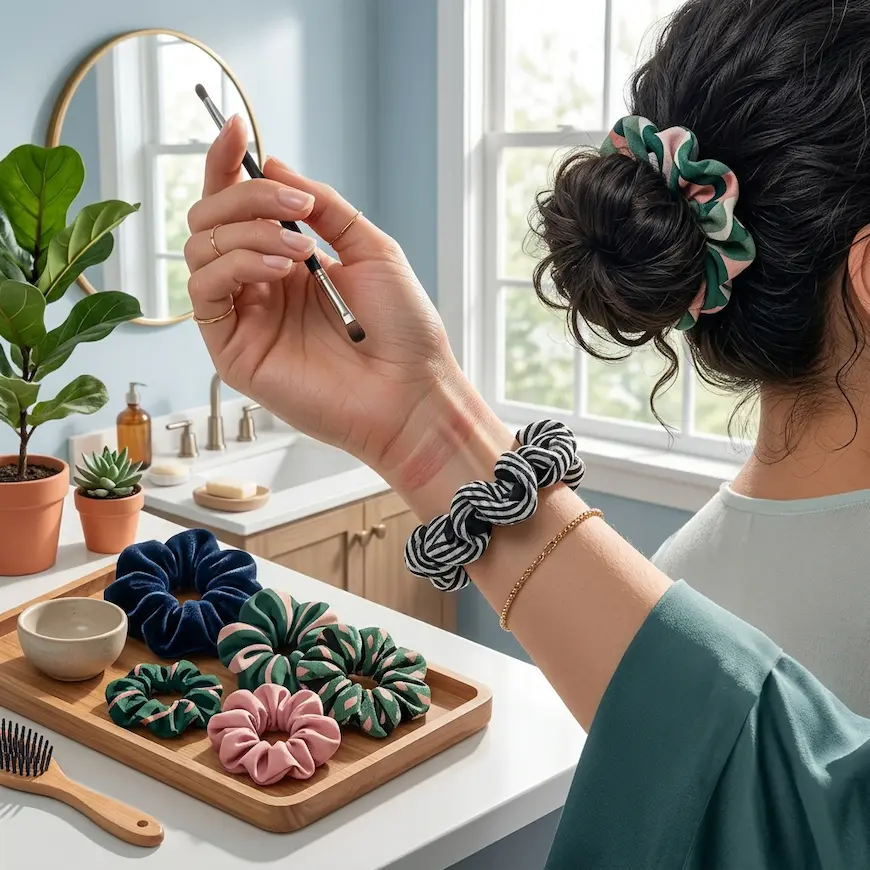
Your wrist is thicker than a folded section of hair. Keeping an elastic stretched around it all day, every day, permanently deforms it. The rubber loses its recovery and the tie stops springing back.
A stretched-out tie is actively worse for your hair. Because it has lost its grip, you compensate with an extra wrap or two. More wraps means more tension concentrated on the same strands, which means more breakage. The damage compounds.
If your ties feel loose and you are doubling or tripling them, replace them. They are cheap. Your hair is not.
Thin elastics and metal joins cause visible breakage
Not all hair ties are equal, and the difference is large:
| Type | Hair damage | Notes |
|---|---|---|
| Thin elastic with metal join | Worst | The metal crimp catches and snaps strands directly |
| Thin rubber bands | High | Grip too tightly, tangle in hair, tear on removal |
| Standard fabric-covered elastic | Moderate | Fine occasionally, damaging daily in the same spot |
| Fabric scrunchie | Low | Wide surface spreads tension, no concentrated pressure |
| Silk or satin scrunchie | Lowest | Low friction, no snagging, gentle on the cuticle |
| Spiral / coil ties | Low | No single pressure point, does not leave a crease |
The metal-join ones are the ones to throw away today. That small crimp is a hard edge pressed against hair under tension, and it snaps strands rather than holding them. If you wear a hair bun daily, this matters more than for most styles, because a bun keeps that crimp buried against the same section of hair for hours.
Repeated tension in one spot can cause hair loss
This is the serious version of the hair problem.
Traction alopecia is hair loss caused by sustained pulling. The AAD is direct that hairstyles that pull can lead to hair loss, and tight ponytails, a tight hair bun, braids and extensions all qualify. The damage is gradual, it shows up first around the hairline and temples, and it can become permanent if it goes on long enough.
A hair bun deserves specific mention here, because it concentrates tension in two places at once: the pull at the hairline, and the twist at the crown where the bun is anchored. A daily high hair bun in exactly the same position is one of the more reliable ways to get traction alopecia, which is unfortunate given how many people wear one as their default work style.
Prevention is simple and does not require giving up ponytails or buns:
- Vary the placement. High one day, low the next. If you wear a hair bun most days, move it around rather than anchoring it in the same spot.
- Loosen it. If it pulls at your hairline or gives you a headache, it is too tight.
- Skip the tie at night, or use a very loose scrunchie. Sleeping in a tight ponytail or hair bun is hours of continuous tension. A satin bonnet does the same job with none of the pull.
- Check monthly. Look at your hairline for thinning or short broken hairs where the tension sits.
So should you stop wearing hair ties on your wrist?
Honest answer: it is fine, if you do it sensibly. The internet’s version of this advice is more alarming than the facts support.
It’s fine when:
- The tie slides freely and leaves no more than a faint mark
- You are not wearing the same one around the clock
- Your skin there is intact and not irritated
Change the habit when:
- It leaves a deep indentation that takes a while to fade
- The skin underneath is red, sore, or broken
- You have eczema or any existing skin condition on your wrists
- Your ties are getting stretched out, because that is your hair paying for the convenience
Better places to keep one: a small pouch in your bag, a hair tie holder or bracelet designed for the purpose, a keyring, or a hook by the door.
The pragmatic middle ground: keep one on your wrist if it is useful, make it a loose fabric scrunchie rather than a tight elastic, and do not leave the same one there permanently.
Frequently asked questions
Can wearing a hair tie on your wrist cause carpal tunnel syndrome?
No. Carpal tunnel syndrome is compression of the median nerve inside the carpal tunnel, and NIAMS attributes it to factors like wrist injury, vibrating machinery, thyroid and autoimmune conditions, diabetes, and fluid retention in pregnancy. A band resting on the skin surface does not affect structures inside the tunnel.
Why does my wrist have a deep mark from my hair tie?
It is temporary compression of soft tissue and surface blood flow, and it fades within minutes. Treat it as a signal that the tie is too tight rather than as a symptom in itself.
Can a hair tie on your wrist cause an infection?
Indirectly, yes. Friction can break the skin, and broken skin can allow bacteria in, potentially causing cellulitis. Signs are redness, swelling, warmth and increasing pain, and that needs a doctor, because cellulitis requires antibiotics.
Do hair ties damage your hair?
Some do, significantly. Thin elastics with metal joins are the worst, because the metal crimp snaps strands. Silk scrunchies and spiral ties cause the least damage because they spread tension over a wider area.
The bottom line
The wrist thing has been overstated. Wear one if it is useful, keep it loose enough to slide, do not leave the same tie there permanently, and pay attention if the skin underneath gets sore.
Ignore the carpal tunnel claim entirely. It is repeated constantly and it is not accurate.
What is actually worth changing: throw out the ties with metal joins, replace the stretched-out ones, and stop putting your ponytail or hair bun in the same place every single day. That is where the real damage is happening.
Related: haircare mistakes that damage your hair covers the rest of the daily habits worth fixing, and if you are chasing volume rather than repair, how to get volume in hair at home is the practical guide.
This article is general information and not medical advice. See a healthcare professional about persistent wrist pain, numbness, or any skin infection.

Hi, I’m Marwa ✅
I test skincare, haircare, and makeup on real skin and a real budget, and writes the honest reviews to prove it.