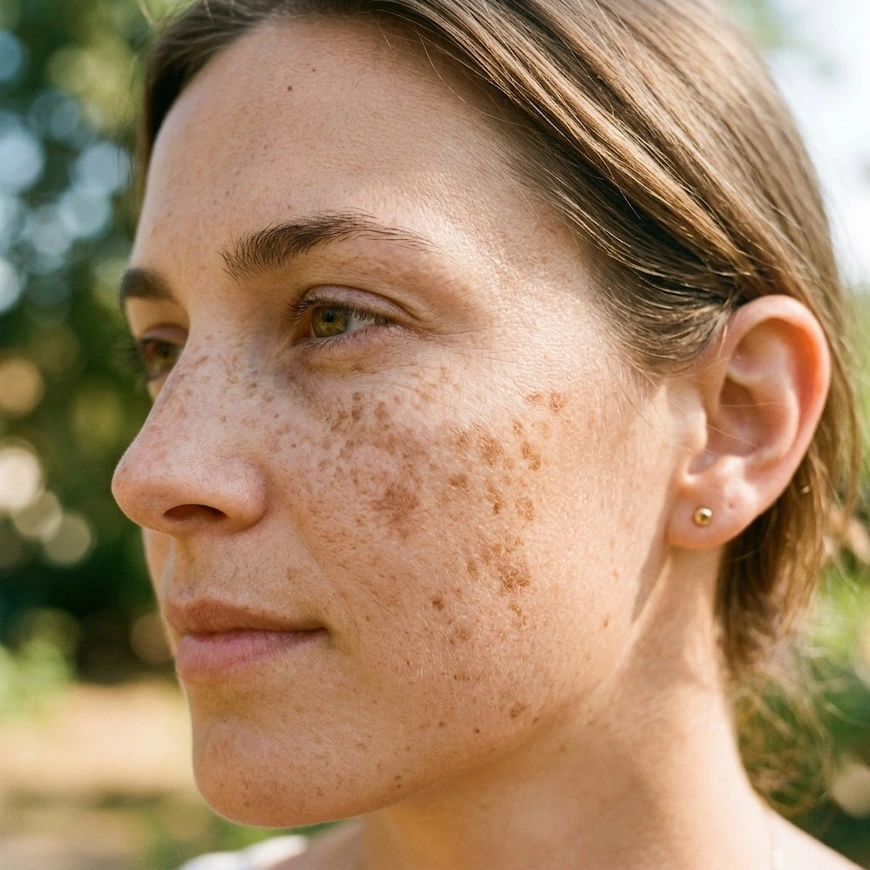
Quick Answer: Sun spots fade with daily sunscreen plus one active: vitamin C, niacinamide, azelaic acid or a retinoid. Expect 8 to 12 weeks for visible change on the face, longer on hands and chest. Sunscreen does the heavy lifting. In a study where women used SPF30 on one hand only, the marks on the protected hand ended up measurably lighter than the ones on the bare hand. If you want them gone rather than faded, that means a dermatologist and a laser. Topicals lighten. Procedures remove.
You get to the end of August, look properly in daylight for the first time in weeks, and there they are. Flat brown patches across your cheekbones, the backs of your hands, your chest.
Sun spots do fade. Slower than the before-and-afters suggest, and one step matters more than every serum you could stack on top of it.
First, are they actually sun spots?
Three different things get called the same name, and they do not respond to the same treatment.
| Sun spots | Melasma | Post-acne marks | |
|---|---|---|---|
| Shape | Small, defined, round | Large, blotchy, symmetrical | Exactly where a spot was |
| Where | Face, hands, chest, shoulders | Cheeks, upper lip, forehead | Anywhere you break out |
| Cause | Years of UV | Hormones, UV and heat | Inflammation |
| Outlook | Fades slowly, returns with sun | Stubborn, often recurs | Fades on its own over 3 to 12 months |
Post-acne marks resolve by themselves, so do not spend money on them. Melasma is set off by heat as well as light, which is why it needs a different plan, and the AAD notes it can persist for years or even a lifetime. If you are trying to work out which pattern your face follows, our guide to face mapping covers where breakouts tend to land.
One thing worth checking properly: a mark that has changed shape, size or colour, has a ragged border, itches or bleeds is not a sun spot. Get that looked at.
The step that does most of the work
Researchers followed 17 women aged 50 and over from spring into summer. Each of them put an SPF30 daily cream on one hand and left the other bare. Same person, same weather, same everything.
By the end of the season, the sun spots on the sunscreened hand measured significantly lighter than the ones on the untreated hand.
That is the whole case for sunscreen in a single experiment. It did not just prevent future damage somewhere down the line. It changed how dark existing sun spots got, over one summer, on one pair of hands.
Which is why a brightening serum without daily SPF is refilling the bath with the plug out.
Use broad-spectrum SPF 30 or higher, every morning, all year. Face, hands, chest, and the tops of your ears. Reapply when you are outdoors, and if you wear makeup there is a technique that allows you to reapply sunscreen for face without starting over. Our roundup of the best sunscreens for summer and winter has year-round options.
Tinted mineral formulas are worth the small upgrade. The iron oxides that give them their colour also block visible light, and visible light drives pigmentation, more so on deeper skin tones. The skin around your eyes needs its own approach, which we cover in our guide to caring for the skin around your eyes.
The ingredients that fade sun spots
Be realistic about what a drugstore product can do. A 2025 review of 41 trials found the strongest topical results came from prescription combinations, and that lasers beat topicals overall.
That does not make over-the-counter actives pointless. It means expecting gradual lightening rather than removal, and giving it three months.
Vitamin C is where I would start. A systematic review of seven controlled trials found measurable lightening of treated skin along with smoother texture, though instruments picked it up more reliably than the participants did. Morning, under sunscreen. Look for L-ascorbic acid at 10 to 15% in opaque or airless packaging, and see when to use vitamin C serum if you are fitting it around other products.
Niacinamide is the easiest to tolerate. It blocks pigment moving into your surface skin cells rather than bleaching anything. Around 5% is the sweet spot, above 10% you mostly buy irritation, and it layers with everything. Here is how to use niacinamide properly.
Azelaic acid is the underrated one. It targets overactive pigment cells specifically, it is well tolerated, it is safe in pregnancy, and it handles redness and breakouts while it works. 10% over the counter, 15 to 20% on prescription.
A retinoid is the strongest thing you can buy without a prescription. It speeds turnover so pigmented cells shed sooner, and it has the deepest evidence base of anything here for photoaged skin. Adapalene 0.1% is cheap and sold over the counter. Twice a week at night to begin with, and our retinol serum guide walks through building up from there.
Alpha hydroxy acids are the supporting act. Glycolic or lactic acid clears pigmented surface cells faster. Two or three nights a week, and not on the same night as your retinoid.
Pick two, not five. Vitamin C in the morning, one other at night. Four actives at once gets you irritation, and irritation makes pigment worse. If your skin is already stinging, stop and read our skin barrier repair guide before adding anything else.
What does not work
- Lemon juice. Acidic, unpredictable, and capable of causing a real phototoxic burn.
- Baking soda. Wrong pH, wrecks your barrier.
- Scrubbing. Sun spots sit deeper than anything you can scrub off, and the irritation makes pigment worse.
- Anything labelled brightening with no named active. If the label will not tell you the ingredient, it is not doing anything.
- Anything promising results in a week. Skin turnover alone takes about a month.
Hands, chest and arms take longer
Almost nobody writes for hands and arms, even though people search for them nearly as often as the face.
Sun spots here fade more slowly. The skin is thicker, turnover is slower, and both areas take far more sun than your face because almost nobody puts sunscreen there.
Keep a hand cream with SPF by the sink and use it after washing. Take your leftover face actives down your neck and chest instead of rinsing them off your fingers. Reapply on your hands during the day. Six months is a realistic timeline rather than three.
When to see a dermatologist
The 2025 review is clear that in-clinic treatment beats creams. If you want sun spots gone rather than lighter:
- Intense pulsed light, 74.6 to 90% success across the trials, and less likely to leave post-inflammatory pigmentation than several alternatives
- Picosecond laser, 67.9 to 93%
- Prescription topicals, where a mequinol and tretinoin combination reached over 80% on facial lesions
- Cryotherapy works, but the review linked it to more severe side effects than the other options
On deeper skin tones the device matters more than the price. The wrong setting leaves darker marks than you started with. Ask which device a clinic uses and whether they treat your skin tone regularly.
Frequently Asked Questions
What is the best ingredient for sun spots?
Vitamin C in the morning and a retinoid at night is the strongest over-the-counter pairing. Niacinamide and azelaic acid are gentler and easier to stick with. Whichever you pick, sunscreen still does more than all of them.
Sun spots or melasma, how do I tell?
Sun spots are small, defined and round, and they appear where the sun hits: hands, chest, cheekbones. Melasma is larger, blotchier and roughly symmetrical across the cheeks, upper lip and forehead, and hormones and heat trigger it as well as light.
Can sun spots come back?
Yes, and they will if you stop using sunscreen. They are a record of accumulated UV, so every unprotected summer adds to them.
Does vitamin C actually fade dark spots?
A systematic review of seven randomised trials found measurable lightening of treated skin along with improved texture. It is gradual rather than dramatic, so treat it as a good first active and not a miracle.
Why are my sun spots not fading?
Three usual reasons. You are not wearing sunscreen daily, you have been at it under eight weeks, or you have stacked so many actives that your skin is irritated, and irritation drives more pigment.
Can I use lemon juice on sun spots?
No. It is unpredictably acidic and can cause a phototoxic reaction that leaves you with a worse mark than the one you started with.

Hi, I’m Marwa ✅
I test skincare, haircare, and makeup on real skin and a real budget, and writes the honest reviews to prove it.