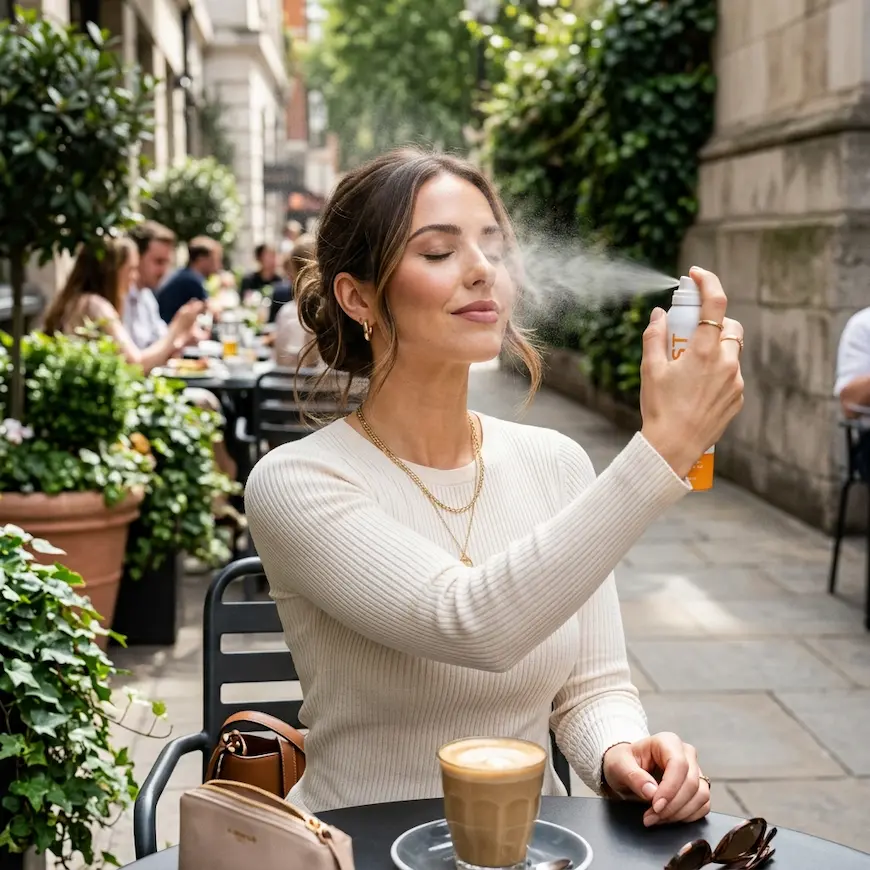
Quick Answer: The most reliable way to reapply sunscreen over makeup is an SPF stick, four passes back and forth over each area, then press in with clean fingers or a damp sponge. A cushion compact SPF works nearly as well and blends better. Powder SPF and mists are top-ups, not real protection. And spray it into your hands first, never directly at your face.
You are supposed to reapply sunscreen every two hours. You also spent twenty minutes on your face this morning. Those two facts do not get along, and nobody explains what to do about it.
The standard answer to how to reapply sunscreen over makeup is a mist. Spritz and carry on. That advice is everywhere because it is easy to give, and it is easy because it asks nothing of you. It also does very little.
So before we get to how to reapply sunscreen over makeup properly, here is the part that always gets skipped.
First, the uncomfortable part
SPF numbers come from lab testing at 2 mg/cm² of skin. That is a thick layer, roughly a quarter teaspoon for a face. Hardly anyone applies that much. A review by Petersen and Wulf found that under real conditions people apply somewhere around 0.39 to 1.0 mg/cm², a quarter to half of the tested amount.
The relationship is not proportional either. Using half the product does not leave you with half the protection, it drops off faster than that, which is why an SPF 50 applied the way most of us apply it behaves closer to an SPF 15 or 20.
Now add makeup underneath, plus a delivery method chosen mainly for not disturbing that makeup. You are not getting the number on the bottle. Neither is anybody else.
That is not an argument for skipping it. It is an argument for three specific things.
Your morning application is the one that counts. Apply it properly and generously to clean skin before anything else, and get where sunscreen goes in your routine right the first time. Everything after that is a top up.
Reapplication is real but partial. More is better than none, and that is not nothing.
Do not let a top up buy you extra sun. If you are outdoors for hours, shade and a hat are doing more for you than any powder can.
With that on the table, here is how to reapply sunscreen over makeup in a way that holds up.
The 5 methods, ranked
Anyone researching how to reapply sunscreen over makeup runs into the same five options, usually presented as equals with different textures. They are not equals.
| Method | Realistic protection | Effect on makeup | Best for |
|---|---|---|---|
| 1. SPF stick | Best. You can physically deposit enough product. | Some disturbance, needs pressing in | Anyone serious about protection. Nose, cheekbones, hairline |
| 2. Cushion compact SPF | Very good. Tinted, so you can see your coverage. | Minimal. It refreshes the base | Full coverage makeup wearers. The best all rounder |
| 3. Tinted mineral cream, pressed on | Good if you use enough | Moderate, sponge required | Light makeup, dry skin |
| 4. Powder SPF | Weak. Top up only. | None. It mattifies | Oily skin, desk days, shine control with a small SPF bonus |
| 5. Mist or spray | Weakest as used. Most of it misses. | None if misted, some if applied properly | Body and limbs, not really the face |
The gap between the first row and the last one is much wider than the beauty internet lets on.
How to reapply sunscreen over makeup, step by step
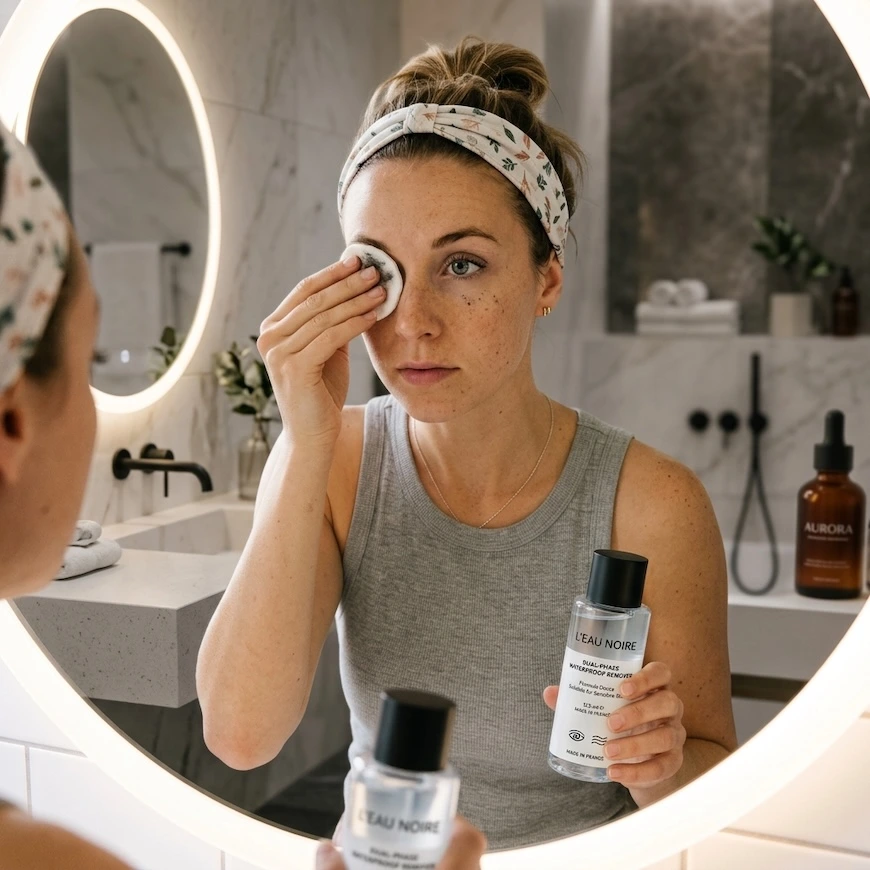
Step 1. Blot, do not powder. Press oil absorbing blotting paper over your T zone. Blotting takes the oil off and leaves your makeup and your existing sunscreen where they are. Powder first just gives you a dry surface that new product will grab unevenly. If you have never got on with blotting papers and shine control, this is the one job they are perfect for.
Step 2. Apply an SPF stick, four passes per area. Not one swipe. The AAD’s instruction for stick sunscreen is four passes back and forth over each area you are protecting. Treat your forehead, each cheek, your nose and your chin as separate areas. It will look like far too much product. That is the point, because it is the only way to get anywhere near a useful amount.
If the stick drags, warm it between your palms for a few seconds first. And take it right up to the orbital bone while you are there, since the skin around your eyes needs sunscreen too and a stick is the easiest format for that spot.
Step 3. Press it in with a damp sponge. This is where technique starts to matter, and most of how to reapply sunscreen over makeup successfully comes down to this one motion. Take a slightly damp makeup sponge and press straight down, then lift. No sweeping, no dragging, because dragging is what moves your foundation around. Pressing melds the sunscreen into the makeup and spreads it into an even film instead of leaving it sitting there in stripes.
A dry sponge drinks too much of the product. Damp is the whole difference.
Step 4. Fix whatever moved. Usually a little concealer under the eyes and around the nose. Put it on after the sunscreen, not before, and press it in the same way. If your base tends to shift every time you touch it, the problem is upstream, and makeup that lasts through touch ups starts with how you set it in the morning.
Step 5. Set only if you need to. A light dust of translucent powder if you are shiny, nothing if you are not. It is one more layer that can pill. While you have everything out, run an SPF balm over your mouth, because lips need SPF too and they are the spot everyone forgets.
Total time is about ninety seconds once you have done it twice.
Why mists and sprays underperform
They are the most recommended method and the least effective, which is worth knowing if a mist is what you own.
Most of the product never lands. Aerosol droplets disperse, so a light mist held eight inches from your face puts a fraction of the bottle on your skin, and outdoors a slight breeze takes much of the rest.
“Until it glistens” is the actual standard. The AAD tells you to spray generously until skin glistens and then rub it in thoroughly. Nobody does that over makeup, because it would wreck the makeup, and that trade off is exactly what most articles on how to reapply sunscreen over makeup skip past.
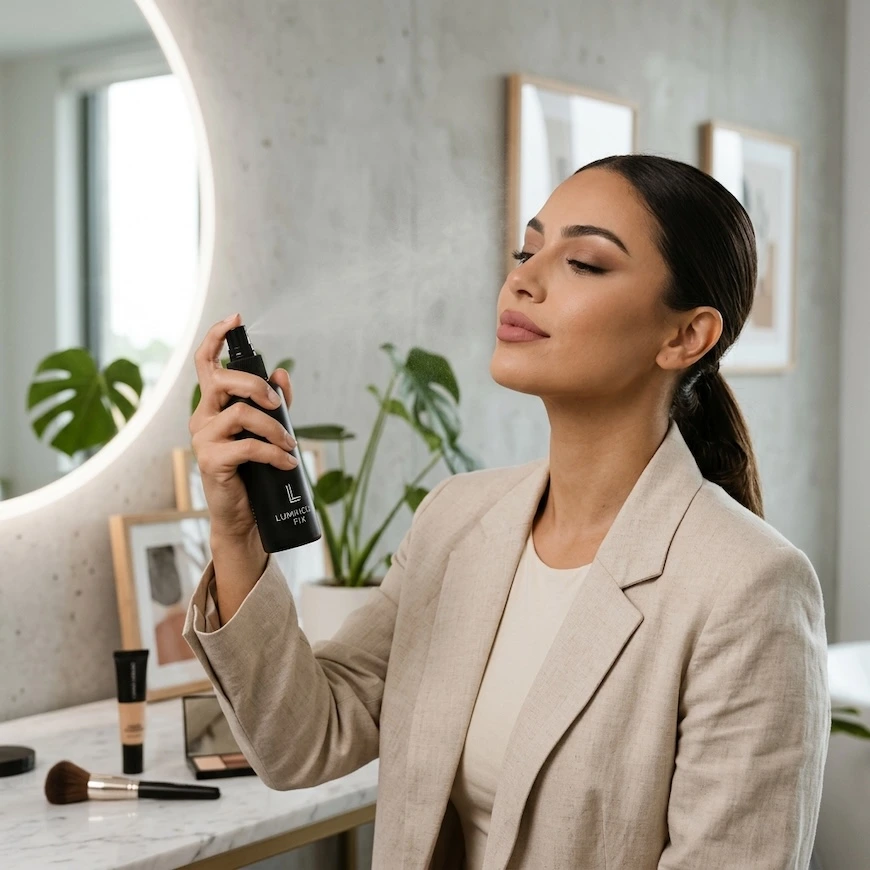
You also should not be spraying at your face at all. The AAD is direct about it: spray into your hands first, then apply to your face. That is an inhalation and eye irritation issue, and it holds for every facial spray sunscreen no matter how fine the nozzle claims to be.
If a mist is what you have, spray into your palms, press it onto your face with your fingertips, and treat it as a partial top up. Save it for your neck, ears and the backs of your hands, where it is actually convenient and there is no makeup to protect.
On SPF setting sprays: a setting spray with SPF is a setting spray first. The SPF is a small bonus, not protection you should be counting on, because you would need to apply far more than any setting spray is built to deliver. Choose a setting spray for its finish and treat the SPF as a rounding error.
Powder SPF: what it is actually for
Powder is what most people reach for when they think about how to reapply sunscreen over makeup at a desk. It has a reputation it has not quite earned, and it deserves precision, because it is useful. Just not for the reason people buy it.
Dermatologist Christine Poblete-Lopez of the Cleveland Clinic puts it plainly: reaching the concentration that gives you adequate protection takes a properly thick layer of powder, and in practice she says it is “probably not going to be used in sufficient quantities” to protect your skin the way it needs. She also points out that powder rubs off skin easily.
A light dusting gives you almost nothing. Getting meaningful SPF from powder alone takes many heavy passes, and by then you look powdered.
So use it for the jobs it is good at. Controlling shine over makeup while adding some UV protection. Touch ups along your part line and scalp, where nothing else works well. Days spent mostly indoors when you want a light top up.
What it is not: your only sunscreen, your plan for a beach day or a long walk, or an option for anyone with a history of skin cancer or melasma.
If you use powder, apply it in several firm passes over the areas that catch the most light, meaning the tops of your cheekbones, your nose and forehead, rather than one sweep across the face.
The Korean answer: cushion compacts
If you have wondered how Korean routines handle midday SPF without a visible reapplication ritual, this is it, and it is the most elegant solution to how to reapply sunscreen over makeup that anyone has come up with.
A cushion compact with SPF is a liquid sunscreen, usually tinted and often built on a hybrid mineral and chemical filter system, held in a sponge inside a compact and applied with a small puff. It works over makeup for one reason: it is tinted, so you can see how much you have applied. With a clear stick or a mist you are guessing. With a cushion, an even visible layer of colour is an even layer of sunscreen. It is also why cushions sit near the centre of the Korean skincare routine rather than at the edges of it.
To use one over makeup, blot first. Press the puff into the cushion and load it properly instead of dabbing at it. Press onto skin and lift, never sweep. Go over your face twice, because one pass is not enough coverage. Concentrate on the nose, cheekbones and forehead.
The trade off is shade range. Cushions were historically made for a narrow band of tones, though that has improved. Buy somewhere with returns and check the shade in daylight, not under store lighting.
Do you actually need to reapply?
Before worrying about how to reapply sunscreen over makeup, it is worth asking how often you need to. Every two hours is the standard advice and the right default for anyone outdoors. But that rule was written for sun exposure, not for a Tuesday at a desk.
Reapply on schedule if you are outdoors, sitting near a large window, sweating, swimming, spending a long stretch in a car, or being treated for melasma or hyperpigmentation.
You can relax a little if you are indoors and away from windows for most of the day. Standard window glass blocks most UVB but lets a substantial amount of UVA through, and UVA is the wavelength behind photoaging and pigmentation. Indoors is not automatically safe. The question is how close you sit to the glass.
Always reapply after swimming, heavy sweating or towelling off. No sunscreen is waterproof, the FDA does not allow that claim, and water resistance ratings run to 40 or 80 minutes.
If you have melasma, treat reapplication as non negotiable. Visible light feeds melasma alongside UV, which is why dermatologists keep recommending tinted mineral sunscreens for it. The iron oxides that provide the tint are the part that blocks visible light, and that is a real argument for picking a tinted cushion or stick over a clear one.
Choosing the right formula for your skin
The method matters less than whether the formula suits your face, so it helps to know your skin type first and work backwards from there.
| Your skin | Reach for | Avoid |
|---|---|---|
| Oily or acne prone | Powder SPF for shine, plus a matte stick | Heavy tinted creams over full makeup |
| Dry | Cushion compact or a hydrating tinted mineral cream | Powder, which accentuates dry patches |
| Sensitive or rosacea | Mineral stick with zinc oxide, fragrance free | Alcohol heavy mists |
| Melasma or dark spots | Tinted mineral, since iron oxides block visible light | Clear formulas alone |
| Deeper skin tones | Tinted or hybrid formulas | Untinted mineral, because the white cast is real |
| Mature or textured | Cushion, pressed in | Powder, which settles into lines |
Knowing how to reapply sunscreen over makeup only helps if the sunscreen underneath is worth reapplying, and which sunscreens are actually worth buying is its own question.
Frequently asked questions
Does powder sunscreen actually work?
Is it OK to spray sunscreen directly on my face?
How do Koreans reapply sunscreen over makeup?
Do I need to reapply sunscreen if I’m indoors all day?
Not on a strict two-hour schedule, but it depends on your windows. Standard glass blocks most UVB and lets significant UVA through, and UVA drives photoaging and pigmentation. If you sit near a large window, top up around midday. If you're away from natural light, your morning application is generally enough.
Will reapplying sunscreen make me break out?
It can if the formula is wrong for you, though the usual culprit is layering heavy products all day without cleansing properly at night. Look for non comedogenic formulas, and if your skin is reactive rather than oily, the issue may be repairing a damaged skin barrier rather than the sunscreen itself.
Should I use SPF setting spray instead?
How much sunscreen should I use on my face?

Hi, I’m Marwa ✅
I test skincare, haircare, and makeup on real skin and a real budget, and writes the honest reviews to prove it.