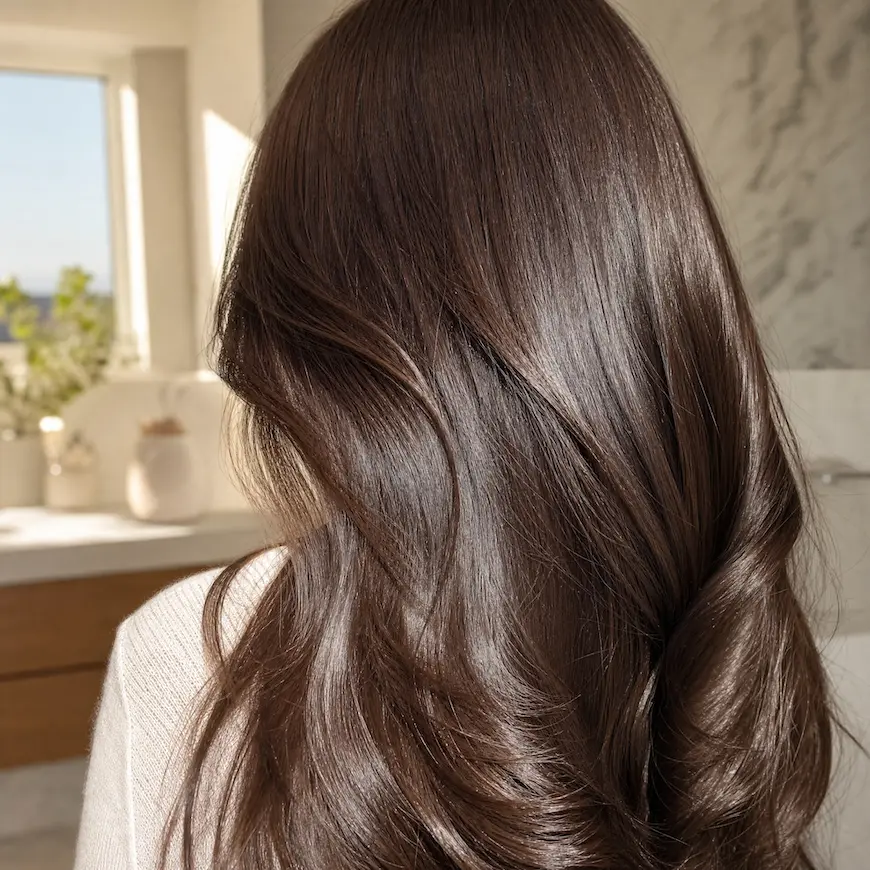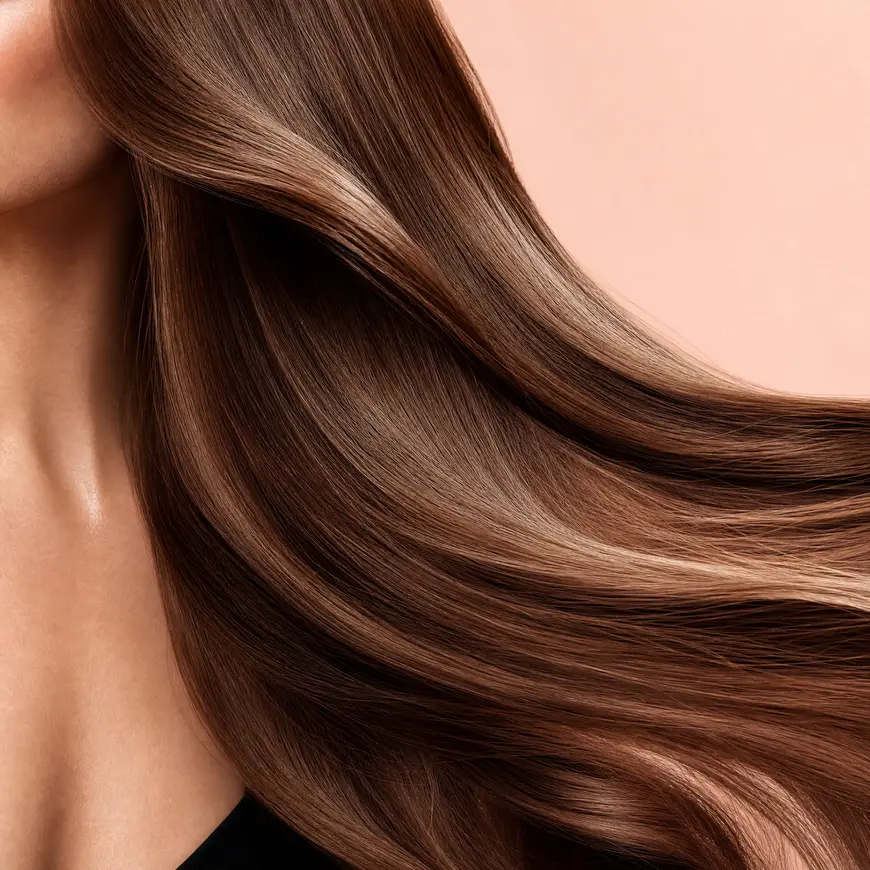
Quick Answer: The most useful hair test costs nothing: pick up a fallen strand and look at the end. A small white or pale bulb means the hair shed naturally — normal, and everyone loses 50–100 a day. No bulb, with a frayed or blunt end, means the hair broke — that’s damage, and it’s fixable. Skip the viral water float test; it measures surface tension, not porosity.
A single strand of healthy hair holds about 3.5 ounces of weight and stretches roughly 30% longer when wet before it snaps. Damaged hair does neither. It gives out early and it gives out often.
The problem is that you can’t tell by looking in the mirror. Frizz can be damage or it can just be humidity on perfectly healthy hair. Shedding can be alarming or completely routine. Dryness can mean a wrecked cuticle or a shampoo that’s too stripping for you.
So here are four tests you can run at home in about five minutes, plus one popular test you should ignore. Between them they tell you whether you’re looking at healthy hair behaving normally or a shaft that’s coming apart.
Test 1: The strand test, or did it shed or break?
Start here. This is the single most informative thing you can do, and almost nobody does it.
Collect the hairs from your brush, your pillow, or the shower drain. Pick a few up and look closely at the ends. Healthy hair leaves a very specific signature here.
| What you see | What it means | What to do |
|---|---|---|
| Long strand, small white or pale bulb on one end | Shedding. The hair finished its growth cycle and released. This is what healthy hair does. | Nothing. Up to 100 a day is expected. |
| Short pieces, uneven lengths, no bulb, frayed or blunt tip | Breakage. The strand snapped somewhere along its length. | This is the fixable one. See below. |
| Suddenly far more shed hairs than usual, all with bulbs | Possible telogen effluvium, a temporary shedding surge after stress, illness, childbirth or rapid weight loss. | Usually resolves in 6 to 9 months. See a dermatologist if it doesn’t. |
Why this matters so much: shedding and breakage have completely opposite solutions. Shedding is a follicle and health story, and no amount of protein bond repair will give you healthy hair if the follicle is the problem. Breakage is a hair shaft story, so a dermatologist can’t do much about it, but changing how you handle your hair can.
Most people who think they’re losing their hair when they see short broken pieces around the hairline are actually looking at breakage, or at new growth. If the short hairs are tapered and soft at the tip, that’s regrowth pushing through, which is a sign of healthy hair rather than a problem. If they’re blunt or split, that’s breakage.
⚠️ Don’t pluck your hair to check the root. You’ll find a bulb every time, because you forcibly removed a growing hair. That tells you nothing and can damage the follicle. Only naturally shed hairs carry useful information.
Test 2: The stretch test, or how much give does your hair have?
This measures elasticity, which is a real and meaningful property and probably the best single indicator of healthy hair you can check at home. Healthy hair stretches and springs back. Damaged hair either snaps immediately or stretches like chewing gum and stays stretched.
How to test for healthy hair elasticity properly:
- Take a single shed strand, not one you pulled from your head.
- Do it on wet hair. Hair is far more extensible wet, and that’s where damage shows.
- Hold both ends and pull gently and steadily.
Reading the result:
- Stretches noticeably, then returns to its original length. That’s the elasticity of healthy hair.
- Snaps almost immediately with barely any stretch. Brittle, often over processed or protein overloaded.
- Stretches a long way and stays limp and stretched, feels gummy. This is the one to take seriously. Gummy, mushy hair usually means damage from bleach, relaxers or too much protein free moisture, and it often breaks in the shower. This is the furthest from healthy hair the stretch test can show you.
Test a strand from your ends and one from near your scalp. Your ends are years older and have taken far more heat, so some difference between the two is expected even on healthy hair. A big difference tells you it’s time for a trim.
Test 3: The slide test, or reading your cuticle
Your cuticle is the outer layer of overlapping scales that protects the inside of the hair, and it does most of the work of making healthy hair look the way it does. When it’s intact, healthy hair feels smooth, reflects light, and holds moisture. When it’s lifted or chipped away, hair feels rough and looks dull.
How to do it: hold a shed strand between your thumb and index finger at the tip end, and slide up toward the root.
- Smooth the whole way. Cuticle in good shape.
- Bumpy, rough, or catches. The cuticle is raised or damaged in those spots.
This is the test the old version of this article mislabeled as a porosity test. It isn’t one, but it’s still worth doing, because cuticle condition governs how your hair feels, how it takes colour, and how fast it dries.
One honest caveat: coarse and textured hair types naturally have a more raised cuticle than fine straight hair. Rough doesn’t automatically mean damaged, and plenty of healthy hair catches slightly under your fingers. Compare your hair to your own hair from six months ago, not to someone else’s.
Test 4: What about porosity, and why does the float test fail?
You’ve almost certainly seen it: drop a strand in a glass of water, wait, and see whether it floats (low porosity), hovers (medium), or sinks (high porosity).
It doesn’t work. Michelle Wong, PhD, a cosmetic chemist who has taken the test apart in detail, points out that it isn’t measuring absorption at all. It’s measuring surface tension, which is a property of the hair’s outer surface rather than its interior, so it tells you very little about whether you have healthy hair. Three things break it:
- Healthy hair already absorbs about 30% of its own weight in water. The premise that undamaged hair repels water is simply wrong.
- Residue dominates the result. Leftover conditioner, oil, silicone or hard water minerals will make a strand float regardless of its actual condition. Sebum from your scalp does the same.
- Physics gets in the way. Tiny trapped air bubbles, water temperature, and how you drop the strand all change the outcome. Run the test twice on the same strand of healthy hair and you can get two different answers.
The float test spread through a viral video in 2014 and has never been validated in the cosmetic chemistry or trichology literature. It isn’t taught in cosmetology curricula either.
What to do instead: porosity is a real property, it just isn’t something you can measure in a cup. Use behaviour rather than a lab test you can’t run.
| Sign | Suggests | Adjust by |
|---|---|---|
| Water beads and sits on your hair; takes forever to get properly wet; products sit on top and pill | Lower porosity behaviour, common in healthy hair that’s never been processed | Lighter products, apply to damp hair, use warmth (a shower cap over a mask) to help absorption |
| Soaks instantly, dries fast, drinks product and still feels dry by evening, tangles easily | Higher porosity behaviour, usually from damage | Richer leave-ins, seal with an oil, add a bond or protein treatment |
Here’s the part the porosity conversation usually misses. For most people, high porosity isn’t a hair type. It’s damage. Bleach, relaxers, and repeated heat lift and erode the cuticle, and that’s what makes hair absorb and lose water quickly. Treat the damage and the porosity moves back toward where healthy hair sits.
Oils help at the sealing stage on the way back to healthy hair, but they aren’t interchangeable. Coconut oil is the one oil shown to reduce protein loss because its molecular shape lets it penetrate the shaft rather than sit on it. Argan oil works differently, and it’s worth knowing what argan oil does and doesn’t do before you spend money on it.
The pull test, or what your dermatologist does and why you shouldn’t
The old version of this article described a test where you pull about 40 strands and count how many come out. That’s a real clinical procedure, and the numbers quoted are roughly right. A dermatologist grasps a bundle of 40 to 60 hairs, pulls gently, and more than about 10% coming away suggests active shedding.
But it’s a test with a large interpretive component. A positive pull test doesn’t mean telogen effluvium. Androgenetic alopecia, alopecia areata and scarring alopecias can all produce one, and they’re treated completely differently. The result also depends on how long since you last washed, and on exactly how hard you pull, which is the part you can’t standardise at home.
Do the strand test in Test 1 instead, since it works on healthy hair and damaged hair alike. It gives you the same shedding versus breakage answer without a technique you can’t calibrate. If your shedding genuinely worries you, that’s a dermatologist visit rather than a home test. The AAD notes that telling normal shedding from true hair loss is exactly the judgement a dermatologist is trained to make.
So what do you actually do about it?
| Your result | First thing to change |
|---|---|
| Breakage, short snapped pieces | Lower your heat tools and always use a heat protectant. The AAD lists excessive heat among the top habits that damage hair. |
| Gummy, over stretchy strands | Stop all chemical processing. Use a bond building treatment rather than more moisture. |
| Snaps with no stretch | You may have too much protein. Swap to a moisturising mask for a few weeks. |
| Rough cuticle, dull hair | Handle wet hair gently, detangle with a wide tooth comb, and sleep on satin. |
| Sudden heavy shedding, bulbs present | Look at the last 3 months for illness, stress, or a diet change. Give it 6 to 9 months. |
The four biggest levers for keeping healthy hair, in order of how much they matter: heat, chemical processing, wet hair handling, and friction while you sleep. Wet hair is where most healthy hair gets wrecked, so learn to detangle without cutting before you reach for scissors. Products help at the margins. Those four are the whole game, and they matter more than anything you can buy in a bottle labelled healthy hair.
When to see a dermatologist
Home tests tell you about the strand. They tell you whether you have healthy hair from the scalp outward, and not much else. They tell you nothing about your scalp, and scalp problems are where the medically important causes live. Healthy hair grows out of a healthy scalp, and a decent scalp care routine solves more than most people expect. Book an appointment if you notice:
- Widening part or visibly thinning density, especially at the crown
- Any smooth, bald patches, which is a pattern rather than damage
- Redness, scaling, burning, or pain on the scalp, though a flaky scalp needs different treatment and isn’t automatically a dermatologist visit
- Shedding that hasn’t settled after nine months
- Hair loss alongside other symptoms like fatigue, weight change, or irregular periods
Scarring alopecias in particular are time sensitive. Follicles that scar over don’t come back, so early treatment matters far more than it does with other types.
Frequently asked questions
Is it normal to lose 100 hairs a day?
Yes. The American Academy of Dermatology puts normal daily shedding for healthy hair at 50 to 100 strands. It looks alarming in the shower because a few days' worth collects at once, and it looks worse the longer your hair is. What matters is whether the number has clearly changed for you, not the number itself.
Does the hair porosity water test actually work?
No. It measures surface tension and surface damage rather than how much water your hair absorbs internally, and residue, water temperature and air bubbles all change the result. Judge porosity from how your hair behaves, meaning how fast it wets, how fast it dries, and whether products absorb or sit on top.
Why is my hair breaking off at the same length?
Usually a friction or heat line, where your hair rubs on a collar or a bag strap, where a ponytail sits, or where a flat iron passes most often. Look for whether the break line matches something you do daily, because healthy hair rarely fails at one consistent height without an outside cause. If it's around your hairline it's often tension from tight styles, and hair ties and breakage go together more often than people realise.
Can damaged hair be repaired?
Not restored, because hair is not living tissue and can't heal itself the way skin does. Bond building treatments genuinely reconnect broken disulfide bonds and will make hair feel and behave much closer to healthy hair, and conditioners smooth the cuticle temporarily. The only permanent fix is growing it out and cutting it off. What you can do immediately is stop causing more.
How often should I trim to prevent breakage?
Every 8 to 12 weeks for most people, sooner if you heat style often or colour your hair. A split doesn't stay put, it travels up the shaft, so trimming isn't cosmetic maintenance. It's damage control, and it's the cheapest healthy hair habit there is. If your ends fail the stretch test and your roots pass, you're overdue.
Does hair porosity change over time?
Yes, and that's the clearest evidence it isn't a fixed hair type. Bleaching, relaxing, and heat all raise porosity by eroding the cuticle. It's much easier to increase porosity than to lower it, because the cuticle doesn't rebuild, but reducing damage stops it climbing further.
What does healthy hair actually look like?
It reflects light, stretches and springs back when wet, sheds with a pale bulb rather than snapping, and slides fairly smoothly between your fingers. Healthy hair is not frizz free or uniformly shiny, and texture type changes what all of this looks like in practice.
Reviewed for accuracy August 2026. This article is for general information and is not medical advice. If you’re concerned about hair loss, see a board-certified dermatologist
Hi, I’m Marwa ✅
I test skincare, haircare, and makeup on real skin and a real budget, and writes the honest reviews to prove it.