Quick Answer: Argan oil for hair works by coating and sealing the cuticle, not by penetrating it. That makes it very good for shine, frizz control and reducing surface damage, which is why a few drops on damp ends transform dry hair. It does not reach the follicle, so it won’t make hair grow. For actual penetration into the hair shaft, coconut oil has the stronger evidence.
Argan oil was the first hair product I ever bought that made an immediate, visible difference. Dry, frizzy ends after a bleach job, three drops on damp hair, and by the time it dried I had what looked like a different head of hair.
What it did not do, despite two years of me quietly hoping, was make my hair grow faster.
That gap between what argan oil for hair really does and what it gets sold as doing is worth closing, because the real benefits are good enough on their own. Here’s what it does, how to use it properly, and how it stacks up against the other oil sitting in everyone’s bathroom.
What argan oil actually does, and how
Argan oil is pressed from the kernels of the argan tree, native to Morocco. It’s rich in oleic and linoleic acids, vitamin E and antioxidants.
The mechanism is where most articles go wrong, so it’s worth being precise.
Hair oils fall into two camps. Some penetrate the hair shaft, getting inside the cortex and reducing protein loss from within. Others coat the shaft, smoothing and sealing the cuticle from outside.
The reference study is Rele and Mohile’s 2003 comparison of mineral, sunflower and coconut oils in the Journal of Cosmetic Science. Coconut oil was the only one of the three that meaningfully reduced protein loss, in both undamaged and damaged hair, whether applied before or after washing. Its main fatty acid, lauric acid, has a low molecular weight and a straight linear chain that lets it slip into the shaft and bind to hair protein. Mineral oil, being a hydrocarbon with no affinity for protein, barely penetrated. Sunflower oil didn’t either, because its bulky, double-bonded structure can’t get into the fibre.
That last finding is the one that matters for argan oil for hair. Argan’s dominant fatty acids are oleic and linoleic, the same larger, bent molecules that kept sunflower oil on the surface. Argan coats and seals.
Which is still worth having. A sealed cuticle lies flat. Flat cuticles reflect light evenly, which is shine. They resist humidity, which is less frizz. And they slide past each other instead of catching, which means less breakage when you brush. That’s most of what people want from a hair oil in the first place.
It’s a surface effect rather than a repair from within, and knowing that tells you exactly how to use the stuff.
The 6 things argan oil actually does
1. Shine
The most reliable benefit and the fastest. Smoothing the cuticle makes light bounce off in one direction instead of scattering. You can see it within seconds of applying. If you only ever try argan oil for hair once, do it on damp ends and watch the light change.
2. Frizz control
Frizz is raised cuticle scales letting humidity in and swelling the shaft. A sealing oil flattens those scales and slows the moisture exchange. This is the one area where argan oil for hair outperforms most of the alternatives.
3. Less breakage from friction
Coated hair has a lower coefficient of friction, so strands slide past each other rather than snagging. Less mechanical damage while brushing, styling and sleeping.
Note the distinction here, because it’s the source of most of the growth confusion: less breakage means you keep more length. Not the same thing as growing hair faster, even though the result can look similar after six months.
4. Some heat protection, but not enough alone
Oils raise the temperature at which the cuticle takes damage and slow moisture loss during blow-drying. That effect is real.
But argan is not a heat protectant. A dedicated protectant contains film-forming polymers built for that job. Argan oil for hair earns its place in a heat routine as the second layer, never the first. Use it in addition to a protectant, not instead of one. The AAD’s hair styling guidance is worth reading on heat damage generally, and it’s blunt about flat irons.
5. Scalp comfort
Massaged into a dry, flaky scalp, argan relieves tightness and itch. It’s an emollient doing emollient things. If the flaking is persistent, though, that’s more likely seborrheic dermatitis or dandruff, which needs an antifungal shampoo rather than oil. My post on dandruff covers how to tell them apart.
6. Split-end camouflage
It makes split ends look sealed and far less visible. Nothing repairs a split end. Only scissors do that. But the cosmetic improvement is real and it lasts until you wash.
What argan oil does not do
I’m being blunt here because these claims are everywhere, including in the earlier version of this article.
It doesn’t make hair grow faster. Growth happens at the follicle, below the skin. A finishing oil sitting on the shaft never reaches it. What argan does is reduce breakage, so hair reaches a greater length before it snaps. That looks like faster growth. It isn’t.
It doesn’t fortify hair follicles. Same reason.
It doesn’t regulate sebum production. No evidence supports this one at all.
It doesn’t repair damaged hair. Argan oil for hair sits on the outside of a structure that stopped being alive the moment it left the follicle. Hair isn’t living tissue and cannot heal. Oils, masks and bond-builders change how damaged hair behaves and looks, but none of them restore it. Olaplex comes closest by reconnecting broken bonds, and even that has limits.
It doesn’t treat hair loss. If you’re shedding more than usual or your part is widening, that’s a different problem, and the AAD’s page on the first signs of hair loss is the right starting point. Not an oil.
None of that makes it a bad product. It makes argan oil for hair a finishing and protecting product rather than a treatment, which is a perfectly good thing to be.
Argan oil vs coconut oil
The comparison people mostly came for.
| Argan oil | Coconut oil | |
|---|---|---|
| Main fatty acid | Oleic, linoleic | Lauric acid |
| Behaviour | Coats and seals | Penetrates the shaft |
| Protein loss | Little effect | Meaningfully reduced (Rele & Mohile 2003) |
| Weight | Light | Heavier, can build up |
| Best used | After washing, on damp or dry hair | Before washing, as a pre-shampoo treatment |
| Best for | Shine, frizz, fine hair, daily finishing | Deep conditioning, coarse or high-porosity hair |
| Downside | No internal benefit | Can stiffen fine hair, needs washing out |
They aren’t competitors. They do different jobs. Coconut oil before you wash, argan after. If your hair is fine, argan alone is usually enough. If it’s coarse, dry or damaged, a pre-wash coconut treatment plus argan oil for hair as the finisher is a strong routine that costs almost nothing.
I’ve written about the other half in benefits of coconut oil for hair and skin.
How to use argan oil properly
Most complaints about argan oil for hair are dosage problems wearing a costume.
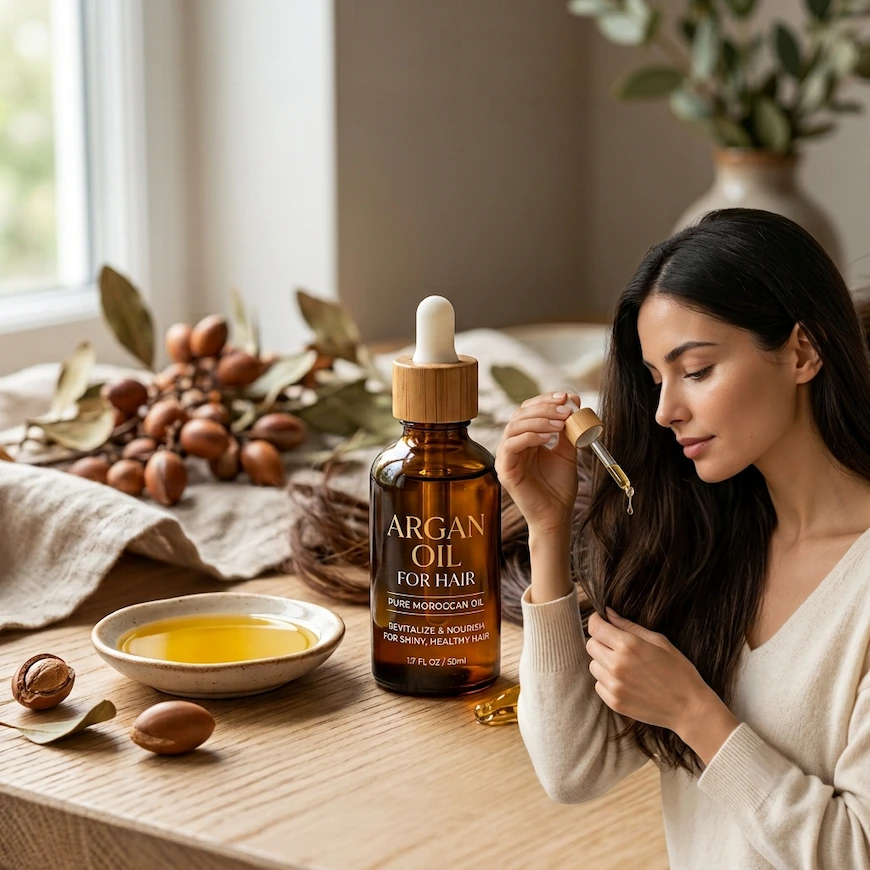
On damp hair, the main method
- Wash and condition, then towel-blot until damp, not dripping
- Take 2 to 4 drops for shoulder-length hair. Fine hair: 1 to 2. Very long or thick: up to 6
- Warm it between your palms for a few seconds
- Apply to the ends first, then work upward to about mid-length
- Stop at your ears. Nothing above that line unless you’re deliberately treating your scalp
- Comb through with a wide-tooth comb, then style
On dry hair, for frizz and flyaways
Half a drop, rubbed between the palms until there’s barely anything left, then smoothed over the surface. This is a finishing touch and the amount really is tiny. The most common mistake is using a proper drop and walking out greasy.
As a scalp treatment, once a week at most
A few drops massaged into a dry scalp, left 30 minutes to overnight, then shampooed out. Only if your scalp is dry. Oily scalps don’t need this and won’t thank you.
As a pre-styling layer
Heat protectant first, then a drop of argan over the mid-lengths. The order matters, because the protectant needs contact with the hair itself.
Frequency: damp-hair application every wash is fine. Dry-hair finishing as needed. Scalp treatments weekly at most.
If your hair goes greasy or limp, you used too much or applied it too high. Halve the dose and start lower down. It’s almost never the wrong product. It’s the wrong quantity. Nearly every bad review of argan oil for hair I’ve read describes exactly this.
What to actually buy
This is where most of the money spent on argan oil for hair gets wasted.
Look for 100% pure argan oil, ideally cold-pressed. The ingredient list should read Argania Spinosa Kernel Oil and very little else. A dark glass bottle, because light degrades the oil. A nutty smell rather than a perfumed one, since deodorised versions are fine but heavily fragranced ones usually contain very little argan. Morocco as the stated origin.
Be wary of anything labelled “argan-infused” or “with argan oil” where argan sits near the end of the ingredient list. Plenty of popular drugstore hair oils are mostly cyclopentasiloxane and dimethicone, which are silicones, with a token splash of argan. Silicones aren’t bad and they do a similar sealing job. You’re just paying an argan premium for a silicone product. Be equally wary of anything very cheap for a large volume, because real argan oil is labour-intensive to produce.
- 100% pure argan oil
- Cold-pressed organic argan oil
- Argan oil hair mask
- Heat protectant spray
Storage: cool, dark, away from the bathroom window. Shelf life is roughly two years sealed and about a year opened. If it smells sharp or slightly crayon-like, it’s oxidised. Bin it.
Who it suits
Argan oil for hair works best on dry, coarse, curly or coily hair, on colour-treated hair, on frizz-prone hair in humid weather, for anyone who heat-styles regularly, and on flaky, tight scalps.
Use it sparingly if your hair is fine or limp, where one drop on the ends is plenty. Skip scalp application entirely if your scalp runs oily. And if your hair is low-porosity, oils sit on top rather than absorbing, so less really is more.
Patch test first if you have a nut allergy. Argan is a tree nut product. Reactions are uncommon, but they happen, and a patch test costs you nothing.
If you’re fighting frizz and flatness at the same time, how to get volume in hair at home covers keeping those two in balance. Oil at the ends, nothing at the roots.
Frequently asked questions
Does argan oil help hair growth?
Not directly. Growth happens at the follicle beneath the scalp, and a shaft-coating oil doesn't reach it. Argan reduces breakage, so hair reaches a greater length before snapping, which can look like faster growth over several months.
How do you use argan oil for hair?
Use 2 to 4 drops on damp hair after washing. Warm it between your palms, apply to the ends first, work upward to mid-length, and stop at ear level. For frizz on dry hair, half a drop as a finishing touch is enough.
Argan oil or coconut oil, which is better for hair?
They do different jobs. Coconut oil penetrates the hair shaft and reduces protein loss, which makes it a strong pre-wash treatment. Argan oil coats and seals, which makes it better as a post-wash finisher for shine and frizz. Plenty of people use both.
Is argan oil a heat protectant?
Not on its own. It offers some protection by slowing moisture loss, but it doesn't replace a dedicated heat protectant with film-forming polymers. Use both, protectant first and oil second.
Should I use argan oil on wet or dry hair?
Damp is best for the main application, since it spreads more evenly and helps seal moisture in. A much smaller amount on dry hair works for taming frizz and flyaways.
The bottom line
Argan oil for hair is a very good finishing oil. It seals the cuticle, which buys you shine, frizz control and less breakage, and that’s worth having on its own terms.
It isn’t a growth treatment, it doesn’t reach your follicles, and it doesn’t repair damage. Anyone selling it as those things is overselling a product that never needed the help.
Two to four drops, damp hair, ends up. Stop at your ears.
Related: coconut oil for hair and skin for the pre-wash half of the routine, and haircare mistakes that damage your hair for the habits quietly undoing your oil’s work.

Hi, I’m Marwa ✅
I test skincare, haircare, and makeup on real skin and a real budget, and writes the honest reviews to prove it.