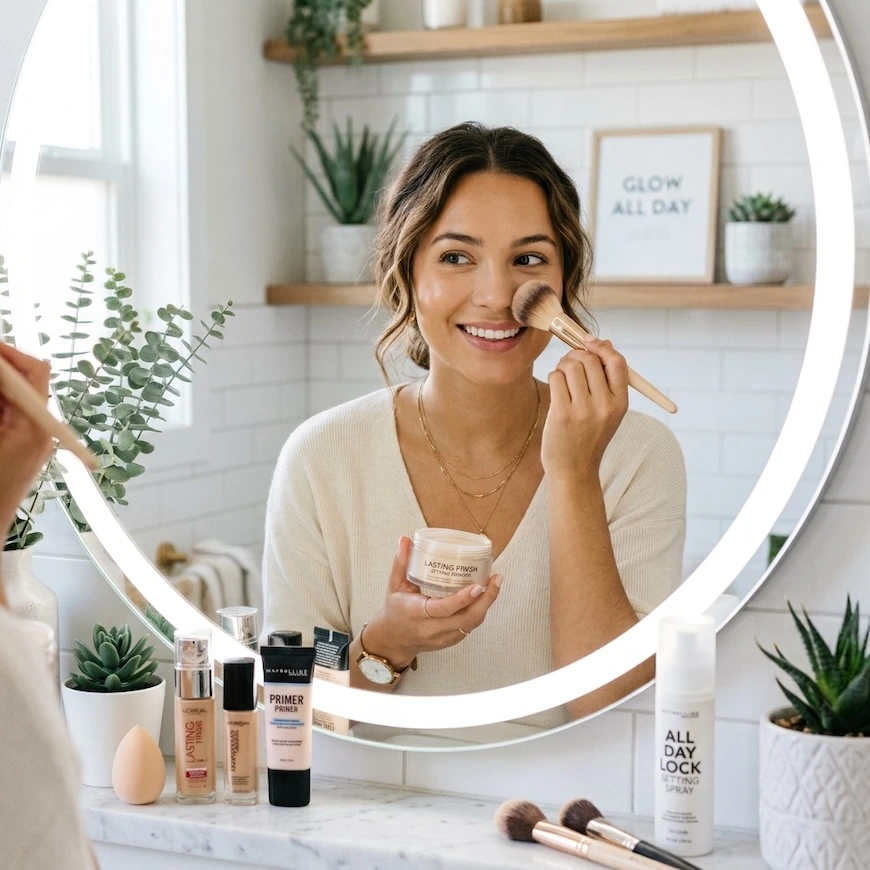
Quick Answer: Foundation breaks down for three reasons: sebum dissolving it from underneath, friction lifting it off, and primer and foundation being chemically incompatible. Fix all three and you get 8 to 12 hours. The short version of how to make your foundation last all day: use a primer with the same base as your foundation, let it set for a full minute, buff foundation in with a dense brush instead of swiping, and set only where you actually get oily.
I used to blame my foundation. I’d buy a new one every few months, apply it exactly the same way, watch it slide off my nose by lunchtime, and conclude the formula was the problem.
It wasn’t. I was using a silicone-based primer under a water-based foundation, a combination that physically cannot bond. The two layers separate and roll into little pills as the day goes on. Nobody mentioned this, and no setting spray was going to fix it.
That’s the theme here. Learning how to make your foundation last all day has far less to do with buying the right product than with four or five technical details nobody mentions. So here’s what’s happening when your base breaks down, and how to stop it.
Why foundation breaks down
Fix the cause, not the symptom.
Sebum dissolves it from underneath. Your skin produces oil all day, and oil is a solvent. It breaks down the emulsion holding your foundation together, starting where you produce most of it: nose, forehead, chin. Which is why breakdown always begins in the T-zone.
Friction lifts it off. Touching your face, a phone against your cheek, a mask, glasses, resting your chin on your hand. It’s mechanical removal, and it accounts for more loss than most people realise.
Base incompatibility is the big one, and almost nobody knows about it. If your primer is silicone-based (ingredients ending in -cone or -siloxane) and your foundation is water-based, or the reverse, the two layers repel each other. They separate, roll up, and you get pilling. Those little grey balls of product.
Dehydrated skin drinks it. Dry skin absorbs the liquid part of your foundation unevenly and leaves pigment sitting in patches. It looks like foundation clinging to dry patches because that’s what it is.
And sometimes the formula simply isn’t long-wear. Sheer, dewy and skin-tint formulas are built to look natural, not to survive twelve hours. That isn’t a defect.
Step 1: Prep your skin, and get the timing right
Cleanse, moisturize, wait.The waiting is the part everyone skips. Moisturiser needs 3 to 5 minutes to absorb before anything goes on top of it. Foundation over wet moisturiser slides, separates and never sets properly.
Match the moisturizer to the problem. Oily skin wants a lightweight gel, and skipping moisturiser because you’re oily triggers more oil production, which is the most self-defeating move in oily-skin makeup. Dry skin wants a richer cream with a hydrating serum underneath, since dehydrated skin is the usual reason foundation goes patchy. The AAD’s tips for relieving dry skin go further if it’s persistent. And everyone wants sunscreen, which also needs a few minutes to set.
If your skincare routine needs rebuilding first, the correct order to layer products is the place to start. Foundation performance is downstream of skin condition.
Step 2: Primer, matched and given time
This is the section that fixes most people’s problem.
Match your primer base to your foundation base
Turn both products over and read the first five ingredients.
| Primer type | Tell-tale ingredients | Pairs with |
|---|---|---|
| Silicone-based | Dimethicone, cyclopentasiloxane, anything -cone or -siloxane high in the list | Silicone-based foundation |
| Water-based | Water or aqua first, glycerin, no silicones near the top | Water-based foundation |
Mismatch them and you get pilling. Those rolled-up balls of product aren’t your skin exfoliating. They’re two incompatible layers separating.
If you take one thing away from this article about how to make your foundation last all day, take this one.
Choose the primer for the problem you actually have
Oily or shiny skin wants a mattifying primer on the T-zone only, not the whole face. Dry or flaky skin wants a hydrating one. Visible pores and texture call for a blurring or grip primer. Redness calls for a green-tinted colour corrector.
Expect to pay around $8 to $35.
Let it set for a full 60 seconds
Primer needs to form a film. Applying foundation into wet primer blends the two into one slippery layer with none of the grip.
Count it out. It feels absurd and it works.
Step 3: The pre-set trick
After primer, before foundation, dust a very light layer of translucent setting powder across your T-zone.
It sounds backwards. Here’s why it works: that powder sits between your skin and your foundation and absorbs sebum as it’s produced, before the oil reaches your base and dissolves it. You’re intercepting the problem instead of mopping up after it.
Use a fluffy brush, use less than feels right, and only where you actually get oily. On dry skin, skip this step completely.
Step 4: Foundation, formula and application
Pick a formula built to last
Look for long-wear, transfer-resistant or matte on the packaging. These hold 8 to 12 hours because they contain oil-absorbing silica and film-formers that resist breakdown.
Sheer, dewy and skin-tint formulas will not last all day. That’s the trade for a natural finish, and it’s often the right one. Just not on a 14-hour day.
I compared two long-wear favourites in Estée Lauder Double Wear vs MAC Pro Longwear if you’re picking between them.
Apply in thin layers, and buff rather than swipe
Start with less than you think. One pump for the whole face, built up only where you want coverage. Thick foundation doesn’t last longer. It breaks down faster and creases.
The application method matters more than the tool:
- A dense flat-top brush with small circular motions presses product into the skin so it grips. Best for longevity.
- A damp sponge with bouncing motions gives a more natural finish and slightly less staying power. Never drag it.
- Fingers work, since warmth helps it melt in, but you transfer oil from your hands. Fine for skin tints, not long wear.
Never swipe. Swiping deposits foundation on top of your skin like paint on glass. Buffing works it into the texture, where it can hold on to something.
If you’re building a brush kit, my roundup of the best affordable makeup brushes under $30 covers the dense buffing brush worth owning.
One more thing that belongs in any honest guide to how to make your foundation last all day: if you’re acne-prone, the AAD advises non-comedogenic or oil-free formulas and washing your applicators regularly. A dirty brush also drags product instead of blending it, so it costs you twice.
Step 5: Set strategically, not everywhere
Powder where you get oily. Nowhere else. Selective setting does more for how to make your foundation last all day than the powder you happen to buy.
For most people that’s the T-zone, plus under the eyes if concealer creases on you.
Press, don’t sweep. A press-and-roll motion with a powder puff or a dense brush locks powder into the foundation. Sweeping just pushes your foundation around.
Use noticeably less than feels right. Over-powdering makes a face look flat, cakey and older, worst of all on camera. You can always add more at 2pm. You can’t take it off.
On dry skin, powder the T-zone only or skip it. Powder settles into fine lines and emphasises texture.
Step 6: Setting spray
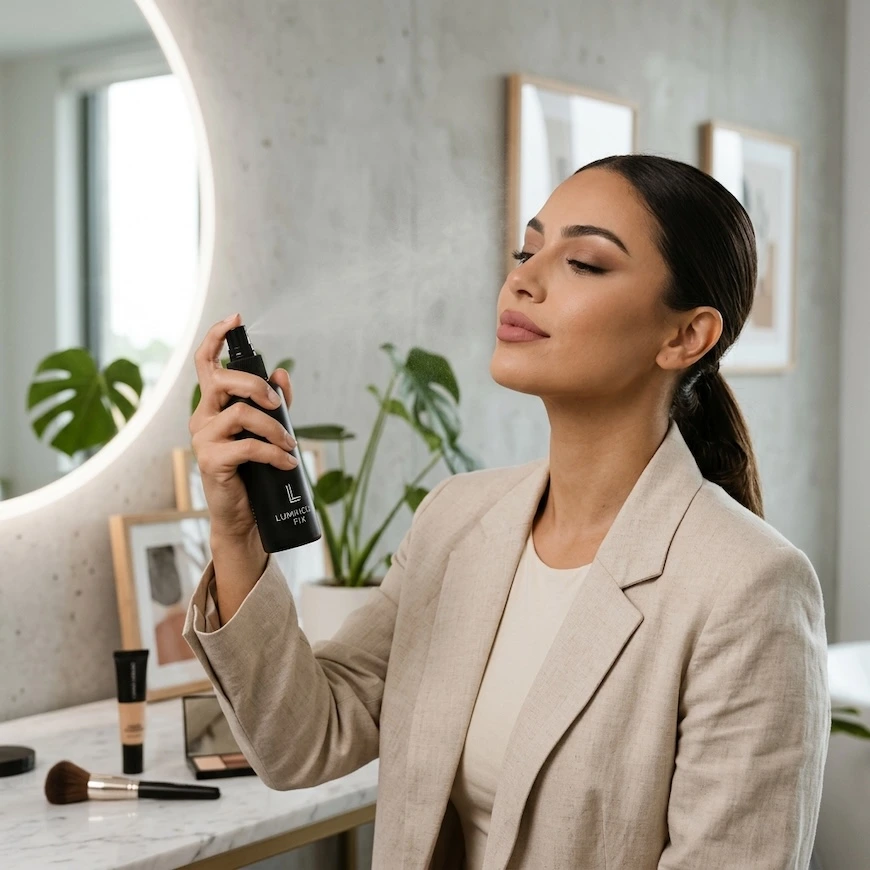
A fine mist over everything melts the powder layer into the rest of your makeup, removing that powdery look and buying a few more hours of hold.
Hold it about 10 inches away, mist in an X and then a T, and don’t touch your face until it’s dry.
I’ve covered formulas and which are worth the money in everything you need to know about setting spray.
Through the day: what keeps it there
Blot, don’t add powder. This is the single biggest touch-up mistake, and it’s the missing half of how to make your foundation last all day. Adding powder on top of oil creates a paste, and that paste is what “cakey by 4pm” actually is. A blotting paper lifts the oil and leaves the foundation underneath intact.
Hands off your face. Every touch removes product and transfers oil. The AAD lists face-touching among the habits that worsen acne, so it costs you twice over.
If you must re-powder, blot first, then the lightest dusting you can manage, T-zone only.
Blotting papers, a compact powder, a small brush. That’s the kit.
Troubleshooting five specific failures
It pills into little balls. Base mismatch between primer and foundation, or foundation applied over skincare that hadn’t absorbed. Check both ingredient lists and extend your wait times.
It goes patchy on dry areas. Dehydration. More hydration underneath, and switch to a dewier formula, because matte foundation clings to flakes.
It disappears from my nose by noon. Sebum. Mattifying primer on the T-zone, pre-set with powder, and blot rather than re-powder.
It creases around my eyes and smile lines. Too much product, or too much powder. Thinner layers, and press the powder rather than sweeping it.
It oxidises and goes orange. The formula is reacting with your skin’s oils and the air, so this one isn’t an application problem. Some foundations just do it. Match your shade in daylight, then check it an hour later before committing.
Frequently asked questions about How to Make Foundation Last All Day
Why does my foundation separate or pill?
Usually incompatible bases: silicone-based primer under water-based foundation, or the reverse. It also happens when you apply foundation before your skincare has absorbed. Check the first five ingredients on both products.
How do I stop my foundation sliding off oily skin?
Mattifying primer on the T-zone, a light pre-set of powder before foundation, a long-wear matte formula, and blotting papers rather than extra powder through the day.
Is setting spray or setting powder better?
They do different jobs. Powder absorbs oil and stops slipping. Setting spray melts the layers together and adds hold. For all-day wear on oily skin, use both, powder first and spray last.
Does foundation expire?
Yes. Liquid foundation typically lasts around 12 months once opened. Old foundation separates, changes texture and won't wear well however you apply it. If it smells different or has split, replace it.
The bottom line
Read the first five ingredients on your primer and on your foundation. If one says dimethicone and the other says aqua, that’s your problem, and no setting spray is going to rescue it.
Everything else about how to make your foundation last all day follows from there: wait a minute after primer, pre-set your T-zone, buff instead of swiping, powder only where you get oily, and blot rather than re-powder.
Related: everything you need to know about setting spray for the final step, and if a full base feels like too much on a weekday, my 5-minute makeup routine skips foundation altogether.

Hi, I’m Marwa ✅
I test skincare, haircare, and makeup on real skin and a real budget, and writes the honest reviews to prove it.