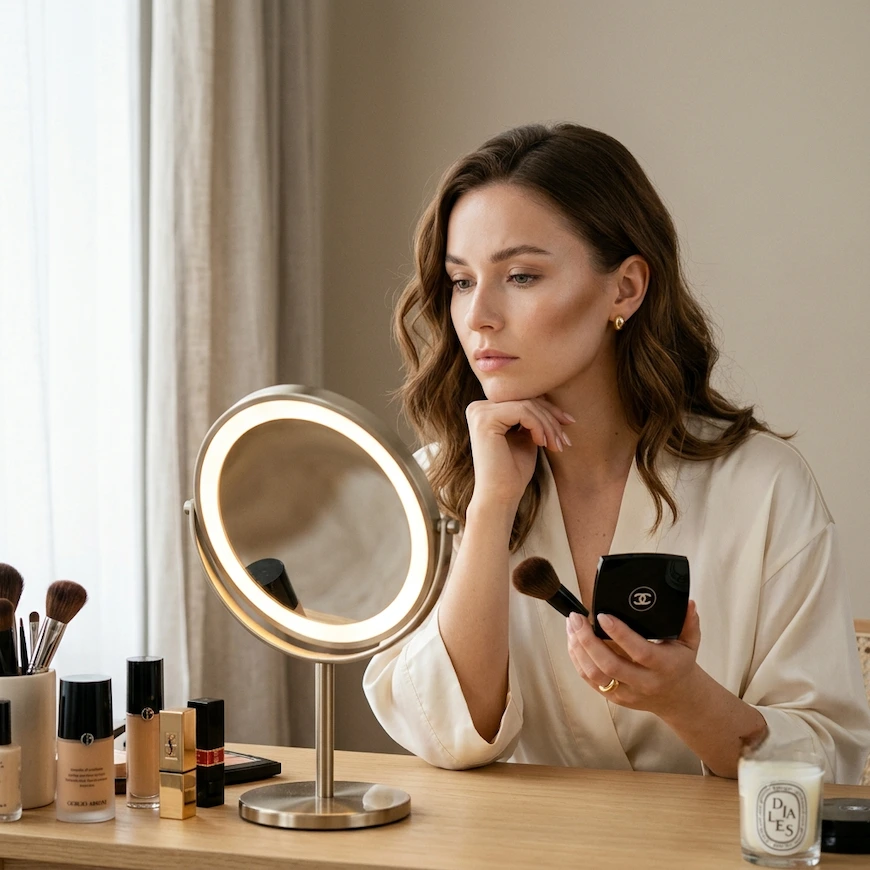
Quick Answer: Bronzer adds warmth where the sun would hit. Contour creates shadow to define structure. That’s the bronzer vs contour distinction in one line, and it’s a real one, but you can absolutely contour with a bronzer as long as it’s matte. What makes a bronzer contour look muddy is shimmer, not warmth. Pick a matte shade one to two levels deeper than your skin, in an undertone that reads as shadow on you: cool-leaning for fair skin, warm brown for deep skin.
For years I contoured with a taupe powder that was technically correct. Cool-toned, matte, exactly what every tutorial said to buy. It also made me look faintly unwell, like I’d been shadowed in by someone who had never seen my face in daylight.
What worked was a matte bronzer two shades deeper than my skin, blended higher than I’d been taught. Which every tutorial told me was wrong.
The rule I’d absorbed, contour cool, bronze warm, never mix them, is a simplification of something more useful. Here’s the version of bronzer vs contour that holds up in practice, including why the standard advice fails on deeper skin tones.
Bronzer vs contour: what each one does
| Bronzer | Contour | |
|---|---|---|
| Purpose | Adds warmth and colour | Creates the illusion of shadow |
| Undertone | Warm: golden, red, orange | Neutral to cool, varying by skin depth |
| Finish | Matte, satin or shimmer | Matte only |
| Placement | Where sun hits: forehead, cheeks, nose bridge, jaw | Where shadows fall: cheek hollows, temples, jawline, nose sides |
| Effect | Face looks sun-warmed and alive | Face looks sculpted and defined |
| Depth | 1 to 2 shades deeper | 1 to 2 shades deeper, cooler in tone |
The simplest way to hold the difference in your head: bronzer goes where light lands, contour goes where light doesn’t.
They aren’t competitors. Plenty of complete looks use both, with contour carving the structure and bronzer over the high points stopping the face from looking grey and flat.
So can you contour with bronzer? Yes, with one rule
This is where the standard advice oversimplifies.
The rule is matte, not shimmer.
A shimmering bronzer in the hollow of your cheek doesn’t read as shadow, because real shadows don’t sparkle. The light-reflective particles fight the exact illusion you’re building, and the result looks muddy and obviously applied. That’s the “dirty” effect people describe, and the finish causes it, not the warmth.
A matte bronzer, one to two shades deeper than your skin, makes a convincing contour. Plenty of professional makeup artists prefer it, because dedicated contour powders often skew too grey and leave an ashy cast, particularly on medium and deep skin.
A bronzer won’t work as contour if it has any shimmer, shine or glitter in it, if it reads strongly orange or red on you, if it’s too sheer to build real depth, or if you want a very sharp sculpt. Dedicated contour products are usually more pigmented for that last one.
It works fine for everyday soft definition, which is what most people are after anyway.
Choosing your shade by skin depth
Here’s the part the old version of this article got wrong.
Fair to light skin
Cool-toned works well. Look for taupe, greyish-beige or a soft cool brown, one to two shades deeper than your skin.
Avoid anything orange. It reads as a stripe rather than a shadow.
Medium and olive skin
Neutral is your friend here. Too cool goes grey, too warm goes orange, and a neutral medium brown in a matte finish sits in the middle.
If you’re olive specifically, avoid pink or red-based contours, which fight the green in your skin.
Deep skin
Warm, rich browns. This is the opposite of the classic advice and it’s correct.
Cool and grey-based contours read ashy and chalky on deep skin. Look for rich browns with red, plum or espresso depth. Shades described as espresso, mocha or walnut tend to work.
The underlying principle doesn’t change. You want something that reads as shadow on your skin. It’s just that on deep complexions a warm brown does that job and a grey doesn’t. This is where the standard bronzer vs contour advice breaks down hardest, because it was written for one narrow range of skin tones and then repeated as universal.
The universal test, whatever your depth: swatch on your jawline in daylight. If it looks like a shadow, it’s right. If it looks like a stripe of colour, it’s wrong.
Expect to pay around $8 to $35 for a decent matte contour palette or bronzer.
Cream or powder?
| Cream or stick | Powder | |
|---|---|---|
| Finish | Skin-like, natural | Defined, more control |
| Best skin | Dry, mature, normal | Oily, combination |
| Difficulty | Easier to overdo, harder to correct | More forgiving, buildable |
| Longevity | Longer on dry skin | Longer on oily skin |
| Order | Before powder products | After cream products |
The order rule matters more than people expect: cream under powder, always. Powder first with cream on top gives you patchy, streaky drag, because the cream lifts and disturbs the powder underneath.
If you’re using both, the sequence is cream contour, set with powder, then powder bronzer on top. A cream contour stick runs about $8 to $30.
Where to actually put it
This is the part nobody explains properly, and it matters more than the bronzer vs contour shade debate everyone gets stuck on.
Contour placement
- Cheek hollows. Feel for the bone and apply underneath it. Start at the ear and stop before you reach the corner of your mouth, because going too far forward drags the face down.
- Temples. A small sweep at the outer edge of the forehead.
- Jawline. Along the underside, blending down onto the neck.
- Sides of the nose. Two thin lines, blended thoroughly, if you want it at all.
Blend upward and back toward your hairline. That creates a lifted effect. Blending downward pulls the face down.
Bronzer placement
Think about where you’d tan first: forehead, tops of the cheeks, bridge of the nose, chin, jaw. A loose “3” shape down each side of the face is the classic path.
Bronzer sits higher than contour. If they’re landing in the same place, you’re just doubling the depth.
Blending is the whole game
The right shade badly blended looks far worse than the wrong shade blended well.
Use a fluffy brush for powder and a dense brush or damp sponge for cream. Blend in small circles rather than back-and-forth swipes. Blend more than you think you need to, until there’s no visible edge anywhere. And build gradually, because you cannot un-apply.
A dense brush for cream and a fluffy one for powder are the two that matter. My roundup of the best affordable makeup brushes under $30 covers both under $20.
Adjusting for your face shape
Contouring isn’t one placement for everyone.
Round faces benefit from contour on the sides and temples to add length, kept vertical. Square faces want the corners of the jaw and outer forehead softened. Long or oblong faces want contour at the top of the forehead and under the chin to visually shorten, going lighter on the cheeks. Heart shapes focus on the temples and the point of the chin. Oval shapes usually need nothing more than a light touch under the cheekbones.
All of this is optional. Nobody is required to alter the shape of their face, and “correcting” a face shape is a choice rather than a rule.
Five mistakes that make contour obvious
Shimmer in the hollows. Real shadows don’t sparkle. Matte only in the shadow zones.
Too low on the cheek. Contouring below the hollow, close to the mouth, drags the whole face downward. Feel for the bone.
Wrong depth for your skin. Too grey looks ashy, too orange looks like a stripe. Test on the jawline in daylight.
Visible edges. Any hard line means it needs more blending. There should be no point where you can see it start.
Contour and bronzer in the same spot. This is the bronzer vs contour mistake that undoes all the others, because the two serve different purposes in different zones. Layering them in one place just makes a dark patch.
One practical note: contour and bronzer both sit on top of your base, so if your foundation is sliding by lunchtime the sculpting goes with it. How to make your foundation last all day covers keeping the canvas in place.
Keeping it clean
Brushes used with cream products build up bacteria fast. The AAD advises washing makeup applicators regularly and choosing non-comedogenic products if you’re acne-prone. Dirty brushes also drag product instead of blending it, so this is a technique problem as much as a hygiene one.
Wash cream brushes weekly and powder brushes every two weeks. And take it all off properly at night, not with a makeup wipe.
Frequently asked questions about Bronzer vs Contour
Can you use bronzer as contour?
Yes, if it's matte. A matte bronzer one to two shades deeper than your skin works well as contour. What makes a bronzer contour look muddy is shimmer, not warmth, because shimmer contradicts the shadow you're trying to create.
What contour shade should I use for deep skin?
Rich warm browns with red, plum or espresso depth. Cool and grey-based contours read ashy and chalky on deep skin, which is why the common "always go cool-toned" advice doesn't apply universally.
Should contour be warmer or cooler than my skin?
It should read as a shadow on your skin. For fair skin that's usually cool-toned or taupe. For medium and olive skin, neutral. For deep skin, warm brown. Swatch on your jawline in daylight and ask whether it looks like shadow or like a stripe.
Why does my contour look muddy?
Usually shimmer in the product, a shade that's too warm or too grey for your skin, or not enough blending. Matte formula, jawline-tested shade, and blend until there's no visible edge.
Cream or powder contour, which is better?
Cream gives a more skin-like finish and suits dry or mature skin. Powder gives more control and lasts better on oily skin. Cream goes on before powder products, never after.
Where should I apply contour on my cheeks?
In the hollow underneath the cheekbone. Feel for the bone with your fingers, start near your ear, and stop before you reach the corner of your mouth. Blend upward toward your hairline.
The bottom line
The old bronzer vs contour rule, never contour with a bronzer, was aiming at something true and missing it. The problem was never warmth. It’s shimmer, and it’s using a shade that doesn’t read as shadow on your particular skin.
Matte formula. One to two shades deeper. Cool-leaning if you’re fair, neutral if you’re medium, warm brown if you’re deep. Blend upward until there’s no edge.
Do that and a $10 matte bronzer will contour better than a $40 palette in the wrong undertone.
Hi, I’m Marwa ✅
I test skincare, haircare, and makeup on real skin and a real budget, and writes the honest reviews to prove it.