A good scalp care routine for hair growth will make your hair healthier, less itchy and less prone to breakage. That’s worth doing, and this article shows you how. But if you’re here because your hair is thinning, a scalp routine on its own probably won’t fix it. The honest version of that, and what actually will, is further down.
Quick Answer: A healthy scalp care routine for hair growth is simple: wash often enough for your scalp type, exfoliate weekly if you use styling products, and stop pulling your hair tight. For actual regrowth, the evidence is narrower than the internet suggests. Minoxidil is the only over-the-counter treatment the FDA has approved, and the AAD calls it the most-recommended treatment for female pattern hair loss. Rosemary oil is the one natural option with a real head-to-head trial behind it, matching 2% minoxidil over six months in a 100-patient study. Scalp massage has far weaker evidence than its reputation suggests: one study, nine men, measuring thickness rather than count.
What a scalp routine can and can’t do
Every scalp care routine for hair growth starts from one fact: your scalp is skin. It gets oily, dry, flaky and irritated for the same reasons the skin on your face does, and it responds to the same kind of care: gentle cleansing, sensible frequency, not stripping it.
What a scalp care routine for hair growth reliably delivers is less flaking, itching and irritation, less buildup making hair look limp, and less breakage, so the hair you already have looks fuller and grows longer before it snaps.
What it doesn’t do is reverse pattern hair loss. That’s driven by hormones and genetics happening below the surface, and no shampoo reaches it. The AAD is blunt about this: hair loss shampoos may help hair hold moisture or reduce breakage, but they cannot regrow hair or stop hair loss from worsening.
That distinction matters, because the two problems look similar in the mirror and need completely different responses. Hair that’s breaking leaves broken pieces and split ends, and it responds to gentler handling. Hair that’s thinning means a widening part, a thinner ponytail, more scalp showing. That needs treatment, not conditioner.
Work out your scalp type
| Type | How it behaves | What it needs |
|---|---|---|
| Oily | Greasy within a day of washing; roots flat by evening | More frequent washing, clarifying weekly, light conditioner on ends only |
| Dry | Tight after washing, small dry flakes, occasional itch | Less frequent washing, gentler surfactants, conditioner at the roots too |
| Combination | Oily at the crown, dry at the hairline and nape | Wash for the oiliest part, treat the dry areas separately |
| Flaky and oily together | Larger yellowish flakes, redness, itch that worsens in cold weather | Likely dandruff or seborrhoeic dermatitis |
One correction worth making, because it’s everywhere: dandruff is not a dry scalp. It’s associated with an oily scalp, and the two need opposite things. If your flakes are large, yellowish and slightly greasy, and your scalp is itchy and sometimes red, that’s dandruff, and washing less to stop drying it out makes it worse.
Dandruff also isn’t an infection. Malassezia, the yeast involved, lives on nearly everyone’s scalp perfectly harmlessly. Dandruff is an inflammatory response to it in people who happen to be susceptible, which is why it’s manageable rather than curable, and why antifungal shampoos control it rather than eliminating it.
The routine
Washing
Frequency is the single most important variable in any scalp care routine for hair growth, and it’s the one most people get wrong in both directions.
- Oily scalp: every day or every other day. Daily washing does not strip a scalp already producing excess oil, and under-washing an oily scalp causes buildup, itch and worse flaking.
- Dry scalp: two to three times a week.
- Coily or tightly curled hair: typically once a week, sometimes less. The frequency that suits straight hair will dry out coily hair badly.
On sulfate-free shampoo, the live version of this article recommended it blanketly, and that’s oversimplified. Sulfates are efficient cleansers and there’s nothing inherently damaging about them for most scalps. If your scalp is dry, irritated, or your hair is colour-treated, gentler surfactants are worth it. If your scalp is oily and prone to buildup, a sulfate shampoo may suit you better and you’ll need it less often. Read what’s in your shampoo and buy for your scalp, not for a marketing claim.
Massage, worth doing but oversold
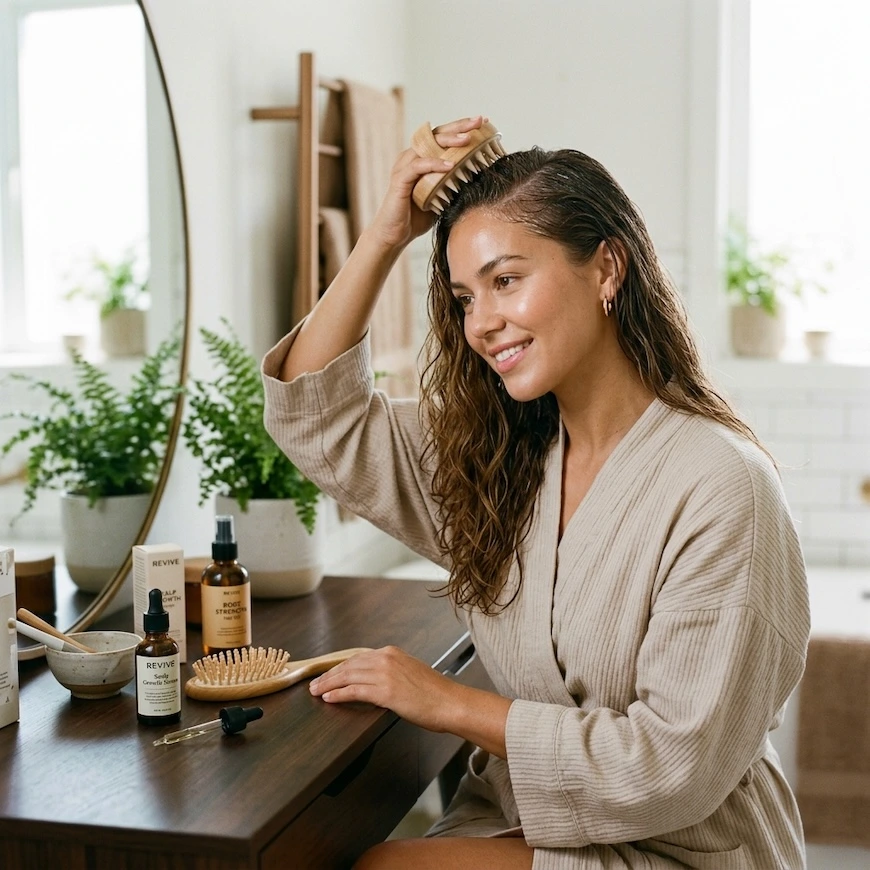
Two minutes with your fingertips while you shampoo is a pleasant, free addition to a scalp care routine for hair growth, and it won’t hurt anything. Do it.
But be clear-eyed about the evidence, because the internet has turned this into a growth treatment.
The study everyone cites is Koyama et al., 2016. Nine men, four minutes of standardised massage daily for 24 weeks, with average hair thickness going from 0.085 mm to 0.092 mm. Roughly an 8% increase in thickness, not hair count, not coverage.
Here’s the part almost nobody quotes. That increase was measured against each man’s own baseline. Compared against the untreated control area on the same scalp, hair thickness showed no significant difference at any point in the 24 weeks, and hair growth rate didn’t change anywhere. Two of the authors were also affiliated with the company that made the massage device.
The mechanism usually given for massage is improved circulation delivering nutrients to the follicle. That isn’t what the researchers proposed either. Their finding was that mechanical stretching forces on dermal papilla cells changed gene expression, which is a physical stimulus rather than a delivery problem.
So: nine people, one study, one measure, no advantage over the control area. Massage your scalp because it feels good and might help slightly. Don’t build a scalp care routine for hair growth around it.
Exfoliation
Exfoliation earns its place in a scalp care routine for hair growth once a week if you use styling products, dry shampoo, or heavy oils. Every other week otherwise.
A physical scrub or a salicylic acid treatment both work, and neither belongs in a scalp care routine for hair growth more than weekly. What matters more is not doing it on an already-irritated scalp. If yours is sore, flaking heavily or inflamed, exfoliating makes it worse, and that’s a very common self-inflicted problem.
Pre-wash oil treatment
Genuinely useful for dry scalps and the part of a scalp care routine for hair growth that most reduces breakage. Apply to the lengths, 15 to 30 minutes before washing, then shampoo out.
Coconut oil has the most support for reducing protein loss from hair, though note that’s about the hair shaft rather than the scalp. If you’re prone to dandruff, heavy oils at the roots can make it worse by feeding the yeast involved. Oil the lengths, go light at the roots. Argan and jojoba oils are lighter alternatives if coconut feels heavy on your hair.
Rosemary: the one natural option with real evidence
Almost every natural ingredient promoted for a scalp care routine for hair growth has no controlled trial behind it. Rosemary is the exception, and it deserves better than the DIY-recipe treatment it usually gets.
Panahi et al., published in Skinmed in 2015, randomised 100 patients with androgenetic alopecia to either rosemary oil or 2% minoxidil for six months, with standardised microphotographic assessment at baseline, three months and six months.
The results:
- Neither group improved significantly at three months
- Both groups showed significant increases in hair count at six months
- No significant difference between the two groups at either timepoint
- Scalp itching was significantly more common in the minoxidil group
That last point is genuinely useful, since scalp irritation is the most common reason people abandon minoxidil.
Now the caveats, because they matter. It’s one trial, in a journal that isn’t top-tier dermatology. The participants were all men aged 18 to 49, so it tells you less about female pattern hair loss than the way it usually gets quoted implies. The comparison was 2% minoxidil, not the 5% most people now use. And “no significant difference” between two groups is not the same as proof they’re equivalent.
How to use it: rosemary essential oil diluted in a carrier oil, jojoba and coconut both work, massaged into the scalp and left at least 30 minutes before washing. Never apply undiluted essential oil to your scalp. And give it six months, since the trial found nothing at three.
Minoxidil: the part the internet skips
If your hair is genuinely thinning, widening part, thinner ponytail, more scalp visible, this is the section that matters, and no scalp care routine for hair growth substitutes for it.
Per the AAD, female pattern hair loss is the most common cause of hair loss in women, it’s progressive, and treatment delivers the best results when started at the first sign of it.
On minoxidil specifically, the AAD’s position is that the FDA has approved this non-prescription treatment for women, and that it’s now the most-recommended treatment for FPHL. Both 2% and 5% are approved.
Four things people are almost never told, all from the same source:
1. It sheds before it grows. For the first two to eight weeks you may notice a temporary increase in hair loss, which stops once regrowth begins. This is the single biggest reason people quit minoxidil. They start it, shed more, panic, and stop at exactly the wrong moment.
2. It takes six to twelve months to judge. You need to use it continuously for that long before you know how well it works for you.
3. Stopping undoes it. Stop applying it and you lose the benefit, gradually shedding more again. It’s ongoing maintenance, not a course.
4. Scalp irritation is common, including dryness, scaling, itching and redness. The AAD’s advice if that happens is to stop and see a dermatologist rather than push through. Unwanted hair growth on the cheeks and forehead is also possible, which you can limit by applying carefully and washing your face afterwards.
One thing the original version of this article left out entirely: minoxidil is not for use in pregnancy or breastfeeding.The AAD advises women who are pregnant or planning to become pregnant to avoid it, since animal studies show it can harm a developing fetus, and traces may pass into breast milk.
See a dermatologist before starting, because several other conditions look like pattern hair loss and need entirely different treatment. Losing hair in distinct patches, for instance, may be alopecia areata, which is treated differently.
Traction alopecia, the preventable one
This is hair loss caused by pulling, and no scalp care routine for hair growth will outrun it. It’s genuinely reversible caught early, and permanent if it isn’t.
The AAD is direct about who’s most affected: people whose culture or profession makes tight hairstyles common, and especially girls and women of African descent, because the shape of the hair follicle makes hair more vulnerable to damage from rough or tight styling. Ballet dancers, military personnel, and anyone required to wear their hair pulled back for work are also at higher risk, as is anyone who pulls hair tightly back before covering it.
Early warning signs to check monthly:
- Broken hairs around your forehead
- A receding hairline, especially at the temples
- Small bumps on the scalp
- Pain from a tight hairstyle. This one is the clearest signal there is. A style that hurts is doing damage.
The AAD recommends loosening braids especially around the hairline, wearing weaves for short periods, and rotating styles so hair recovers between tight ones. On coverings, their guidance is specific: a head scarf or covering made of silk or satin is gentler on hair than other materials.
Seeing these signs? Change the style now. Traction alopecia caught early recovers. Left long enough, the follicles scar and it doesn’t.
The DIY remedies, honestly assessed
| Remedy | Verdict | Notes |
|---|---|---|
| Rosemary oil | Best evidence of any natural option | Dilute in a carrier oil. Six months minimum |
| Coconut oil | Good for breakage, not growth | Best on lengths. Can worsen dandruff at the roots |
| Tea tree oil | Mild antifungal. Patch test first | A common contact allergen; worse when oxidised |
| Apple cider vinegar | Harmless diluted; oversold | Won’t treat dandruff. Never undiluted |
| Ginger rinse | No evidence | Skip it |
On tea tree oil, this needs a warning the original article didn’t carry. It’s among the most frequently reported essential-oil contact allergens, and its sensitising potential rises substantially as it oxidises with age and air exposure. Patch test on your inner forearm for three days before it goes anywhere near your scalp, keep the bottle sealed and out of light, and replace it once it’s a year old.
On apple cider vinegar, the usual claim is that it balances scalp pH. Your scalp sits around pH 4.5 to 5.5. Undiluted ACV is around pH 2 to 3, considerably more acidic than what you’re trying to match. Diluted one part to two parts water and used weekly it’s harmless and can add shine by smoothing the cuticle. It is not an antifungal treatment, and if you have dandruff you want a shampoo with an actual antifungal active.
Diet and lifestyle, what holds up
Some of what matters happens outside your scalp care routine for hair growth entirely. Iron and vitamin D deficiencyare genuinely associated with hair shedding, and both are common, particularly in menstruating women. If you’re shedding noticeably, ask your doctor for a blood test including ferritin. That’s more likely to find a fixable cause than any change to your shampoo.
Biotin. Worth being straight about. Supplements only help if you’re deficient, and true deficiency is rare. Taking biotin when your levels are normal does nothing for your hair, and it can interfere with laboratory blood tests including thyroid and cardiac panels, producing misleading results. Tell your doctor before any blood work. The AAD’s own summary of hair supplements generally is that most studies found no effect on growth or thickness.
Protein and overall nutrition matter. Significant weight loss, restrictive dieting and illness commonly cause a delayed shed, typically two to three months later.
Stress. Chronic stress can trigger telogen effluvium, a diffuse shed that usually resolves on its own once the trigger passes.
Water. The eight-glasses claim was in the original version of this article and shouldn’t have been. No evidence links extra water intake to scalp condition or hair growth. Drink enough to feel well.
Heat and styling. Not diet, but it belongs here, because heat styling does more measurable damage than most of the things people worry about. Ordinary everyday hair care habits protect more hair than any supplement will.
Common mistakes
These are the errors that undo an otherwise sound scalp care routine for hair growth.
- Washing an oily scalp less to let it balance. It doesn’t balance. It builds up.
- Treating dandruff as dryness and adding oils. Feeds the yeast, worsens flaking.
- Exfoliating an irritated scalp.
- Quitting minoxidil during the initial shed, at exactly the point it’s starting to work.
- Expecting three months to tell you anything. Hair grows roughly a centimetre a month, so six months is the minimum honest assessment window.
- Ignoring a hairstyle that hurts.
- Buying a new product every six weeks and never knowing what worked.
When to see a dermatologist
Sooner rather than later, and definitely if:
- Your part is widening or your ponytail is noticeably thinner
- You’re losing hair in distinct patches
- Your scalp is bleeding, oozing or painful
- You have thick silvery scales extending past the hairline, likely scalp psoriasis
- Hair loss came with irregular periods, unusual hair growth elsewhere, or fatigue
- You’re seeing broken hairs or a receding hairline from a tight style
The AAD’s line on female pattern hair loss is worth ending on: treatment can prevent it worsening and help women regrow hair, and it works best started at the first sign. Waiting to see whether it improves on its own is the most expensive thing you can do here. In the meantime, styling for fuller-looking hair is a reasonable stopgap, and if you colour, managing brassiness in blonde hair keeps what you have looking its best.
Frequently asked questions
Does rosemary oil work for hair growth?
It has better evidence than any other natural option. A 2015 randomised trial put rosemary oil against 2% minoxidil in 100 patients over six months and found significant hair count increases in both groups with no significant difference between them, plus less scalp itching on rosemary. It's a single trial, in men only, against the lower minoxidil strength, so treat it as promising rather than proven. Dilute in a carrier oil and give it six months.
How often should I wash my scalp?
It depends on your scalp, not on a rule, and it's the biggest variable in any scalp care routine for hair growth. Oily scalps generally do better washed daily or every other day, dry scalps at two to three times weekly, and coily or tightly curled hair often needs only weekly washing. If your scalp is flaking and itchy and you've been washing less to avoid drying it out, try washing more. Dandruff is associated with an oily scalp, not a dry one.
Can a scalp care routine for hair growth stop hair loss?
It can stop hair breakage, which makes a genuine visible difference. It cannot stop pattern hair loss, which is driven by hormones and genetics below the skin. If your part is widening or your ponytail is thinner, you need treatment, and minoxidil is the FDA-approved over-the-counter option and the AAD's most-recommended one for women.
Why is my hair falling out more since I started minoxidil?
That's expected and temporary. The AAD notes a possible increase in shedding for the first two to eight weeks, stopping as regrowth begins. It's the most common reason people abandon minoxidil, usually just before it starts working. Give it six to twelve months before judging.
Can I use minoxidil while pregnant?
No. The AAD advises women who are pregnant, planning to become pregnant, or breastfeeding to avoid minoxidil, because animal studies show it can harm a developing fetus and traces may pass into breast milk. If hair loss started after pregnancy, that's often postpartum shedding, which usually resolves on its own. Speak to your doctor rather than starting a treatment.
Is tea tree oil safe for the scalp?
In proper dilution, usually, but it's one of the most frequently reported essential-oil contact allergens, and oxidised tea tree oil is significantly more sensitising than fresh. Patch test on your inner forearm for three days first, never apply it undiluted, and replace the bottle after about a year.
Does apple cider vinegar treat dandruff?
No. Diluted and used weekly it's harmless and can add shine, but it isn't antifungal and won't control dandruff. If you have dandruff, use a shampoo with an actual antidandruff active and leave it on for the time stated on the bottle.
Should I take biotin for hair growth?
Only if you're deficient, and deficiency is rare. There's no benefit to supplementing at normal levels. Biotin supplements can also interfere with lab tests including thyroid and cardiac panels, so tell your doctor if you're taking it before any blood work.

Hi, I’m Marwa ✅
I test skincare, haircare, and makeup on real skin and a real budget, and writes the honest reviews to prove it.