Niacinamide is in almost everything now: serums, moisturisers, toners, sunscreens. It’s also the ingredient people most often get wrong, in two specific ways. They buy a percentage far higher than the evidence supports, and they avoid combining it with vitamin C because of a myth.
Here’s what the research actually shows, and how to use niacinamide in a way that matches it.
Quick Answer: Niacinamide is vitamin B3. It strengthens the skin barrier, reduces oil, and fades dark marks, not by blocking melanin production but by stopping pigment being transferred into your surface skin cells. 5% is the sweet spot. The clinical studies behind its reputation used 2 to 5%, not 10% or 20%, and higher percentages mostly buy irritation. As for how to use niacinamide day to day: apply it to clean skin before your moisturiser, morning or night. You can use it with vitamin C. The idea that they cancel each other out is a myth from decades-old work on unstable formulations.
What niacinamide is
Niacinamide, also called nicotinamide, is a form of vitamin B3. It’s water-soluble, stable across a wide pH range, and unusually well tolerated, which is why it turns up in so many formulas without much fuss and why how to use niacinamide is a shorter conversation than it is for most actives.
Unlike most actives, it doesn’t work through one dramatic mechanism. It does several modest things at once, and the combination is what makes it useful rather than any single effect being spectacular. That shapes how to use niacinamide sensibly, and it’s worth setting expectations early: it’s a supporting ingredient that makes a routine better across the board, not a fix for one specific problem.
What it does, and the mechanism everyone gets wrong
It blocks pigment transfer, not pigment production
This is the correction worth knowing, because nearly every article on how to use niacinamide states the mechanism backwards.
The landmark study is Hakozaki et al., published in the British Journal of Dermatology in 2002. The researchers tested niacinamide against melanin production directly and found it had no effect on the catalytic activity of mushroom tyrosinase, and none on melanogenesis in cultured melanocytes.
In other words, it does not reduce melanin production. At all.
What it did instead was inhibit melanosome transfer by 35 to 68% in the coculture model. Your melanocytes package pigment into melanosomes and hand them to the keratinocytes making up your visible skin surface. Niacinamide interrupts the hand-off. The pigment still gets made; less of it reaches the surface where you’d see it. The authors’ own conclusion is that niacinamide lightens skin by inhibiting that transfer from melanocytes to keratinocytes.
Two practical consequences follow, and they’re why the mechanism matters.
- The effect is gradual and reversible. You’re intercepting a continuous process, not switching it off. Stop and pigment transfer resumes.
- It pairs well with actives that work differently. Vitamin C, azelaic acid and retinoids all address pigmentation by other routes. Because niacinamide isn’t competing for the same pathway, stacking makes sense. That’s the opposite of actives that don’t combine well.
In the clinical arm of the same study, 18 people used a 5% niacinamide moisturiser against a vehicle control and showed significantly reduced hyperpigmentation after four weeks. A separate group of 120 used 2% niacinamide with sunscreen for facial tanning.
Note the numbers. Five percent, and two percent. Not twenty. One caveat worth knowing: the study came out of Procter & Gamble’s research arm, which doesn’t invalidate it but is the kind of thing to hold in mind when a single paper underpins a whole category.
It reduces oil
This one is real and reasonably supported. In a 2021 split-face trial, one side of the face received 2.5% benzoyl peroxide plus 5% niacinamide and the other benzoyl peroxide alone. After 12 weeks, the niacinamide side showed a significant drop in sebum from baseline.
Be precise about what that does and doesn’t show, though. Sebum fell 26% on the niacinamide side against 20% on the control side, and that difference between sides wasn’t statistically significant. The trial also ran on only 21 patients. So: good evidence niacinamide reduces oil, weaker evidence it beats benzoyl peroxide alone at doing so.
If you have an oily T-zone and want something that changes how your skin behaves by mid-afternoon, this is still niacinamide’s most immediately noticeable benefit.
It strengthens the barrier
Niacinamide supports ceramide production, and ceramides are a core part of the barrier holding water in and keeping irritants out. That’s why it turns up alongside retinoids so often, since it makes them more tolerable, and why it suits skin that’s been over-exfoliated.
It helps acne, but less than you’ve been told
Here’s where honesty is worth more than enthusiasm.
Niacinamide is widely marketed as an acne treatment. Cochrane’s 2020 systematic review, the highest tier of evidence review there is, looked at 49 trials across six topical ingredients and found that no study measured the primary outcome, patients’ own global assessment of improvement, when evaluating nicotinamide. What evidence existed was rated low quality.
That doesn’t make it useless for acne-prone skin. The split-face trial above found that adding 5% niacinamide to benzoyl peroxide produced a greater reduction in non-inflammatory lesions, meaning blackheads and whiteheads, than benzoyl peroxide alone.
The fair summary: niacinamide is a good supporting ingredient for acne-prone skin. It reduces oil, calms redness, and helps with the marks acne leaves behind. It is not a substitute for benzoyl peroxide, adapalene or a prescription, and if you’re treating actual acne it should sit alongside a real acne treatment rather than replace one.
The percentage question
Most niacinamide serums sold today are 10%. Some are 20%. The market drifted upward because a bigger number sells better, and it’s now the main thing people get wrong about how to use niacinamide.
The evidence hasn’t moved with it.
| Concentration | Evidence | Best for |
|---|---|---|
| 2% | Used in published pigmentation work | Sensitive skin, first time, daily moisturisers |
| 4 to 5% | Where most of the clinical evidence sits | Almost everyone. This is the target |
| 10% | Very common; no clear advantage shown over 5% | Fine if your skin is comfortable with it |
| 20% | No good evidence of extra benefit | Not recommended. Irritation, flushing, tightness |
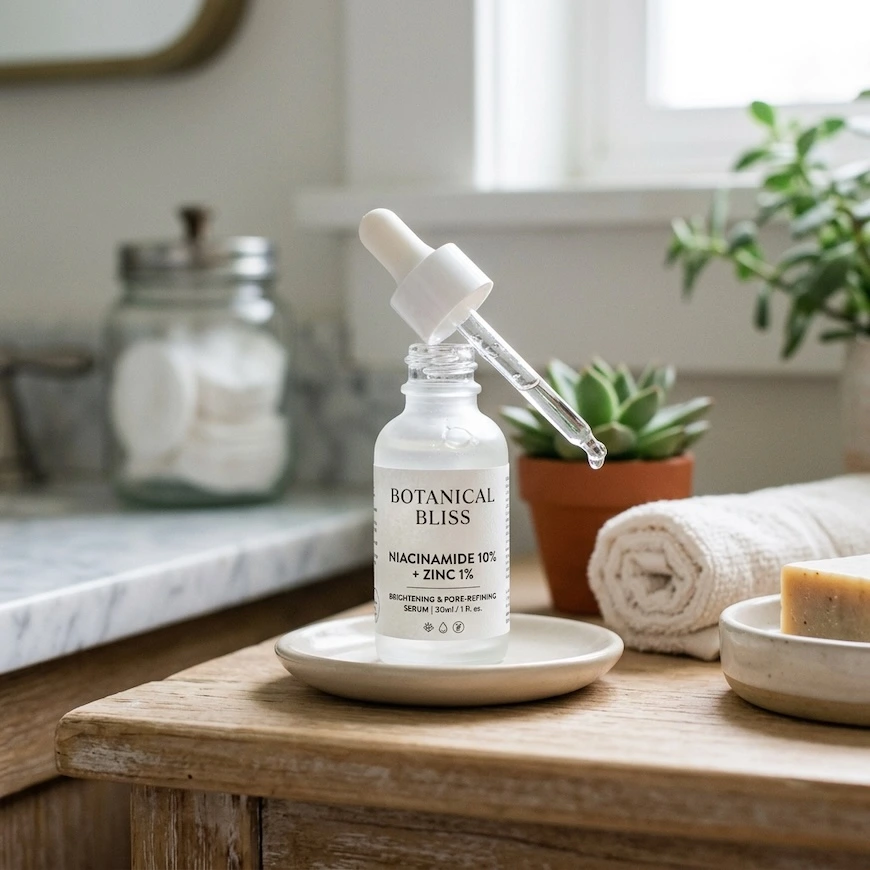
So the short answer on how to use niacinamide well is to start at 5% and stay there unless you have a reason not to. If a 10% product suits your skin, there’s no need to change. But going higher chasing faster results is the most common mistake in this category, and the usual outcome is a stinging, flushed face and the conclusion that niacinamide doesn’t agree with you.
If a product stings, the percentage is the first thing to look at. What else is in it comes second.
The vitamin C myth
You’ll be told constantly that niacinamide and vitamin C cancel each other out, or combine into something that turns your face red.
They don’t, and you can use them together.
The idea traces back to old laboratory work in which niacinamide and ascorbic acid were combined under heat in unstable conditions, producing a compound that caused flushing. That isn’t what happens in a modern, stabilised, room-temperature formulation sitting on your face. Products containing both are widely sold and work fine.
So, on how to use niacinamide alongside vitamin C rather than avoiding the pairing:
- Vitamin C in the morning. It’s photoprotective and complements sunscreen. This is the correction to make if you’ve been told otherwise, because vitamin C is a morning ingredient, not a night one.
- Niacinamide morning or night, or both. It’s stable and tolerant enough to sit anywhere.
- If you’re genuinely sensitive, use vitamin C in the morning and niacinamide at night. Not because they conflict, but because that’s simply less on your face at once, which is sensible for reactive skin generally.
Where niacinamide goes in your routine
The rule is thin to thick, water-based before oil-based.
- Cleanse
- Toner, if you use one
- Niacinamide serum, onto clean, dry skin
- Other treatments: retinol at night, vitamin C in the morning
- Moisturiser
- Sunscreen, mornings
Before moisturiser, not after. If you remember one thing about how to use niacinamide, make it this. A serum applied over moisturiser has to get through it first. If your niacinamide is in your moisturiser, that’s fine, because it’s formulated for that position.
With retinol: niacinamide first, then retinol. One of the better pairings there is, because the barrier support directly offsets what retinol does to your barrier in the first six weeks. If you’re working out how to use niacinamide inside a full routine, this is the pairing to get right first.
With exfoliating acids: here how to use niacinamide gets simpler than it sounds. Wait a few minutes between them, or use them at different times of day. Not because they react badly, but because layering multiple actives back to back is the fastest way to irritate yourself.
How long it takes
| Timeframe | What to expect |
|---|---|
| Week 1 | Nothing visible. Skin may feel slightly less tight |
| Weeks 2 to 4 | Oil control becomes noticeable. Less midday shine |
| Week 4 | Where the pigmentation study measured significant improvement |
| Weeks 8 to 12 | Dark marks visibly lighter; tone more even |
| Ongoing | Effects are maintained, not permanent. Stop and they fade |
Nothing about how to use niacinamide involves pushing through a purge, because niacinamide doesn’t purge. If you break out after starting it, that isn’t adjustment. It’s either a reaction to something in the formula or a coincidence. Stop and reassess.
Who should be careful
Niacinamide is one of the best-tolerated actives available, but knowing how to use niacinamide includes knowing when not to.
- If you flush easily or have rosacea, start at 2 to 4%. Some people find higher concentrations trigger flushing.
- If you’re sensitive, patch test. Inner forearm, twice daily for three or four days.
- If you’ve had a reaction before, check the percentage of what you used. It was very likely 10% or 20%.
One thing not to worry about: niacinamide is not niacin. Oral niacin causes the well-known flushing reaction. Niacinamide doesn’t, and neither does the topical form. Different compounds despite the similar names.
None of this is complicated, and it lines up with ordinary dermatologist basics rather than anything specialist.
Frequently asked questions
Can you use niacinamide and vitamin C together?
Yes, and this is the biggest myth about how to use niacinamide. The belief that they cancel each other out comes from old laboratory work using unstable forms under heat, not from how modern formulations behave on skin. Plenty of products now contain both. If you'd rather separate them, vitamin C in the morning and niacinamide at night works fine, but do it for simplicity rather than because of a chemical conflict.
What percentage should I use?
Around 5%. The published clinical work sits at 2 to 5%: the pigmentation trials used 5% and 2%, the benzoyl peroxide acne trial used 5%. Ten percent is very common and fine if your skin is comfortable, but there's no good evidence it outperforms 5%, and 20% mostly buys irritation.
Does niacinamide go before or after moisturiser?
Before, and this is the part of how to use niacinamide people most often reverse. A serum should go onto clean, dry skin so it isn't working through a layer of moisturiser. If your niacinamide is built into a moisturiser, that's a different product and it goes in the moisturiser step as normal.
How do you use niacinamide with retinol?
Niacinamide first, then retinol, and it's one of the better pairings there is. Niacinamide supports the skin barrier, which directly offsets the dryness and irritation retinol causes in the first several weeks. This is the single most useful thing to know about how to use niacinamide alongside another active.
Does niacinamide help with acne?
Modestly. Cochrane's 2020 review found no trial measured the primary outcome for nicotinamide, and rated the available evidence low quality. A 2021 split-face trial did find that adding 5% niacinamide to benzoyl peroxide improved blackheads and whiteheads more than benzoyl peroxide alone. Treat it as useful support alongside a real acne treatment, not a replacement.
Will niacinamide make me flush?
Almost certainly not, and worrying about it shouldn't change how to use niacinamide. You're thinking of niacin, a different form of vitamin B3, which causes flushing taken orally. Niacinamide doesn't do this. Some people do get transient redness from high-percentage topicals, which is an irritation response to the concentration, and dropping to 5% usually resolves it.
Does niacinamide shrink pores?
It can make them look less noticeable, mainly by reducing the oil that distends them. It doesn't change their actual size, since pore size is largely genetic. Expect a modest improvement in appearance over a couple of months, not a transformation.
How long does niacinamide take to work?
Longer than most people expect, whatever they've read about how to use niacinamide for fast results. Oil control shows up within two to four weeks. For pigmentation, the clinical study measured significant improvement at four weeks with continued gains after that, so give it eight to twelve weeks before judging. The effects are maintained rather than permanent, and they fade if you stop.

Hi, I’m Marwa ✅
I test skincare, haircare, and makeup on real skin and a real budget, and writes the honest reviews to prove it.