This post contains affiliate links. If you buy through them, we may earn a commission at no extra cost to you.
Quick Answer: Use vitamin C serum in the morning, on clean skin, before moisturiser and sunscreen. It’s an antioxidant, so it works alongside SPF to neutralise free radicals from daylight, and research found vitamin C with vitamin E and ferulic acid roughly doubled skin’s photoprotection. Night use isn’t wrong, just less useful. And if your serum has turned orange, it has oxidised: it’s lost potency and can temporarily stain skin.
When to Use Vitamin C Serum? Vitamin C is one of the best-researched ingredients in skincare, and one of the most temperamental. It works well when it’s formulated properly and used at the right time, and does very little when it isn’t.
So let’s answer the timing question first, then cover the part nobody mentions until your bottle turns orange.
When to Use Vitamin C Serum: Morning or Night? The actual answer
Morning. Here’s the reasoning, which matters because it also tells you what to pair it with. If you’re wondering when to use vitamin C serum, morning is generally the most logical choice.
Vitamin C is an antioxidant. Its job is neutralising free radicals, the reactive molecules generated by UV exposure and pollution that damage collagen and drive pigmentation. Those are produced while you’re exposed to daylight, so an antioxidant is most useful sitting on your skin before the exposure happens, not after.
It also works alongside your sunscreen rather than instead of it. Research published in the Journal of Investigative Dermatology in 2005 found that a topical solution of 15% L-ascorbic acid and 1% vitamin E, stabilised with 0.5% ferulic acid, doubled photoprotection against solar-simulated exposure, from roughly 4-fold to around 8-fold, measured by both redness and sunburn cell formation. A later trial from the same group extended the finding to human skin.
That’s the case for morning use in one sentence. Sunscreen blocks UV, vitamin C mops up what gets through. Which sunscreen matters more than which serum, so which sunscreen to pair it with is the more important decision of the two.
Is night use wrong? No, just less efficient. You’re deploying an antioxidant while you sleep in the dark. If your evening routine is the only one you reliably do, evening vitamin C beats no vitamin C. So, when considering when to use vitamin C serum, consistency matters more than following a perfect routine.
One useful finding for anyone inconsistent: the Pinnell study found tissue levels saturate after three daily applications, with a half-life of disappearance from skin of about four days. That work was done on pig skin rather than human volunteers, so treat the numbers as a guide rather than a promise. Still, the implication holds: once you’ve built up, missing a day doesn’t reset anything. Consistency over weeks matters far more than never skipping.
Where it goes in your routine
Morning:
- Cleanser
- Vitamin C serum, on clean dry skin
- Moisturiser
- Sunscreen
The principle is thinnest to thickest, actives before occlusives. A serum can’t get through a layer of moisturiser. If you’re wondering how and when to use vitamin C serum, this is the basic rule to follow. If your routine has more steps than this, the full layering order covers where everything else fits, and the Korean routine, simplified is a sane version of the longer approach if that’s the direction you’re going.
Apply to dry skin, not damp. This is the exception to the usual damp-skin advice, because L-ascorbic acid needs a low pH to penetrate and water on your face dilutes the formula and raises the surface pH.
Wait a minute or two before your moisturiser. Long enough to absorb, not the ten minutes some routines insist on.
How much: three to five drops for the whole face. More isn’t better, since the skin saturates.
Why your vitamin C serum turned orange
If your serum has gone from clear or pale yellow to orange, amber or brown, it has oxidised.L-ascorbic acid is unstable. Exposed to air, light and heat it converts to dehydroascorbic acid and then breaks down further. The colour change is the reaction happening.
| Colour | What it means | Action |
|---|---|---|
| Clear to pale yellow | Fresh | Use it |
| Deeper yellow or light amber | Oxidation starting | Still usable, potency dropping, use it up |
| Orange or brown | Substantially oxidised | Replace it |
| Dark brown, thick, off smell | Well past it | Bin it |
Two things worth knowing. An oxidised serum can temporarily stain your skin, which is why “vitamin C serum turned my hands orange” is such a common complaint. It washes off. It isn’t self-tan and it isn’t harmful. And oxidised vitamin C isn’t dangerous, it’s just weak. You’re not damaging anything, you’re applying something that’s stopped working.How to slow it down:
- Buy opaque or dark glass packaging, ideally airless or a pump. Dropper bottles let air in on every single use.
- Store it somewhere cool and dark. Not a sunny windowsill, not a steamy bathroom shelf. Refrigerating it genuinely helps.
- Close it properly, immediately.
- Buy smaller bottles. A 30ml you finish in two months beats a 60ml you’re still using in month six.
- Look for ferulic acid and vitamin E on the label. They’re there to stabilise it, which is why they turn up in the well-regarded formulas.
Expect roughly three to six months from opening for a well-packaged L-ascorbic acid serum. Derivative forms are more stable and last longer.
What actually matters when choosing one
Ignore most of the marketing. Four things determine whether a vitamin C serum works. Before any of them, find your skin type, because the sensitive-skin answer and the oily-skin answer diverge immediately.
1. The form of vitamin C.
L-ascorbic acid is the pure, best-researched form and the one nearly all the evidence uses. It’s also the least stable and the most irritating.
Derivatives (sodium ascorbyl phosphate, magnesium ascorbyl phosphate, ascorbyl glucoside, THD ascorbate) are more stable, gentler and work at higher pH. The trade-off is that they have to convert to ascorbic acid in the skin, and the Pinnell work found several derivatives didn’t raise skin levels of L-ascorbic acid at all in that model.
Practical translation: L-ascorbic acid if your skin tolerates it and you’ll manage the storage. A derivative if you’re sensitive or you’ve tried L-AA and reacted, accepting less certainty about how much is actually getting in.
2. pH, which nobody mentions.
For L-ascorbic acid, the same research found the formula has to sit below pH 3.5 to enter the skin. Above that it largely stays on the surface.
This is why a “10% vitamin C serum” at pH 6.5 behaves completely differently from a 10% L-ascorbic acid serum at pH 3. Same number on the label, different product. Brands rarely publish pH, but a low-pH L-AA serum usually says so, and a formula marketed as gentle and non-irritating is probably a derivative at higher pH.
3. Concentration, and where more stops helping.
The same study found maximal absorption at 20%. Above that you don’t get more in, you just get more irritation.
- 8 to 10% is a sensible starting point, especially for sensitive skin
- 15% is the concentration used in most of the research, and the sweet spot for most people
- 20% is the ceiling. Effective, more likely to sting
- 25% or 30% is marketing. No additional benefit, more irritation
4. Packaging.
Opaque or dark glass, airless pump if possible. A clear bottle with a dropper is the worst combination for an unstable ingredient, however good the formula inside it.
Five vitamin C serums worth buying
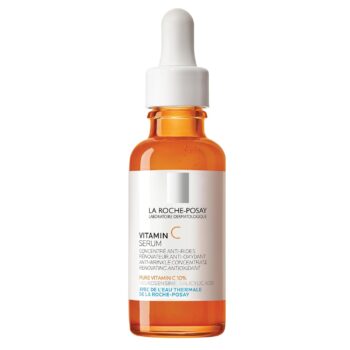
1. Best for sensitive skin: La Roche-Posay Pure Vitamin C 10% pure vitamin C with salicylic acid and neurosensine. Well tolerated, from a brand with a strong record on reactive skin. Skip it if you want maximum potency, since 10% is a starting concentration.

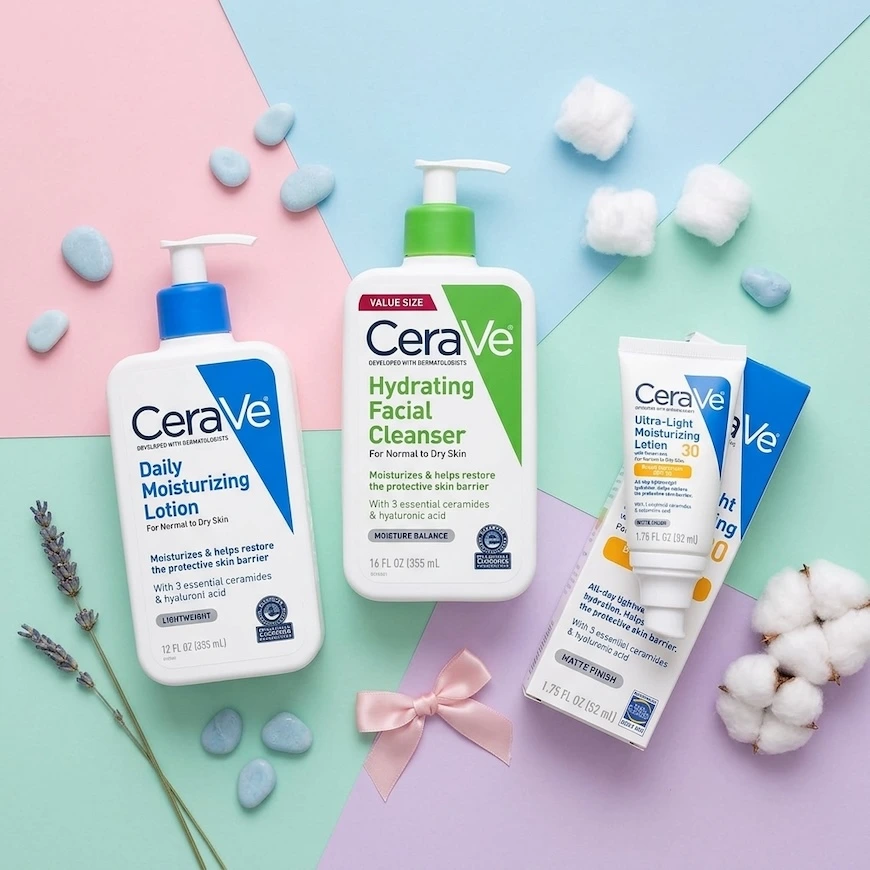
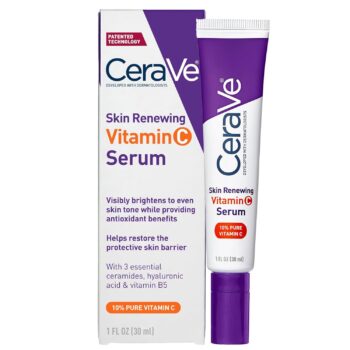
2. Best value: CeraVe Skin Renewing Vitamin C 10% L-ascorbic acid with ceramides and hyaluronic acid. The ceramides earn their place here, supporting the barrier while an acidic active works on it. It also slots neatly into a full drugstore routine without anything clashing. Skip it if you’re looking for research-level 15%.
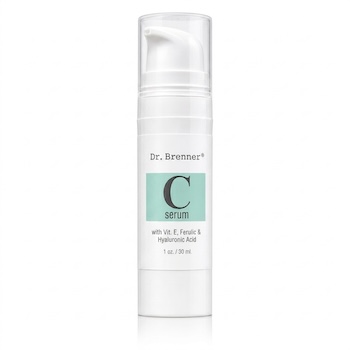
3. Best researched concentration: a 20% L-ascorbic acid serum with vitamin E and ferulic acid This is the combination the photoprotection research used. If you want the formula the evidence is actually built on, that’s the specification to look for. Skip it if your skin is sensitive, because 20% L-AA at low pH stings on reactive skin.
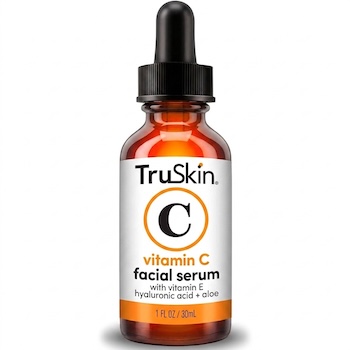
4. Most affordable: TruSkin Vitamin C Serum 20% vitamin C with hyaluronic acid and vitamin E, at a fraction of the price of the prestige options. Enormously popular. Worth being straight about: it uses sodium ascorbyl phosphate, a derivative, not L-ascorbic acid. Gentler and more stable, but as above, derivatives have less certain delivery. Good value, not equivalent to a 20% L-AA serum despite the matching number.
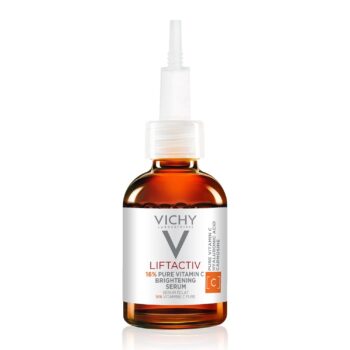
5. Best mid-range: Vichy LiftActiv Vitamin C 15% pure vitamin C with hyaluronic acid, in packaging designed to limit oxidation. Skip it if you want the cheapest option that works.
Frequently asked questions
Why did my vitamin C serum turn orange?
It has oxidised. L-ascorbic acid breaks down on exposure to air, light and heat, and the colour change is that reaction. An orange serum has lost potency and can temporarily stain skin, though it isn't harmful. Replace it, and store the next one cool, dark and in opaque packaging.
Can you use vitamin C serum with niacinamide?
Yes. The idea that they cancel each other out comes from 1960s research using unstable raw ingredients at high heat, not modern formulations. Millions of people use both without issue. There's more in our guide to mixing skincare ingredients, and how to use niacinamide covers the practical side of running them together.
Does vitamin C serum go before or after moisturizer?
Before. Serums are lighter and formulated to penetrate, moisturiser seals everything in. Applying a serum over cream means most of it stays on the surface. Cleanser, vitamin C, moisturiser, then sunscreen.
What percentage of vitamin C should I use?
Between 10% and 20%. Research found maximal skin absorption at 20%, and above that you get more irritation without more benefit. Start at 10% if your skin is sensitive. 15% is the concentration used in most of the research and suits most people.
How long does vitamin C serum take to work?
Antioxidant protection begins immediately but is invisible. Brightness takes four to six weeks. Pigmentation takes far longer, and the AAD notes that treating melasma usually takes three to twelve months even with a full prescription plan. Skin levels saturate after about three days of use with a half-life of roughly four days, so consistency over weeks beats never missing a day.
Can you use vitamin C serum every day?
Yes, and daily use is the point. If your skin is sensitive, start every other day for two weeks and build up. If you're getting stinging, redness or peeling, either the concentration is too high or you're layering it with another acid. Reduce one of those.
Does vitamin C serum expire?
Yes, and faster than most skincare. Expect roughly three to six months from opening for a well-packaged L-ascorbic acid serum, less if it's in a clear bottle or stored somewhere warm. Colour is your indicator: clear to pale yellow is fine, orange or brown means replace it. The same logic applies across your shelf, which is covered in when to throw products out.
Can I use vitamin C with retinol?
Yes, but ideally not in the same routine. Both can irritate, and using them together raises the chance of a reaction without a proportional benefit. The standard approach is vitamin C in the morning and retinol at night, which suits both ingredients anyway. How to use retinol safely covers the introduction schedule.
Is vitamin C serum safe during pregnancy?
Topical vitamin C is generally considered one of the safer actives in pregnancy, unlike retinoids. That said, pregnancy skincare is a question for your doctor or midwife rather than a website, particularly if you're using several products at once.
Reviewed August 2026. General information, not medical advice. See a board-certified dermatologist about persistent pigmentation or a reaction to a product.

Hi, I’m Marwa ✅
I test skincare, haircare, and makeup on real skin and a real budget, and writes the honest reviews to prove it.