If you’ve ever looked at a face mapping chart and wondered whether your forehead breakout really means something is wrong with your liver, this is the honest answer.
Some of what face mapping tells you is genuinely useful. Some of it has no basis at all. And the parts that are useful work for completely different reasons than the chart claims, which matters, because the real reason usually points to a fix.
Quick Answer:Acne location is driven mainly by where your oil glands are densest, which is why the T-zone breaks out most, plus whatever physically touches your skin there. Acne is a disease of the pilosebaceous unit, so it turns up where those units are concentrated. The organ links in traditional face mapping charts (nose = heart, brows = liver) have no dermatological basis. But three parts of the map are accidentally right: forehead acne often is hair products, cheek acne often is your phone or pillowcase, and jawline acne often is hormonal. Read on for which is which.
Where face mapping comes from
Face mapping has roots in Ayurveda and Traditional Chinese Medicine, where the face is read as a diagnostic surface, each zone standing in for an internal organ or system. It’s genuinely ancient, and within those systems it’s internally coherent.
What it isn’t is a dermatological finding. No study has shown that the position of a spot tells you anything about your liver, your lungs or your heart. The organ associations were never derived from looking at acne. They were inherited from a much older framework and applied to it afterwards.
That doesn’t make the whole face mapping chart useless. It means you have to separate the observations from the explanations, because the people who built face mapping were watching real faces and they noticed real patterns. They just credited the wrong causes.
What actually decides where you break out
Four things drive an acne lesion, and none of them is an organ that face mapping would recognise.
- Excess oil. Androgens, which both men and women produce, increase the size of oil glands and how much sebum they make. That’s why acne is so common in adolescence.
- Dead skin cells shedding into the pore rather than off the surface.
- C. acnes, a bacterium living in the follicle, multiplying in that environment.
- Inflammation, which is what turns a clogged pore into a red, sore spot.
Now add the piece that explains the whole map. Acne is a chronic inflammatory disease of the pilosebaceous units, characterised by increased sebum production, and those units are not evenly distributed across your face. They’re densest across the forehead, nose and chin, and sparser on the outer cheeks and temples.
That’s the whole geography. You break out most where you have the most oil glands, and secondarily wherever something is pressing, rubbing or depositing oil onto your skin.
Once you know that, most of the face mapping chart explains itself.
The face mapping chart, zone by zone
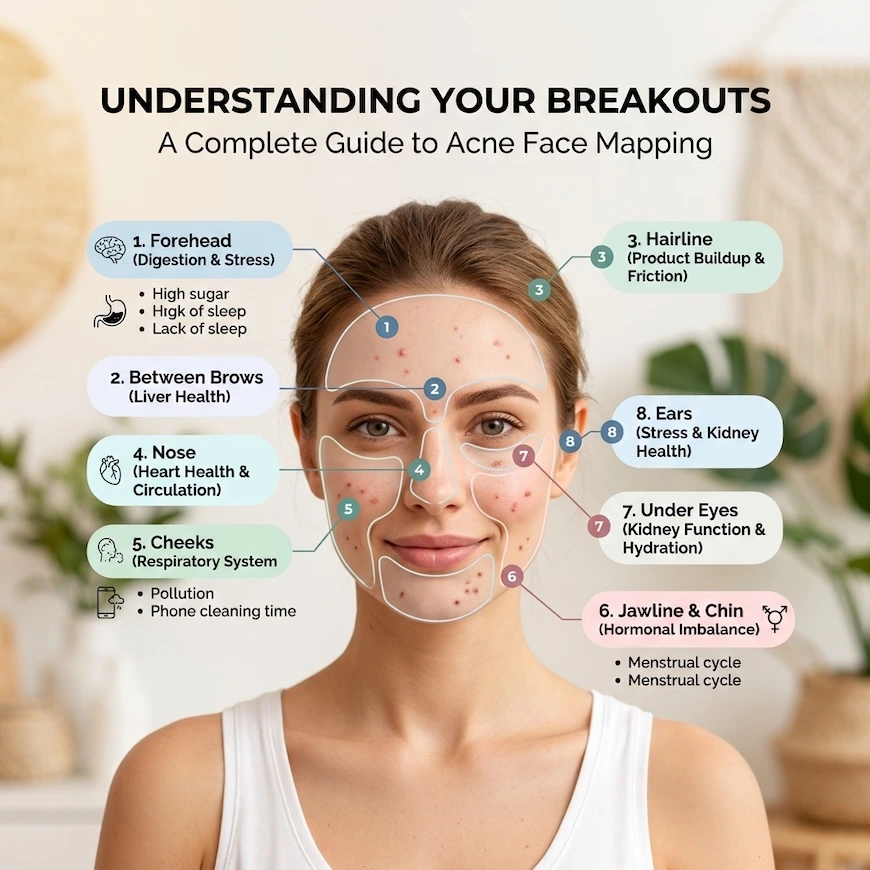
| Zone | What face mapping says | What’s actually going on |
|---|---|---|
| Forehead | Digestion, liver. No | Hair products. Plus high oil gland density |
| Between the brows | Liver, alcohol, detox. No | T-zone oil. Glasses resting there |
| Nose | Heart, blood pressure. No | Highest oil gland density on the face. Often not acne at all |
| Cheeks | Lungs, respiration. No | Phone, pillowcase, hands, masks. Right pattern, wrong reason |
| Chin and jawline | Hormones. Partly | Closest to true, but location alone doesn’t prove it |
Forehead: face mapping is wrong here, but the fix is real
Face mapping says digestion and liver. There’s no evidence for that.
What there is evidence for is far more useful. The AAD has a name for it: acne cosmetica, meaning acne caused by what you put on your skin or hair. When hair products contain oil, that oil migrates onto the skin and clogs pores, and the result is typically whiteheads and small flesh-coloured papules along the hairline, the forehead, or the back of the neck.
Look at where that lands. Hairline and forehead, precisely the zone face mapping assigns to your liver.
So traditional face mapping spotted a genuine pattern. It just credited an organ instead of your conditioner.
What to do about it: stop the suspect products and give it time. The AAD puts the clearing period at four to six weeks after you stop. Pomades and waxes are the obvious offenders, but dry shampoo and styling products can all contain oils too, along with conditioners and gels. Wash everything your head touches as well: pillowcases, hats, headbands, phone.
Four to six weeks is the part people get wrong. They swap products, see nothing in a fortnight, and swap again.
Between the brows: no, this isn’t your liver
Face mapping assigns this strip to liver function, alcohol, and detoxification.
Your liver detoxifies your body continuously and does not route the results through your forehead. There’s no mechanism by which it would.
What’s actually here: the middle of your T-zone, so it’s oil-gland-dense. And if you wear glasses or push sunglasses up onto your head, the bridge and pads sit exactly there, pressing and transferring oil. That’s friction acne, and it responds to cleaning your glasses rather than to a detox tea.
Nose: the weakest claim on the chart, and the most common mix-up
Nose acne is supposedly linked to your heart and blood pressure. There’s no basis for this at all.
The nose has the highest density of sebaceous glands anywhere on your face. That’s the entire explanation for why it’s the oiliest part of you and the most prone to congestion. Anatomy, not cardiology.
There’s also a good chance what you’re looking at isn’t acne. The small grey-brown dots people scrub at are usually sebaceous filaments, normal structures lining every pore that refill within days no matter what you do to them. Treating them as blackheads and going at them with scrubs and strips is how a lot of people end up with irritated skin and more visible pores.
Cheeks: accidentally right, for the wrong reason
Face mapping says lungs and respiration. Skip that part.
The advice attached to it is sound, though, and for a real dermatological reason: acne mechanica, caused by pressure, friction and repeated contact. Your phone against your cheek. Your pillowcase for eight hours. A hand propping up your face while you work. A mask strap.
Cheeks have fewer oil glands than the T-zone, which is exactly why a contact cause stands out there. When something repeatedly touches a lower-oil area and that area breaks out, the contact is usually why.
Worth actually doing: wipe your phone screen daily, change your pillowcase twice a week, and notice whether you rest your face on your hand. Then check whether one cheek is worse than the other. If it is, that’s an almost certain sign of a contact cause, and it’s the single most useful diagnostic in this entire article, because a systemic cause doesn’t pick a side.
Chin and jawline: the one that holds up best
This is where face mapping comes closest to being right, and it’s worth being precise about how close.
Hormonal acne is real. Androgens drive oil production, and adult acne in women has long been described as concentrating on the lower third of the face. A large share of women with adult acne are developing it for the first time as adults, and for many of them it’s hormonally driven.
But a 2017 review in the Journal of Clinical and Aesthetic Dermatology is careful here. Its authors describe the long-held assumption that adult female acne appears on the lower third of the face as a dogma that recent evidence has challenged, and one international study of 374 women found that roughly 90% had a facial distribution much like a teenager’s.
So the association is real and the pattern is common, but location alone doesn’t diagnose it. Three things are more reliable than where the spot sits.
- Timing. Flaring in a predictable window before your period is the strongest signal there is.
- Lesion type. Deep, tender, slow bumps under the skin that never come to a head, rather than surface whiteheads.
- Other signs. New or worsening acne alongside irregular periods, unusual hair growth or hair thinning is worth a doctor’s appointment. PCOS is common and underdiagnosed.
If that’s your pattern, over-the-counter products will only take you so far. Hormonal treatments exist and work, with combined oral contraceptives and spironolactone both used for exactly this, and they need a prescription. That’s a conversation with a doctor, not a shopping decision.
What about diet?
Face mapping handles diet badly, sending greasy food to the forehead, alcohol between the brows and fatty food to the nose. The underlying instinct that diet matters isn’t wrong, though, and the real evidence is more interesting than the chart.
Glycemic load has the strongest support. A 2022 systematic review in JAAD International screened 410 articles, included 34 that met its criteria, and concluded that high glycemic index, glycemic load and carbohydrate intake have a “modest yet significant proacnegenic effect.” The AAD summarises supporting trials from the US, Australia, Korea and Turkey, including one in which 2,258 patients moved to a low-glycemic diet and 87% reported less acne.
Note the word modest. This is a real effect, not a cure.
Dairy is murkier. The AAD cites a study of 47,355 women in which those drinking two or more glasses of skim milk a day were 44% more likely to have acne. The JAAD International review is more cautious, describing the dairy literature as mixed and possibly dependent on sex, ethnicity and cultural eating habits.
The honest caveat comes from the AAD itself, which notes that other studies have found no connection between a high-glycemic diet and acne, and that more research is needed.
What isn’t supported: detoxing. Your liver and kidneys do that continuously, and no food, tea or drink assists them. Drinking eight glasses of water a day does not flush toxins out through your skin, and there’s no good evidence that more water clears acne. Stay hydrated because it’s good for you, not because your face is a filter.
One more correction while we’re here. On stress, the AAD’s position is that stress can’t cause acne but can make existing acne worse. It isn’t the origin. It’s an amplifier.
What to actually do instead
Forget the face mapping zones. Work out which of these three you’re dealing with, because that’s the useful diagnosis.
1. Is something touching it? One-sided acne, a sharp edge along the hairline, or breakouts that map to where a strap or frame sits are contact-driven. Remove the contact and wait six weeks.
2. Is it cyclical? Track it for two or three months. If flares land predictably before your period, it’s hormonal, and hormonal acne needs hormonal treatment.
3. Is it neither? Then it’s ordinary acne in your oiliest zones, and it responds to an ordinary, consistent routine. Boring, but it works. Start by taking two minutes to work out your skin type, since that decides your cleanser and moisturiser more than anything else does.
A routine that actually works
Morning
- Cleanse with something gentle and non-stripping
- Treat, with a niacinamide serum here if you want one, since it helps with oil and post-acne marks
- Moisturise with something non-comedogenic
- Sunscreen, every day. This is the step that prevents the marks acne leaves behind, and skipping it is why those marks last months
Evening
- Cleanse, with a second cleanse only if you wore makeup or heavy sunscreen
- Treat, and adapalene 0.1% is where I’d start. A genuine retinoid, over the counter in the US, and inexpensive
- Moisturise
Adapalene goes at night, not in the morning. It’s photosensitising and degrades in light, so a morning application is both less effective and more likely to leave you sun-sensitive. Start twice a week, expect six weeks of dryness, buffer with moisturiser, and don’t increase frequency until that settles. If you’re unsure what order to apply things, that’s worth sorting out before adding anything else.
Chemical exfoliant, two to three times a week at most, on nights you’re not using adapalene. Not both, not nightly. Over-exfoliating is the most common self-inflicted acne problem there is.
Pick one active and give it twelve weeks. Almost every acne routine that fails, fails because someone stacked four new products at once, got irritated, and couldn’t tell which one caused it.
When to see a dermatologist
Go sooner than you think, and definitely if:
- You get deep, painful lumps that last weeks and never come to a head. These scar, and scarring is far easier to prevent than to treat
- Acne is leaving marks or pitting
- Three months of consistent over-the-counter treatment hasn’t helped
- Your acne is cyclical and you want hormonal treatment
- Acne appeared alongside irregular periods, unusual hair growth or hair thinning
- It’s affecting how you feel about going out
The AAD’s position is worth knowing: virtually every case of acne can be treated successfully. Very few people need to put up with it.
Frequently asked questions
Does forehead acne mean digestive problems?
No. The most common cause of forehead and hairline breakouts is hair products. The AAD calls it acne cosmetica and names the hairline and forehead as typical locations. Pomades, waxes, dry shampoo, conditioner and gels can all do it. Stop the suspect product and allow four to six weeks.
Does jawline acne always mean hormones?
It's the strongest association in face mapping, but location alone isn't proof. A 2017 review describes the lower-third-of-the-face pattern as a long-held assumption that newer evidence has challenged. Timing matters more. If flares arrive predictably before your period, that's a far better indicator, and deep tender lumps that never surface point the same way.
Can drinking more water clear my acne?
There's no good evidence that it does. The idea that water flushes toxins out through your skin isn't how the body works. Your liver and kidneys handle that, and they aren't waiting on your water bottle. Drink enough to feel well; don't expect it to treat acne.
Does chocolate cause acne?
Face mapping sends chocolate to the forehead, which is meaningless. Chocolate itself is less clear than the sugar and dairy it usually arrives with. The stronger evidence is for high glycemic load overall, which the 2022 systematic review found has a modest but real effect. A square of dark chocolate isn't the issue. A daily habit of high-sugar food might contribute, modestly.
Why do I break out on one cheek only?
That's the clearest sign of a contact cause, and it's where face mapping is least useful, because systemic explanations don't pick a side. Look at which side you sleep on, which side you hold your phone to, and which hand you rest your face on. Change the pillowcase twice weekly and wipe the phone daily.
What are the small dots on my nose that never go away?
Most likely sebaceous filaments rather than blackheads. They're normal structures lining every pore, they refill within days, and they can't be permanently removed. Squeezing and pore strips leave the surrounding skin more irritated and make the pores look larger over time.
Does stress cause acne?
Not on its own, and no face mapping zone tracks it. The AAD's position is that stress can't cause acne but can worsen acne you already have. Managing stress is worth doing and may reduce how badly you flare, but it won't treat acne that's already established.

Hi, I’m Marwa ✅
I test skincare, haircare, and makeup on real skin and a real budget, and writes the honest reviews to prove it.