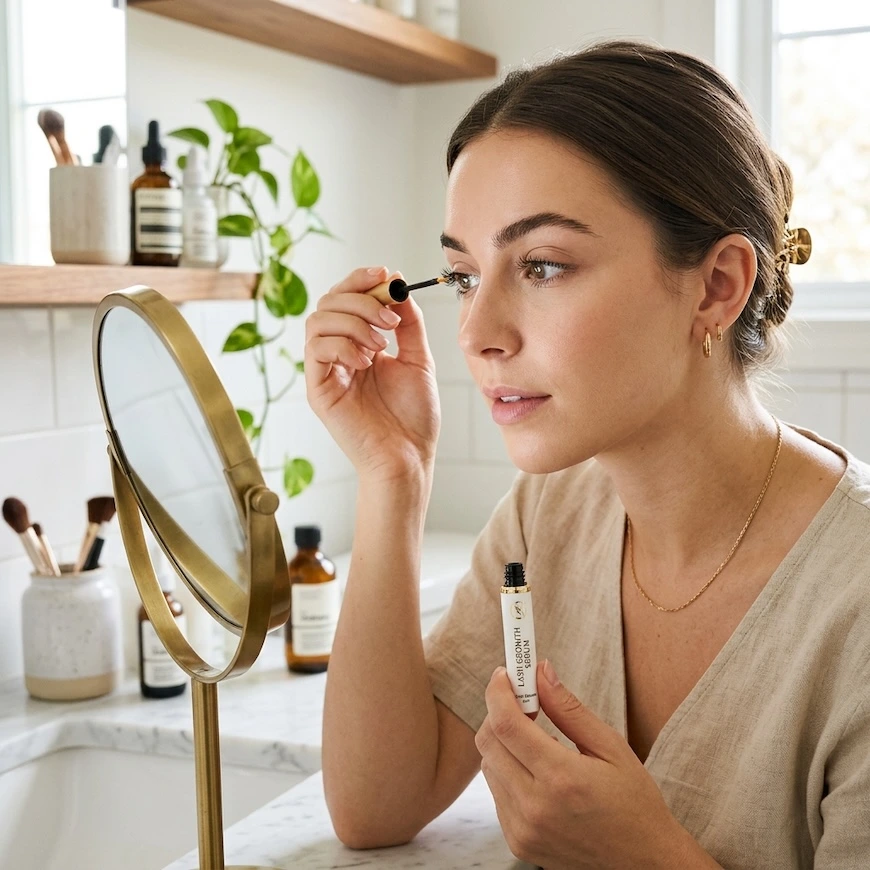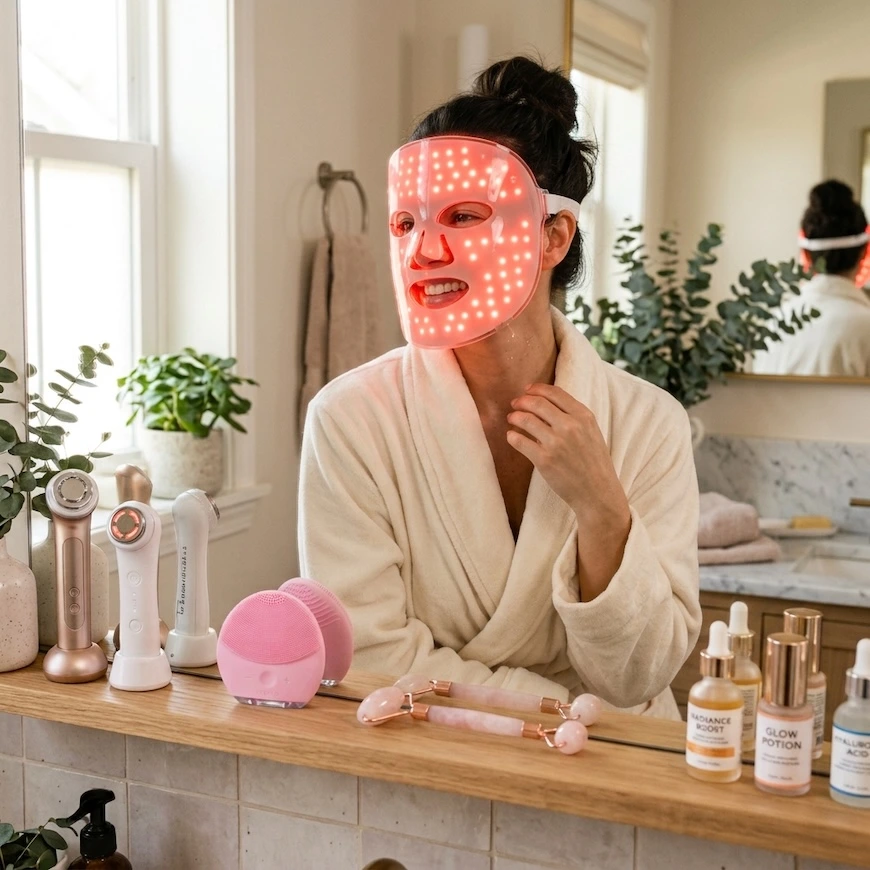
At home skincare devices are one of the few categories where the marketing and the evidence pull in genuinely different directions. Not because the devices don’t work, but because what they do is more modest than what’s implied.
Here’s what each of the main at home skincare devices actually does, what it can’t do, and the safety rules that mostly don’t make it onto the box.
Quick Answer: At home skincare devices work, modestly. A 2026 review in Facial Plastic Surgery concluded they show a favourable safety profile and modest clinical efficacy, with outcomes more gradual and less pronounced than professional-grade equipment because they run at lower treatment intensity. LED masks have the strongest evidence: blue for acne, red for collagen and healing, yellow for pigmentation. Microcurrent gives real but temporary lift that reverses when you stop. Dermaplaning is exfoliation, not anti-ageing. None of them replaces sunscreen, a retinoid, or a dermatologist.
What “FDA-cleared” actually means
You’ll see this on almost every listing for at home skincare devices, and it doesn’t mean what most people assume.
FDA-cleared is not FDA-approved. Clearance means the manufacturer demonstrated the device is substantially equivalent to something already on the market and meets safety standards. It is not a finding that the device produces the results advertised.
A 2026 review in Facial Plastic Surgery summarises it fairly: many of these devices are FDA-cleared, which indicates they meet established safety standards when used according to manufacturer instructions. Safety standards, not efficacy claims. The FDA’s own guidance on light-emitting devices is worth a look if you want the regulatory detail.
That same review is the most honest summary of the whole category I’ve found. Its conclusion is that at home skincare devices demonstrate a favourable safety profile and modest clinical efficacy for maintenance therapy and early dermatologic intervention, when used appropriately. Small clinical studies suggest they may stimulate collagen, reduce acne lesions and improve texture, but outcomes are more gradual and less pronounced than professional equipment delivers, because the treatment intensity is lower.
Maintenance and nudging. That’s the accurate framing. A device claiming to match professional results at home is telling you something the physics doesn’t support, since lower energy output is the entire reason it’s safe to use unsupervised.
LED light therapy masks
The best-evidenced of all at home skincare devices, and what I’d buy first if I were buying one thing.
LED masks deliver narrow-wavelength light that skin cells absorb, driving changes in mitochondrial function and inflammation. It’s called photobiomodulation, it’s non-invasive, and no UV is involved. LED masks do not tan, burn or raise skin cancer risk.
What each wavelength does
This is where most articles, including the earlier version of this one, get it wrong. Based on the 2025 review in Photodermatology, Photoimmunology & Photomedicine:
| Colour | Wavelength | What it’s shown to do |
|---|---|---|
| Blue | 400 to 470 nm | Acne, via antibacterial action. Also aids barrier repair |
| Yellow | 570 to 590 nm | Pigmentation and melasma, by suppressing melanogenesis |
| Red | 630 to 760 nm | Collagen, scar healing, rejuvenation. Penetrates deepest of the visible wavelengths |
| Near-infrared | 760 to 1200 nm | Pigmentary disorders, ageing, wound healing |
Note what isn’t on that list: green. You’ll see green light sold for pigmentation constantly. It doesn’t appear in the review’s wavelength analysis at all. Yellow is the pigmentation wavelength, and if pigmentation is your reason for buying, that’s the setting to look for.
The review also found that combining wavelengths improves outcomes for acne, photoageing and wound repair, which is a genuine argument for a multi-setting mask over a single-colour one.
LED safety, the part that isn’t on the box
Protect your eyes. Bright light aimed at your face for twenty minutes at a stretch isn’t something to be casual about. Use the shields supplied, or keep your eyes closed throughout. A mask with no eye protection and no cut-outs is a reason not to buy.
Check your medications. Several common drugs cause photosensitivity: isotretinoin, doxycycline and other tetracyclines, some diuretics, some antidepressants, and St John’s wort. On any of them? Ask your prescriber before starting light therapy.
If you have melasma, be cautious. Melasma is triggered by light and heat and can worsen from sources that seem harmless. Introduce it very slowly, one short session, and stop if pigmentation darkens.
If you have a seizure disorder, flashing or pulsed modes can be a trigger. Choose continuous-output devices and check with your doctor.
Don’t overdo it. More sessions do not produce faster results, and the manufacturer’s stated time exists for a reason. Ten to twenty minutes, three to five times a week, is the typical protocol.
Expect twelve weeks. Acne responds fastest, often in four to six. Collagen changes take a full twelve, minimum.
Microcurrent devices
Among at home skincare devices, microcurrent is the one that delivers very low-level electrical current to stimulate the facial muscles under the skin. It’s a genuine professional technology adapted for home use, and it does something real.
What it does: a visible lift and tightening, most noticeable along the jaw and cheekbones, usually apparent within an hour of a session.
What it doesn’t do: anything permanent. This is the honest bit that “non-invasive facelift” marketing obscures. Microcurrent results are cumulative but reversible. They build with regular use over weeks and fade over weeks when you stop. Closer to training a muscle than changing a structure. It is not a facelift, and calling it one sets people up to feel misled.
Realistic protocol: five minutes a day, five days a week, for eight to twelve weeks to build results, then two or three times a week to maintain. Missing a fortnight will show.
Conductive gel isn’t optional either. Microcurrent needs a conductive medium to work at all, and running the device on dry skin is both ineffective and uncomfortable. Budget for ongoing gel and factor it into the cost, because it’s a recurring expense reviews rarely mention. The same goes for high frequency wands, which have their own consumables and their own learning curve.
Microcurrent, who should not use it
This list was absent from the earlier version of this article, and it matters more than for any other of the at home skincare devices covered here. Do not use microcurrent if you have:
- A pacemaker, implanted defibrillator, or any implanted electrical device
- Epilepsy or a seizure disorder
- A current pregnancy
- Active cancer, or ongoing cancer treatment
- Metal implants or plates in the face or head
- Recent facial injectables. Wait at least two weeks after botulinum toxin or fillers, and check with your injector
- Broken skin, active infection, or an inflamed rash in the treatment area
Also avoid the thyroid area at the front of the neck.
If you’ve had a stroke, have a heart condition, or are unsure about any of the above, ask your doctor first. This is a device passing current through your face, and the caution costs you nothing.
Dermaplaning tools
Of all the at home skincare devices here, this is the bluntest. Dermaplaning is exfoliation with a blade. It removes dead surface cells and vellus hair, the fine peach fuzz, and the immediate result is genuinely good: smoother skin, brighter appearance, noticeably better makeup application. The SonicSmooth dermaplaning device is the version most people ask about, though a plain blade does the same job for a fraction of the money.
Be clear about what it is. Mechanical exfoliation. It does not build collagen, treat fine lines at any structural level, or do anything anti-ageing. The “diminished fine lines” claim usually attached to it is a light-reflection effect from a smoother surface, lasting until the skin resurfaces.
And the peach fuzz will not grow back thicker or darker. That’s the most common worry and it’s unfounded. Vellus hair returns exactly as it was, because cutting hair doesn’t change the follicle.
How to do it safely:
- Clean, completely dry skin
- Hold the skin taut
- Blade at roughly a 45-degree angle
- Short downward strokes, always in the direction of hair growth
- Never over the same area twice in one session
- Every three to four weeks, not weekly
- Moisturise straight after, and sunscreen the next morning without fail, since freshly exfoliated skin burns more easily
- A fresh blade every time. A dull blade drags and cuts
Dermaplaning, when to skip it
- Active acne, especially inflamed or pustular, where you’ll spread bacteria and can scar
- Rosacea or eczema in the treatment area
- Currently on isotretinoin, or within six months of finishing
- Active cold sores anywhere on the face
- Sunburnt or already irritated skin
- Keloid-prone skin
Don’t combine it with acids or retinoids in the same 48 hours in either direction. That’s how people end up with a raw, stinging face and blame the tool.
Three more categories worth knowing about
The earlier version of this article covered three types of at home skincare devices. Three others deserve inclusion, and two come with warnings.
Cleansing brushes. Genuinely useful for makeup removal, and gentler than the reputation they picked up in the harsh-bristle era. Silicone heads, gentle setting, not daily if your skin is reactive.
Radiofrequency devices. These heat the dermis to stimulate collagen. Reasonable evidence, slow results, and like most at home skincare devices they run at much lower energy than clinic equipment. Twelve weeks minimum, and the same implanted-device cautions as microcurrent.
At-home IPL hair removal. Works, with more caveats than most at home skincare devices carry. It targets pigment contrast, so it performs best on light skin with dark hair and poorly on very fair, red or grey hair. Most home IPL devices are unsuitable for the darkest skin tones and can cause burns and pigment changes, so check the manufacturer’s skin-tone chart against your own before buying rather than after. Never use it over tattoos or moles. Some people also try at-home hair removal for keratosis pilaris, which is a different problem with a different answer.
One category I’d avoid entirely: microneedling at home. Depth control is the whole safety margin, infection risk is real, and the FDA has been explicit that microneedling devices are not approved for driving products into the skin. This one belongs in a clinic.
How to choose, and whether to buy at all
Before comparing at home skincare devices at all, start with the honest question: what’s actually bothering you?
| Your concern | Best device | Should you buy a device first? |
|---|---|---|
| Acne | Blue LED | No. Try adapalene first. It costs a fraction as much |
| Fine lines, dullness | Red LED | Only once you’re already using retinoid and sunscreen daily |
| Pigmentation, melasma | Yellow LED, cautiously | No. Sunscreen and topicals do more, and light can worsen melasma |
| Sagging, jaw definition | Microcurrent | Yes, if you’ll commit to using it several times a week indefinitely |
| Texture, makeup application | Dermaplaning | Yes. Cheapest thing on this page and the most immediately satisfying |
| Puffiness | Cold therapy for puffiness | Yes, and it costs about £12 |
| Unwanted facial hair | IPL, if suitable for your skin tone | Check the tone chart first |
Three rules before you spend on any at home skincare devices:
- Get the basics right first. No device outperforms daily sunscreen and a retinoid. Not doing both? A £300 mask is the wrong purchase, and if acne is the problem, how dermatologists actually treat it starts with topicals rather than hardware.
- Be honest about consistency. Everything here needs three to five sessions a week for twelve weeks to show anything. Most at home skincare devices fail in a drawer, not in a trial.
- Buy for one concern. Devices claiming to do everything usually do each thing weakly.
Frequently asked questions
Do LED face masks really work?
They have the best evidence of any at home skincare devices category. Blue light has demonstrated antibacterial effects for acne, red light supports collagen and healing, and yellow light shows efficacy for pigmentation and melasma. Combining wavelengths appears to improve results. Expect four to six weeks for acne and a full twelve for anything collagen-related.
Is green LED light good for pigmentation?
Green is widely marketed for pigmentation but doesn't appear in the wavelength analysis of the 2025 review this article relies on. Yellow is the wavelength shown to reduce melasma and photoageing by suppressing melanogenesis. If pigmentation is why you're buying a mask, look for yellow rather than green.
Do I need eye protection with an LED mask?
Yes, and it's the safety step most often skipped with at home skincare devices. Use the supplied shields or keep your eyes closed for the whole session. A mask offering neither shields nor cut-outs isn't one I'd buy. If you're on any photosensitising medication, isotretinoin, doxycycline and St John's wort among them, check with your prescriber before starting.
Are microcurrent results permanent?
No, and it's the most important thing to know before spending. Results build with regular use and fade when you stop, over a similar timescale. Closer to training a muscle than to a structural change. If you're not prepared to use it two or three times a week indefinitely, the "non-invasive facelift" framing will disappoint you.
Who shouldn’t use a microcurrent device?
Anyone with a pacemaker, implanted defibrillator or other implanted electrical device; anyone with epilepsy; anyone pregnant; anyone with active cancer; and anyone with metal implants in the face or head. Also wait at least two weeks after injectables, avoid broken or infected skin, and stay off the thyroid area at the front of the neck.
Will dermaplaning make my facial hair grow back thicker?
No. Vellus hair grows back exactly as it was, same thickness and same colour. Cutting a hair at the surface doesn't change the follicle producing it. This is the most common concern about dermaplaning and it has no basis.
Can I dermaplane if I have acne?
Not over active, inflamed or pustular acne, where you risk spreading bacteria and scarring. Dermaplaning suits skin with texture and peach fuzz, not skin with active breakouts. Once your acne is under control and you're left with residual texture, it's fine. Go around any active spots.
What does FDA-cleared mean for a skincare device?
It means the manufacturer showed the device is substantially equivalent to something already on the market and meets safety standards when used as directed. It is not a finding that the device produces the advertised results. Clearance is about safety. Efficacy claims are a separate question, and they usually aren't part of what was cleared, which is worth remembering across all at home skincare devices.

Hi, I’m Marwa ✅
I test skincare, haircare, and makeup on real skin and a real budget, and writes the honest reviews to prove it.