Quick Answer: Microneedling uses fine needles to make controlled micro-injuries in the skin, which triggers collagen production as it heals. The evidence is strongest for atrophic acne scars. A systematic review of 33 studies found improvement in every one. It is weaker for melasma and will not fix significant sagging. The FDA has authorised it for facial acne scars, facial wrinkles and abdominal scars in people aged 22 and over, and it is not approved for driving serums or PRP into the skin.
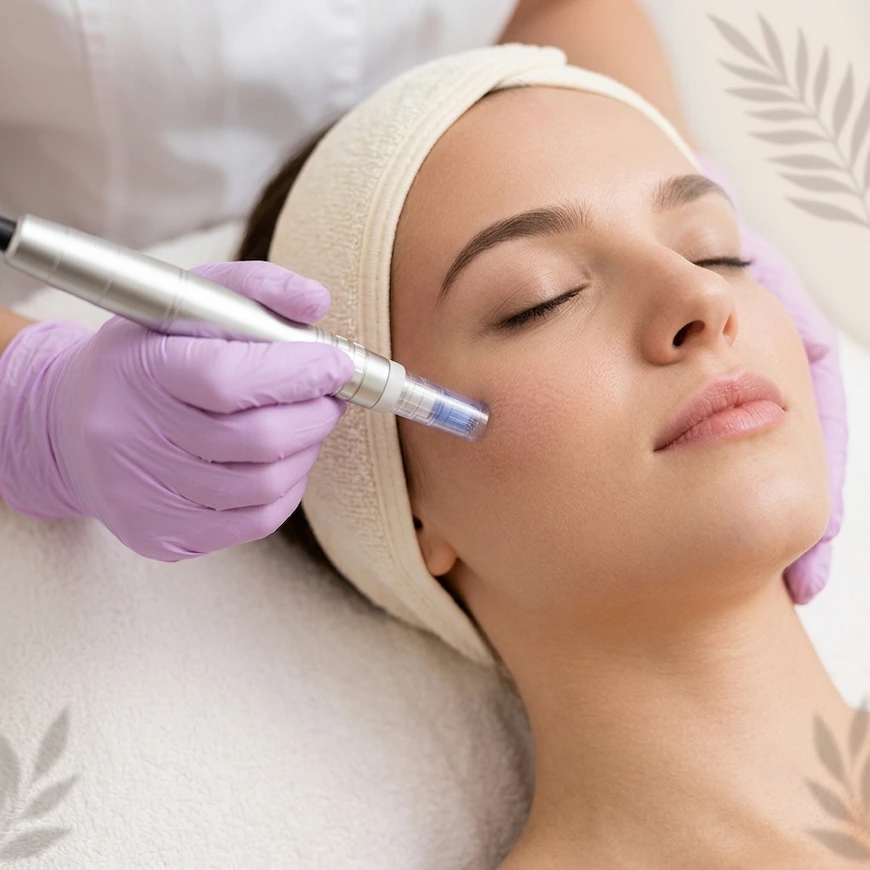
If you are asking what is microneedling, the short version is this. Microneedling, sometimes called collagen induction therapy, is a minimally invasive procedure that uses fine needles to create shallow, controlled punctures in the skin.
The logic is that a small deliberate injury is easier for the body to repair than the damage it is fixing. As the skin heals it produces collagen and elastin, and the new tissue is smoother than what it replaced.
That is the mechanism, and it is real. What varies wildly is how well it works for a given problem, and that is where most answers to what is microneedling stop being useful.
What is microneedling, in regulatory terms?
The FDA describes microneedling devices as instruments with many small needles, tips or pins on the surface, repeatedly inserted into and removed from the skin. Asking what is microneedling as a device category gets you three broad forms:
- Rollers. Needles on a cylinder, rolled across the skin.
- Stamps. Needles on a flat surface, pressed straight down.
- Pens. A motorised tip where the practitioner controls depth and speed.
If you have been shopping for at-home dermaplaning tools, note that those exfoliate at the surface and microneedling is a different procedure working at a different depth.
There is an important regulatory line here that gets glossed over constantly. Not every microneedling product is a medical device. The FDA’s position is that products which do not penetrate into living skin, meaning they only disrupt the stratum corneum, the dead outer layer, and which claim only to exfoliate or improve appearance, are generally not devices. Products that do penetrate living skin are.
That distinction is why a $30 roller and a clinical pen are both called microneedling while doing very different things, and what microneedling actually does depends heavily on which one is in your hand. We cover that comparison separately in the at-home versus professional guide.
So when someone asks what is microneedling authorised for, the answer is narrower than the marketing suggests: improving the appearance of facial acne scars, facial wrinkles and abdominal scars in patients aged 22 or older. That is the list. Hair loss, melasma, stretch marks and pore size are all off-label. Off-label is not automatically wrong. It means the evidence bar the FDA reviewed has not been met for that use.
What is microneedling actually good for?
Here is an honest ranking, because “it helps with everything” is how most articles answer what is microneedling effective for. Sorting what the evidence says about microneedling from what the marketing says is most of the work.
| Concern | Evidence | Realistic expectation |
|---|---|---|
| Atrophic acne scars (rolling, boxcar) | Strongest. FDA-authorised use. | Meaningful improvement over 4 to 6 sessions. Not erasure. |
| Fine lines, skin texture | Good. FDA-authorised use. | Gradual smoothing over 3 to 6 months. |
| Enlarged pores | Moderate | Pores look smaller when surrounding skin is firmer. They don’t shrink. |
| Stretch marks | Moderate, off-label | Better on newer red marks than old white ones. |
| Hair loss (with minoxidil) | Promising, off-label | Studied as an addition to minoxidil, not a replacement. |
| Melasma | Inconsistent | Can worsen it. Discuss carefully before proceeding. |
| Sagging, jowls, laxity | Weak | Won’t do it. This needs energy-based devices or surgery. |
The acne scar evidence in detail, since it is the best case for the procedure. A systematic review by Mujahid and colleagues in Dermatologic Surgery pulled together 33 studies published from 2009 onwards. All 33 showed improvement in acne scar appearance after microneedling, and patient satisfaction ran high across the board, whichever device was used.
The caveat the review raised itself: the evidence turned inconsistent as soon as the authors compared microneedling on its own against combination treatment, or against fractional laser. So it reliably helps. Where it sits against the alternatives is still open.
A 2022 meta-analysis of randomised controlled trials in Aesthetic Plastic Surgery pooled 12 RCTs covering 414 participants and reached a similar place, favouring microneedling without radiofrequency for acne scarring, with no cases of secondary scarring or infection reported.
What is microneedling aftercare supposed to look like? The part most articles get backwards
You will read constantly that microneedling boosts your skincare products by letting them penetrate deeper. Of everything written about what is microneedling good for, take this claim the most carefully.
The FDA is explicit that microneedling devices are not approved for delivering cosmetics, topical medications such as creams, ointments and gels, vitamin solutions, drugs, or blood products including platelet-rich plasma into the skin.
Micro-channels do increase absorption. That part is true. The problem is that absorption is not selective. Your skin barrier keeps irritants, preservatives and fragrance out just as much as it keeps actives out. Bypass it and everything goes deeper, including the things you would rather stayed on the surface. The FDA lists stinging or itching when cosmetic products are applied as a known risk of the procedure.
So the aftercare rule is the reverse of what you would expect. Apply less, not more.
| When | Use | Avoid |
|---|---|---|
| First 24 hours | Whatever your provider gave you. Water. Nothing else. | Makeup, actives, fragrance, exercise, sweating |
| Days 2 to 3 | Gentle cleanser, bland moisturiser, hyaluronic acid, mineral sunscreen | All actives, scrubs, hot showers, saunas |
| Up to 7 days | Keep it simple; sunscreen daily without fail | Retinoids, vitamin C, glycolic/salicylic acid, benzoyl peroxide |
Sunscreen is the non-negotiable part of what is microneedling aftercare done properly, and the general rules for looking after skin after a procedure like microneedling apply here too. Freshly treated skin is more vulnerable to UV, and post-inflammatory hyperpigmentation is one of the more common ways a good result turns into a new problem.
What is microneedling likely to do wrong? The complete risk list
The FDA groups the answer to what is microneedling likely to cause by frequency.
Common: dryness, rough skin, tightness, redness, itching, peeling, discomfort, burning, bruising, bleeding, crusting.
Less common: pigmentation changes, either darker or lighter, lines on the face, reactivation of herpes cold sores, swollen lymph nodes, infection, and stinging when products are applied.
Most resolve within days. But the FDA’s own framing deserves repeating: any microneedling device can cause side effects that last a short time or a long time, and some may be permanent.
One update worth knowing about. In October 2025 the FDA issued a safety communication about potential risks with certain uses of radiofrequency microneedling specifically. If a clinic is offering you an RF device rather than a standard one, that is a reasonable thing to ask about directly.
Two questions to ask before anyone touches your face, both taken from the FDA’s patient guidance:
- Is a new needle cartridge used for every patient and every session? Reusing a cartridge is unsafe and outside the terms of the device’s authorisation, even if it has been cleaned.
- What is your training and experience with this device? The FDA has said it is aware of microneedling devices being marketed that it never reviewed.
Who shouldn’t have microneedling?
Part of answering what is microneedling suitable for is knowing who it is not suitable for. The FDA lists these as reasons to reconsider. It is a longer list than most articles publish, and several items are easy to overlook.
- Currently taking isotretinoin (Accutane), or in the past 6 months
- Bleeding or clotting disorders such as haemophilia
- Taking anticoagulants: warfarin, heparin, including low-dose aspirin
- Immune deficiency or immunosuppressive medication
- Uncontrolled diabetes
- Active skin infection, whether bacterial, viral or fungal
- Hepatitis or HIV
- Eczema, psoriasis, vitiligo or autoimmune disease
- An active rash on the face, or a current cold sore outbreak
- Keloid scars or a history of them
- Actinic (solar) keratoses, warts, moles or birthmarks in the treatment area
- Darker skin tones. Pigment change is a real risk, and the FDA notes some authorised devices were not studied in subjects with darker skin types
- Currently tanned, or planning sun exposure within two weeks
- A known malignancy, or undergoing or about to undergo chemotherapy, radiotherapy or steroid treatment
- Allergy to stainless steel, or to topical or local anaesthetics
- Pregnant or breastfeeding
That darker-skin-tone entry deserves emphasis rather than a footnote. It does not mean don’t do it. It means find a practitioner with documented experience treating your skin tone, ask what device they are using and whether it was studied on skin like yours, and expect a more conservative approach. Post-inflammatory hyperpigmentation is the specific concern.
What is microneedling going to cost, and how long does it take?
Sessions. Most protocols run 3 to 6 treatments, 4 to 6 weeks apart. Acne scarring is usually at the higher end.
Cost. In the US, professional microneedling typically runs a few hundred dollars per session, more with add-ons, and it is rarely covered by insurance because it is cosmetic. Budget for the full course rather than one visit. A single session is largely wasted money.
Downtime. Expect to look sunburned for 24 to 48 hours, with some flaking on days 3 to 5. Plan around events. Most people can wear makeup again after 24 hours, though the first application often stings.
Timeline for results. This is where expectations break. The needling is not the result. The collagen remodelling is, and that takes 3 to 6 months to fully show. Anyone promising a transformation in a fortnight is selling something.
So what is microneedling worth, in the end?
Depends entirely on what you are treating, which is why what is microneedling worth has no single answer.
Probably yes if you have atrophic acne scars or textural roughness, you can commit to a full course plus aftercare, and you are realistic about improvement rather than erasure. Worth pairing with treating acne scarring at the source, since new breakouts will keep producing new scars.
Probably not if your main concern is sagging or laxity, you want a single dramatic session, you are on isotretinoin, or you have melasma, where microneedling can make things worse.
One thing worth knowing about the advice you will find online. Nearly every page ranking for “is microneedling worth it” belongs to a clinic that sells microneedling. That does not make them wrong, but you are unlikely to read “this probably isn’t for you” from any of them. Ask your dermatologist what they would recommend instead. The answer is often a prescription retinoid first, which is cheaper, evidenced, and something you can start this week.
Frequently asked questions
What is microneedling actually proven to work on?
Yes, for specific things. The evidence is strongest for atrophic acne scars, where a systematic review of 33 studies found improvement in all of them, and good for fine lines and texture. It is inconsistent for melasma and weak for sagging. Results come from collagen remodelling over 3 to 6 months, not from the session itself.
What should I avoid after microneedling?
For the first 24 hours: makeup, exercise, sweating, and everything except what your provider gave you. For up to a week: retinoids, vitamin C, glycolic and salicylic acid, benzoyl peroxide, scrubs, saunas and hot showers. Sunscreen daily is essential. Micro-channels increase absorption of irritants just as much as actives.
Does microneedling help skincare products absorb better?
It does increase absorption, but the FDA has not approved microneedling devices for delivering cosmetics, topical medications, vitamin solutions or PRP into the skin, and the increased absorption applies to preservatives and fragrance too. The safer approach is fewer and blander products afterwards, not more active ones.
What is microneedling going to take? How many sessions do I need?
Most protocols use 3 to 6 sessions spaced 4 to 6 weeks apart, with acne scarring usually needing the higher number. One session produces very little. Full collagen remodelling takes 3 to 6 months after the last treatment.
What is microneedling capable of doing permanently?
It can. The FDA states plainly that some side effects may be permanent, and lists pigmentation change and infection among the risks. Permanent problems are uncommon with a trained practitioner and an authorised device, and much more likely with unauthorised devices, reused needle cartridges or aggressive settings.
Why does my skin look worse after microneedling?
In the first few days, redness, tightness and flaking are expected. If it is still worsening after a week, meaning spreading redness, pustules, pain or new dark patches, contact your provider. New dark patches suggest post-inflammatory hyperpigmentation, which is more likely in deeper skin tones and needs treating early.
Is microneedling safe for darker skin tones?
It can be, with the right practitioner, but there are real considerations. Pigmentation change is a listed risk, and the FDA notes that some authorised devices were not studied in subjects with darker skin types. Ask specifically about the practitioner's experience with your skin tone and expect a more conservative depth and spacing.
What is microneedling like to sit through? Does it hurt?
Most providers apply a topical numbing cream for 20 to 30 minutes first, which makes it tolerable. People usually describe it as scratchy or prickly rather than sharp. Bony areas like the forehead and jawline are the most uncomfortable. Afterwards it feels like sunburn for a day or two.
What is microneedling better at than retinol?
They are not really competitors. A prescription retinoid is cheaper, has decades of evidence, and works on texture, fine lines and acne, and most dermatologists will suggest trying one first. We break down microneedling vs retinol for acne scars in more detail separately. Microneedling reaches deeper structural scarring that topicals cannot. Many people end up using both, just not in the same week.
Reviewed for accuracy August 2026. This article is general information and is not medical advice. Microneedling may be a medical procedure. Consult a board-certified dermatologist about your own skin.

Hi, I’m Marwa ✅
I test skincare, haircare, and makeup on real skin and a real budget, and writes the honest reviews to prove it.