Quick Answer: Barrel size decides your curl, not price. 1 inch is the do-everything size; 1¼–1½ inch gives loose waves; ¾ inch gives tight ringlets. Choose a clamp iron for uniform curls and a wand for a more natural, undone look. Set it to the lowest heat that works — 250–300°F for fine or colour-treated hair, 300–350°F for medium, 350–400°F for coarse — and never skip heat protectant.
Most curling iron guides hand you ten products and leave you to work out which one suits you. That’s backwards. The best curling iron for you is decided almost entirely by two things you can figure out in about a minute: the curl you want, and how much heat your hair can take.
Get those right and the best curling iron for you might cost $30. Get them wrong and a $400 one will still give you curls you don’t like, on hair that’s slowly getting worse.
So let’s do those first, then find the best curling iron to match.
Barrel size: the decision that actually matters
Barrel diameter determines curl diameter. Not the brand, not the price, not the coating. Nothing else changes the shape of your curl as much as this one number, which is why the best curling iron for a bob is a different tool from the best curling iron for waist-length hair.
It’s also worth thinking about hairstyles for your face shape before you commit, since where the curl starts matters as much as how tight it is.
| Barrel | Curl you get | Best for |
|---|---|---|
| ⅜ – ½ inch | Tight corkscrew ringlets | Very short hair, pixie cuts, defined spiral looks |
| ¾ inch | Small, springy curls | Short to chin-length hair; curls that need to survive a long day |
| 1 inch | Classic, bouncy, medium curl | Almost everyone. If you’re buying one iron, buy this |
| 1¼ inch | Loose curls, soft waves | Shoulder-length and longer; the “blowout” look, and a good starting point if you’re after how to get volume at home |
| 1½ inch + | Big loose waves, bend rather than curl | Long or very thick hair; beachy waves |
Two things people get wrong when picking the best curling iron.
Your curl will drop. Whatever comes off the barrel loosens within an hour, more so on fine or heavy hair, so size down from the curl you’re picturing. If you want soft waves, a 1-inch barrel usually lands there better than a 1¼.
And shorter hair needs a smaller barrel than you’d think. A 1½-inch barrel on a bob gives you a slight bend and not much else, because there isn’t enough length to wrap around the circumference. If your hair is long or thick, look for a longer barrel as well as a wider one. The best curling iron for long hair is one that lets you take big sections, because a standard barrel makes you work in small ones and doubles your styling time.
Temperature: use less than you think
This is where the actual damage happens, and it’s the section every best curling iron roundup skips.
| Your hair | Temperature |
|---|---|
| Fine, damaged, bleached or colour-treated | 250–300°F (120–150°C). Bleached hair needs lower heat than almost anyone expects. |
| Medium, healthy | 300–350°F (150–175°C) |
| Thick, coarse, resistant | 350–400°F (175–200°C) |
| Anyone, ever | Never above 400°F |
Which row you’re in depends on whether your hair is already damaged, and that’s worth checking honestly rather than optimistically. Bleached hair sits in the top row even if it feels fine.
There’s a reason 400°F is the ceiling. Research on thermal damage found that flat irons operating above 200°C, or 392°F, cause significant damage to hair keratin. The study tracked the mechanism: heat converts the hair’s α-helix protein structure into β-sheet, degrades the keratin, and leaves treated hair holding less water. The finding that matters most if you style regularly is that thermally stressed hair showed significantly increased breakage when combed.
That’s the trade you’re making at 430°F. The curl sets faster, and the hair gets measurably more fragile.
The rule worth remembering: use the lowest temperature that gives you the curl you want. Start low, do one section, go up only if it doesn’t hold. Most people never need the top half of the dial.
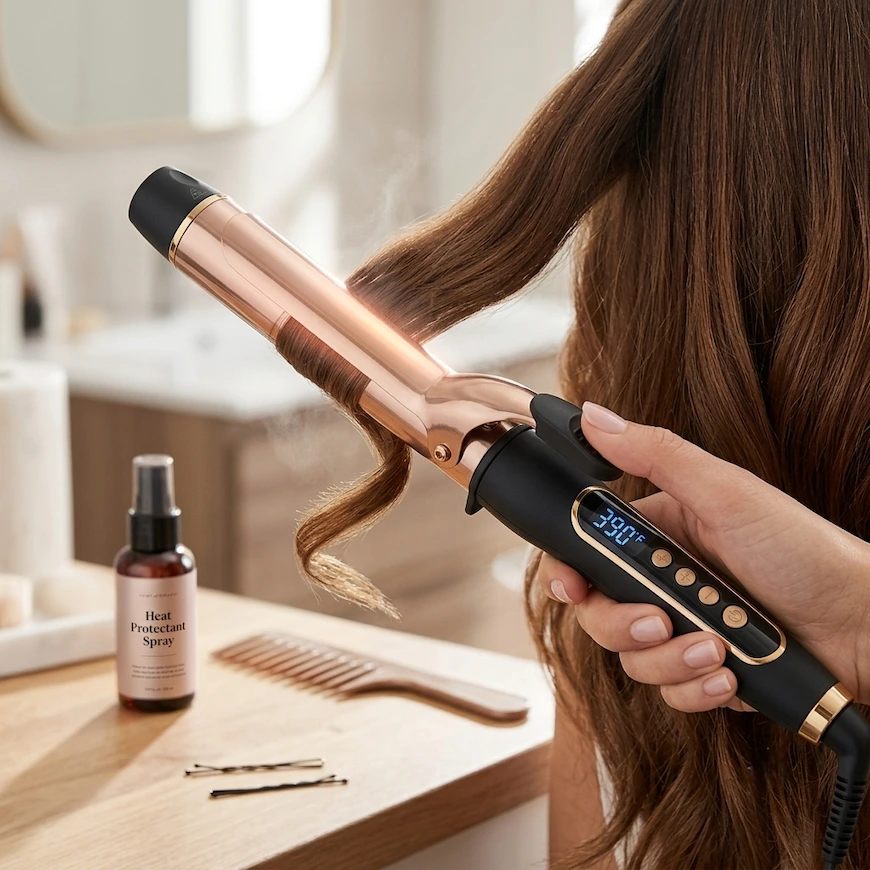
Use heat protectant, and not as a formality. That same study found hair pre-treated with protective polymers had significantly less breakage after repeated hot ironing. That’s better evidence than most haircare claims have, though the research came from a polymer manufacturer. If you prefer an oil in the mix, what argan oil does for heat-styled hair is a reasonable companion to a dedicated protectant rather than a replacement for one.
One last thing on heat: a fixed-temperature iron is a red flag if your hair is fine, bleached or damaged. Plenty of budget irons and a few professional ones run one high temperature with no adjustment. Adjustable heat is worth more than almost any other feature on the box, and the best curling iron at any price is the one that lets you turn it down.
Curling iron vs wand vs air styler
Three different tools, and the difference is worth understanding before you spend anything.
| Tool | How it works | Result | Choose it if… |
|---|---|---|---|
| Clamp iron | A spring clamp holds the hair while you wrap | Uniform, polished, defined curls | You’re a beginner, or you want consistency |
| Wand (no clamp) | You hold the ends and wrap manually | Softer, more natural, slightly irregular | You want beachy or undone. Wear the glove |
| Rotating / automatic curler | A motorised chamber draws hair in and curls it | Very uniform curls, no technique needed | You struggle with coordination or have limited mobility |
| Air styler (e.g. Dyson Airwrap) | No hot barrel. Airflow wraps and sets the hair | Soft, blowout-style volume and bend | Heat damage is your main concern and budget isn’t |
Air stylers deserve a note of their own, because they get lumped into every best curling iron roundup going, including the earlier version of this one. They’re a different category of tool. An air styler has no heated metal barrel. It uses fast-moving air at lower temperatures, which is why it’s gentler and why it won’t produce the sharply defined curl a hot barrel does.
If you want a soft, voluminous, blow-dried look with minimal heat, that’s your tool. If you want defined ringlets that hold all night, it isn’t, and no amount of money changes that.
Six options for the best curling iron by hair type
💡 These are chosen for range: one best curling iron for each realistic budget and hair type, rather than ten near-identical barrels. Prices change constantly, so check pricing at the link.
1. Best overall: a 1-inch adjustable ceramic clamp iron
The default for most people, and the best curling iron to buy if you’re only buying one. A 1-inch barrel handles nearly every curl you’d actually want, and ceramic distributes heat evenly, which matters more for hair health than barrel-material marketing suggests.
Look for adjustable temperature down to 280°F, a swivel cord, and auto-shutoff. Skip it if your hair is past your waist, where you’ll want a longer barrel.
2. Best on a budget: a double-ceramic clamp iron
The best curling iron under $50 is usually ceramic-coated, and these genuinely work. The compromises are usually a shorter warranty, slower heat-up and less precise temperature control, none of which affect the curl much if you style once or twice a week.
Look for multiple heat settings rather than a single fixed temperature. Skip it if your hair is bleached or fine, since precise low-temperature control is the one thing you can’t compromise on.
3. Best curling iron for long or thick hair: a long-barrel styler
A longer barrel lets you take bigger sections, which roughly halves your styling time. If you’ve ever spent 45 minutes curling, this is the fix. Look for an 8-inch barrel and a wide temperature range.
4. Best wand for beach waves: a tapered ceramic wand
The best curling iron for beachy texture isn’t an iron at all. A tapered wand gives a curl that’s tighter at the end and looser at the root, which is what reads as natural rather than styled.
Look for a heat-resistant glove in the box, because you’ll be holding hot hair. Skip it if you want uniform, polished curls; get a clamp instead.
5. Best for beginners: a rotating automatic curler
The barrel draws the section in and curls it for you, which makes it the best curling iron for anyone who finds the wrap awkward. A real accessibility win for anyone with limited hand mobility or strength. Look for an adjustable timer and temperature. Skip it if your hair is very long; most chambers can’t take it.
6. Best low-heat option: an air styler
No hot barrel, so you get soft blowout volume rather than defined curls. Expensive, and worth it only if minimising heat damage is genuinely your priority. For a lot of people, a $40 adjustable iron at 300°F does more for hair health than a $600 air styler used badly, which is the argument against assuming the best curling iron is the priciest one on the shelf.
1. Dyson Airwrap Complete Styler
The Dyson Airwrap Complete Styler is a revolutionary hair tool that combines styling and hair care in one device, designed to give you smooth, voluminous, and frizz-free hair without extreme heat. Using innovative Air Multiplier technology, it dries and styles hair simultaneously by harnessing the power of air to curl, wave, smooth, or add volume.
The Airwrap comes with multiple attachments, including barrels for creating different curl sizes, a smoothing brush, and a pre-styling dryer, making it suitable for all hair types and styles. Its intelligent heat control ensures the temperature remains safe, preventing hair damage, while its lightweight design provides easy handling. Whether you want bouncy curls, sleek waves, or straight, shiny hair, the Dyson Airwrap Complete Styler delivers professional-quality results at home.





Hi, I’m Marwa ✅
I test skincare, haircare, and makeup on real skin and a real budget, and writes the honest reviews to prove it.