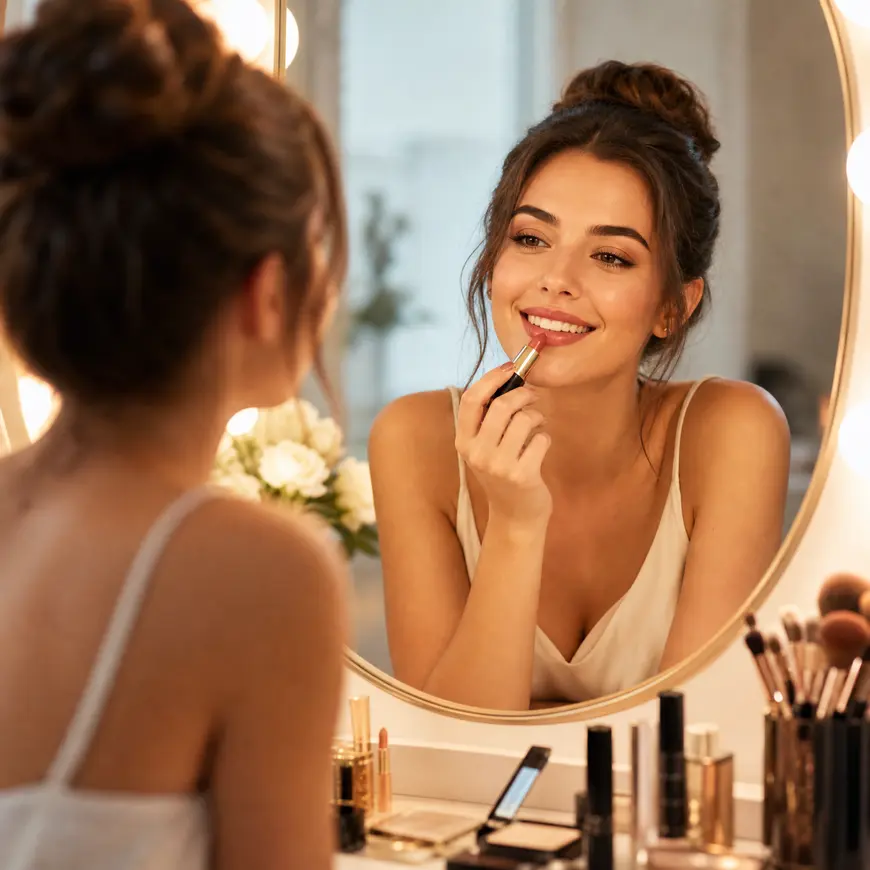
Quick Answer: Yes. Research suggests makeup can measurably improve mood and self-image, though the effect depends heavily on why you wear it. A 2024 randomized controlled trial found that women who began wearing makeup regularly showed reduced depressive symptoms, a 25% improvement in self-image scores, and a 55% drop in stress hormone levels after their first application. In the psychology of makeup, the benefit is strongest when makeup is self-motivated rather than felt as an obligation.
I put on mascara before a job interview once and could not tell you afterward whether it helped me or whether I just believed it helped me. That question bothered me enough to go read the research instead of the beauty-industry summary of it.
What I found is more interesting than either camp usually admits. The psychology of makeup does not resolve into empowerment or oppression. It resolves into something smaller and more testable: a minor psychological intervention that has been run through randomized controlled trials, cortisol assays, and EEG studies, with encouraging results and one significant asterisk.
Here is what the psychology of makeup says, study by study, and what it means for how you use it.
What the psychology of makeup research actually found
Six studies worth knowing about, in plain English. Together they make up most of the usable evidence base in the psychology of makeup.
| Study | What it measured | Key finding |
|---|---|---|
| Dermatology and Therapy, 2024 (randomized controlled trial, 145 women) | Depressive symptoms, self-image, cortisol | Regular makeup use reduced depressive symptoms; self-image scores rose 25%; cortisol fell 55% |
| PLOS ONE, 2022 (1,483 women) | Self-esteem, body image, makeup habits | Social self-esteem predicted more makeup spending; higher general self-esteem predicted less |
| PLOS ONE, 2016 | Attractiveness effect sizes | Professionally applied cosmetics measurably shifted attractiveness ratings |
| Frontiers in Psychology, 2021 | Observer perceptions | Any level of makeup raised rated competence; self-applied heavy makeup raised rated attractiveness |
| Frontiers in Human Neuroscience, 2024 (systematic review) | EEG, heart rate, physiological response | Cosmetic use produces measurable neurophysiological changes, though the evidence base is small |
| Journal of Cosmetic Science, 2019 | Cosmetics use vs. self-esteem | Examined the relationship in a Lebanese women’s sample |
The strongest evidence: a 2024 randomized controlled trial
This is the study that changed my mind, because the design actually establishes cause rather than correlation. Most of the psychology of makeup literature cannot do that.
Researchers ran an open, randomized, controlled trial published in Dermatology and Therapy with 145 Brazilian women of medium-to-low purchasing power who rarely wore makeup. Ninety-five received makeup workshops, product kits, and instructional videos over 60 days. Fifty received nothing.
The results in the intervention group:
- A sustained 8.3 percentage-point reduction in average Zung Index scores, a standard depression screening measure
- A 25% increase in self-image perception, measured with a mirror test
- A 55% reduction in salivary cortisol following the first makeup application
That last number is the one that stops people, and it is the single strongest data point in the psychology of makeup. Cortisol is a stress hormone measured in saliva, and it is not something a participant can fake to please a researcher. Something physiological happened.
The authors concluded that encouraging makeup use is “simple and inexpensive to implement” as a wellbeing intervention. That is a striking sentence to find in a dermatology journal.
The honest caveat: 145 participants is a modest sample, the design was open-label, meaning participants knew which group they were in, and part of the effect almost certainly comes from the workshops themselves. Attention, instruction, being handed something for free. Real, but not a magic wand, and worth holding loosely.
The asterisk: motivation changes everything
The largest study in the psychology of makeup literature complicates the happy version. A 2022 PLOS ONE paper surveying 1,483 women found that the relationship between makeup and self-esteem runs in more than one direction.
Women who placed high importance on appearance used makeup more often, spent longer applying it, and spent more money on it. But women with higher general self-esteem spent less money on makeup, while women with higher social self-esteem spent more.
Read that twice, because it reframes the psychology of makeup in a useful way. Makeup looks like a social tool more than a self-worth tool. People reach for it to feel capable in rooms that have other people in them, not to fix how they feel about themselves alone at home.
Worth noting the limit: this study was cross-sectional, so it captures associations rather than causes. It cannot tell you whether social confidence drives makeup spending or the reverse. Still, the pattern is the difference between makeup that helps you and makeup that quietly costs you.
Part of the effect isn’t in your head at all
One piece of the psychology of makeup has nothing to do with your internal state. Other people treat you differently, and you respond to that.
A 2021 study in Frontiers in Psychology found that observers rated faces wearing any amount of makeup as more competent than bare faces. The attractiveness result was stranger. When the makeup was self-applied rather than done by a professional, heavier looks rated higher than light ones, which reverses what earlier research had found. A 2016 PLOS ONE study measured the size of the attractiveness effect from professionally applied cosmetics directly.
So when someone says “I felt more confident in that meeting,” some of that may be that the room was, measurably, slightly warmer toward them. The confidence is not purely self-generated. It is partly a feedback loop, and that loop is doing real work in the psychology of makeup.
Whether that reads as encouraging or bleak probably depends on your mood today. It is true either way.
It shows up in the body, not just the survey
A 2024 systematic review of neurophysiological research on cosmetics in Frontiers in Human Neuroscience gathered EEG, heart rate, and skin conductance studies and found that cosmetic products produce measurable physiological responses rather than only self-reported ones.
Physiological data matters to the psychology of makeup because self-report studies in beauty research have an obvious weakness: people know what answer the researcher wants.
Be careful how much weight you put on this one, though. The reviewers found only 33 studies in the whole field and just 12 using EEG, and they spent much of the paper arguing that the methodology needs tightening. It is a signal that something measurable is happening, not a settled result, and it is one of the softer areas in the psychology of makeup.
The “lipstick effect” and what it actually means
You will see the lipstick effect cited constantly as proof that makeup boosts mood. That is not what the term originally meant, and it is worth getting right.
The lipstick effect described a consumer spending pattern. During economic downturns, sales of small luxuries like lipstick hold steady or rise while big-ticket purchases collapse. Leonard Lauder popularized the observation after the 2001 recession.
Later research extended it into psychology, suggesting people reach for affordable appearance-enhancing products when they feel economically or socially precarious. That is a finding about coping behavior under stress, related to but not the same as “lipstick makes you happy.”
Both can be true. Just do not cite the lipstick effect as evidence for a mood boost when you are describing the psychology of makeup. Cite the 2024 trial for that. It is the stronger card, and it is the one that actually tested the question.
When makeup builds confidence and when it erodes it
Everything above points at the same practical distinction. Here is how the psychology of makeup plays out in an ordinary morning.
The psychology of makeup works for you when:
- It’s self-initiated. You chose it. Nobody’s expecting it.
- It’s optional. You can leave the house without it and not think about it.
- It’s creative. The wellbeing benefit is strongest when makeup is experienced as self-expression, mastery, or play rather than correction.
- It’s fast. A five-minute ritual is a mood lift. A forty-minute one before every grocery run is a different thing.
- It’s additive. You like your face, and this is a layer on top.
It’s worth examining when:
- You feel unable to be seen without it. Not “prefer not to.” Genuinely unable.
- A missed step ruins your morning. The emotional stakes have gotten disproportionate.
- You’re covering rather than enhancing. If the goal has become concealment of a specific feature, and that goal is anxious rather than aesthetic.
- Spending has climbed with your distress. The 2022 data suggests spending tracks appearance anxiety, not appearance satisfaction.
- You’re skipping the underlying issue. Covering persistent acne with heavier foundation instead of treating it is a common one, and the AAD notes that makeup is fine with acne as long as you are also treating the acne itself.
None of these make you vain or broken. Nothing in the psychology of makeup treats them as character flaws. They are signals worth noticing. The American Psychological Association’s overview of self-esteem is a useful read if the second list felt uncomfortably familiar. And if low mood has been persistent rather than situational, the NIMH’s information on depression is the right next stop. Makeup is not a treatment for depression, and the 2024 study’s authors would not claim otherwise.
How to use makeup so it works in your favor
The practical version of the psychology of makeup, translated into things you can do this week.
Keep the routine short. The wellbeing benefit in the research comes from the ritual and the outcome, not from duration. Long routines create dependency and eat the mornings that were supposed to feel better. My 5-minute everyday makeup routine is built around exactly this. Six products, five minutes.
Run the no-makeup test occasionally. Once a week, go out without it. Not as punishment, as information. If it is genuinely neutral, your relationship with makeup is healthy. If it is not, that is useful to know.
Invest in skin, not coverage. The most reliable confidence upgrade in beauty is skin you do not feel the need to cover. That is boring and it is true. A consistent drugstore skincare routine under $50, applied in the correct layering order, does more for how you feel about your face over six months than anything on your vanity.
Treat problems as problems. If something specific bothers you, whether it is texture, persistent redness, or hair, addressing it directly tends to beat concealing it indefinitely. That might be a dermatologist, or it might be an at-home tool like the dermaplaning device I reviewed or a treatment route like laser for keratosis pilaris. Either way, solving beats hiding.
Let it be fun. The most consistent thread in the psychology of makeup is that it helps most when it feels like creativity rather than obligation. Buy the weird eyeshadow. Play with it on a Saturday. That is not frivolous. According to the research, it is the mechanism.
Frequently asked questions about how makeup boost confidence
Why do I feel better with makeup on?
Three overlapping reasons, and the psychology of makeup rests on all three: the ritual itself has a measurable calming effect, you evaluate your own reflection more positively, and other people respond slightly differently to you, which feeds back into how you carry yourself.
Is relying on makeup for confidence unhealthy?
Not inherently. The psychology of makeup suggests it becomes a concern when makeup shifts from optional to obligatory, when you cannot be seen without it, or when a missed step derails your day. Self-motivated use tracks with better wellbeing. Obligatory use does not.
What is the lipstick effect?
Originally a consumer-spending observation. Sales of small affordable luxuries like lipstick stay resilient during recessions while large purchases fall. It has since been extended into psychology as a description of coping behavior under stress, not as direct evidence that makeup improves mood.
Does makeup make you look more competent?
Observers in published studies rate faces with cosmetics as both more attractive and more competent. That is a finding about perception, not ability, but perception affects how people treat you, which is part of why the confidence effect is real.
Do men experience the same effect from grooming?
The research base here is thin. Nearly all of these studies used female samples, which is a real limitation of the field and a gap in the psychology of makeup as it currently stands. The underlying mechanism, appearance ritual feeding self-perception feeding social response, has no obvious reason to be sex-specific, but nobody has tested it at anything like the same scale.
Does wearing makeup every day damage your skin?
Not by itself, if you remove it properly and choose products suited to your skin. The AAD's position is that makeup is compatible with acne-prone skin when you use non-comedogenic products, clean your applicators, and remove everything before bed.
What’s the fastest way to get the confidence benefit without a long routine?
Keep it to about five minutes and six products. The research points to ritual and outcome, not duration. A short routine gets you the same benefit without building a dependency or losing your morning.
The bottom line
Makeup is not a personality and it is not a lie. The best available evidence, including a randomized controlled trial with a physiological endpoint, says it produces a small, real improvement in mood and self-image, and that the improvement is largest when it is chosen rather than required.
Use it because you want to. Keep it short. Notice if it stops being optional. That is the whole lesson of the psychology of makeup, and it took six studies to arrive at something your gut probably already suspected.
Next: if you want the practical version, here is the 5-minute makeup routine with 15 easy tips that gets you the benefit without losing your morning to it.
Hi, I’m Marwa ✅
I test skincare, haircare, and makeup on real skin and a real budget, and writes the honest reviews to prove it.