Quick Answer: A Teen skincare routine needs three things: a gentle cleanser, a light moisturiser, and sunscreen. Add one acne treatment if you’re breaking out. That’s the whole routine. In a 2026 survey of 168 dermatologists, only 12.5% recommended multi-step routines in practice, while nearly all of them called daily sunscreen essential. Skip: retinol, vitamin C serums, exfoliating acids, toners and anything anti-ageing. Not because you’re too young to deserve nice things, but because they’ll make your skin worse.
If you’re thirteen and everyone at school is talking about a ten-step routine, here’s something that might be a relief. You need three products. That’s it. And all three together cost less than one bottle of the stuff being advertised to you.
This isn’t me being cheap on your behalf. It’s what dermatologists actually recommend.
Why three products, when the internet says ten
Because the ten-step routines are causing problems, and dermatologists are the ones seeing them.
A 2026 survey asked 168 dermatologists what they make of the multi-step routines spreading through social media. The results were not subtle:
- 91.6% were worried about how popular these routines have become
- 88.1% said they regularly see patients with skin problems caused by skincare products, most often irritant eczema, perioral dermatitis, allergic contact dermatitis, and acne triggered by products
- The ingredients that came up most: fragrance, retinoids, exfoliating acids, and things marketed as natural
- Only 12.5% recommended a structured multi-step routine to patients
What almost all of them agreed on was sunscreen. When asked how many steps they’d suggest for healthy skin, the median answer was three. And 89.3% said they’re seeing kids start elaborate routines younger than they used to.
Here’s the thing about teenage skin. It’s already doing most of the work. Your barrier is intact, your cell turnover is fast, and your collagen is fine. You have nothing to reverse. Products sold as anti-ageing are solving a problem you don’t have, using ingredients strong enough to cause one.
That’s the whole logic behind a short skincare routine for teens. Not deprivation. Just nothing your skin has to recover from.
The three products for Teen skincare routine
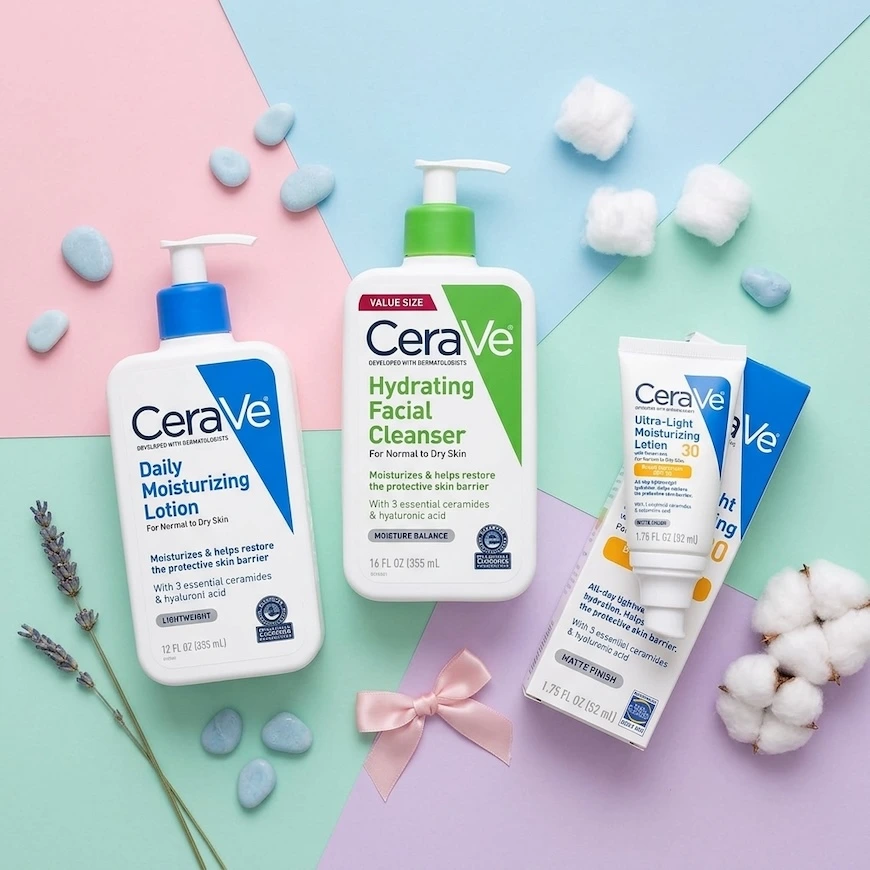
If you want a full routine on a budget, this is it. Three things, all available in any pharmacy.
1. A gentle cleanser
Washing your face properly is the single most useful thing in this article.
The American Academy of Dermatology’s advice is short. Use a gentle, non-abrasive cleanser without alcohol. Apply it with your fingertips, because washcloths, mesh sponges and cleansing tools irritate skin. Rinse with lukewarm water. Limit washing to twice a day, plus after heavy sweating.
Twice a day is a ceiling, not a target. Morning and night. If your skin feels tight and squeaky afterwards, the cleanser is too harsh. That squeak is a stripped skin barrier, and your face will make more oil to compensate.
What to look for: fragrance-free, non-foaming or gently foaming, no scrubbing beads.
2. A light moisturiser
This is the step teenagers skip most, and skipping it is why so many end up oilier.
Strip your skin and it overproduces oil to make up for it. Moisturiser breaks that cycle. Yes, even if you’re oily. Yes, even if you have acne.
What to look for: the word non-comedogenic, which means it won’t clog pores. Fragrance-free. A lotion or gel rather than a thick cream.
3. Sunscreen
The one dermatologists were nearly unanimous about, and the reason it belongs in every skincare routine for teens rather than something you start at thirty.
UV damage accumulates. It doesn’t undo itself, and the products sold later to fix it are expensive and slow. Sunscreen is cheap and it works now. Even on overcast days, up to 80% of UV still gets through the clouds, which is why “it’s not sunny” isn’t a reason to skip it.
And if you use an acne treatment, this stops being optional. The AAD notes that some acne medications make skin much more sensitive to UV.
What to look for: SPF 30 or higher, broad-spectrum, water resistant, and labelled for face. Body sunscreen is thicker and likelier to clog. If you want help choosing, here’s more on picking sunscreen every morning across seasons.
What to skip, and why
Nobody tells you this part, so here it is plainly. None of these are “too grown up.” They’re just wrong for skin that’s working fine, and most of them contradict the AAD’s guidance for acne-prone skin. A skincare routine for teens gets worse, not better, as you add to it.
| Skip | Why |
|---|---|
| Retinol and anti-ageing serums | You have nothing to reverse, and retinoids were one of the two ingredients dermatologists named most often in skincare-related reactions |
| Vitamin C serums | Expensive, unstable, and doing very little on young skin |
| Exfoliating acids and scrubs | The AAD tells acne-prone skin to avoid exfoliants because they dry skin out and make acne look worse |
| Toners and astringents | Same AAD advice. Alcohol-based ones strip your barrier |
| Face scrubs and cleansing brushes | Scrubbing irritates. It doesn’t clean deeper |
| Ten-step routines | More products, more chances to react to one |
| Anything with fragrance | Fragrance was the single most commonly named ingredient in that survey |
| Pore strips | They pull out normal structures that refill within days |
One honest note. If you’ve been given expensive skincare as a gift, you haven’t done anything wrong and you don’t have to bin it. Just don’t use all of it. Take the moisturiser out of the set and leave the actives.
If you’re curious about what’s trending and what works, that’s a separate rabbit hole, and worth reading before you buy rather than after.
The routine
Morning
- Rinse with lukewarm water, or cleanse if you’re oily
- Moisturiser
- Sunscreen, every day, winter included
Evening
- Cleanse
- Acne treatment, if you use one
- Moisturiser
Four minutes a day. If your skincare routine for teens takes twenty, something has gone wrong.
If you have acne, add one thing
Acne isn’t a hygiene problem. It isn’t chocolate and it isn’t not washing enough. It’s hormones plus oil plus a blocked pore, and roughly everyone gets some.
Add one treatment. One. Stacking three at once is how skin gets raw.
Adapalene 0.1% is where I’d start. It’s a real retinoid, the only one sold over the counter in the US, and it has far more evidence behind it than any serum being marketed to you. It costs about as much as a takeaway.
- Start twice a week, at night, on dry skin
- Pea-sized amount for the whole face
- Moisturiser on top, always
- The first six weeks are dry and slightly worse. That’s normal. Don’t quit at week three
- Sunscreen every morning, no exceptions
Benzoyl peroxide is the other option, better if your acne is mostly red and inflamed rather than clogged. Start at 2.5%. Higher strengths irritate more without working better. It bleaches fabric, so keep a white towel and don’t use it the night you’ve just bought a satin pillowcase.
Not both on the same night. Alternate, or pick one.
The AAD’s point about timing is worth holding onto: treatments take weeks to months, not days, so switching products every fortnight guarantees you never find out whether anything worked. And most acne is treatable, which is worth knowing before you spend a year experimenting alone.
Adjusting for your skin
It helps to work out your skin type first, but the adjustments are small.
Oily. Gel cleanser, gel moisturiser, and don’t wash more than twice a day. More washing makes it worse.
Dry or tight. Cream cleanser, richer moisturiser, and a proper wash only at night. A rinse is enough in the morning.
Sensitive or easily red. Fragrance-free everything, and add one product at a time so you know what caused a reaction.
Combination. Follow whichever half bothers you more. You don’t need different products for different parts of your face.
Boys’ skin is the same skin. Slightly thicker and oilier on average, same three products. If you shave, do it after cleansing, with the grain, and moisturise afterwards.
Five mistakes worth avoiding
Most of these have nothing to do with which products you own. They’re the reason a perfectly good skincare routine for teens stops working.
1. Picking. The AAD is blunt about this: picking and squeezing makes acne take longer to clear and raises your risk of scarring and dark marks. The mark lasts far longer than the spot would have.
2. Changing products every two weeks. Nothing works in two weeks. Give anything new eight weeks before you decide.
3. Drying your face on the family bath towel. The AAD says to pat dry with a soft, clean towel. The problem isn’t towels, it’s the damp shared one that’s been on the rail for five days.
4. Ignoring your hair. The AAD notes that oil from your hair causes forehead acne. If you break out along your hairline, look at your hair products before your face products. It’s also worth paying attention to where you break out, because the pattern often points at the cause.
5. Doing it because of a video. Someone selling you a routine makes money whether or not it works on your skin.
When to see a doctor
A skincare routine for teens has limits, and there’s no prize for struggling through. See someone about:
- Deep, painful lumps that last weeks and never come to a head. These scar, and scarring is much easier to prevent than to treat
- Acne that’s leaving marks or pitting
- Three months of consistent treatment with no change
- Skin that’s raw, weeping or stinging from plain water
- Acne that’s making you avoid going out
Nearly all acne responds to treatment. Prescriptions work faster than anything you can buy, and a GP can start you off.
Frequently Asked Questions
What’s a good skincare routine for a 13-year-old?
Gentle cleanser at night, moisturiser morning and night, sunscreen every morning. If there's acne, add one treatment, adapalene or benzoyl peroxide, not both. Four minutes a day, three products.
Can teens use retinol?
Not the anti-ageing kind, and there's no reason to. Adapalene is different. It's a retinoid used specifically for acne, sold over the counter, and well studied in teenagers. Cosmetic retinol serums marketed for wrinkles are among the ingredients dermatologists most often link to teen skin reactions.
Do teens need moisturiser if they have oily skin?
Yes, and it usually helps with the oil. Stripping your skin makes it produce more. Use a gel or lotion labelled non-comedogenic.
Does a skincare routine for teens need a toner?
No. The AAD specifically lists toners and astringents among the products acne-prone skin should avoid, because they dry skin out and make acne look worse.
What’s the best skincare for teenage acne?
Gentle cleanser, non-comedogenic moisturiser, sunscreen, and one treatment. Adapalene suits blackheads and congestion. Benzoyl peroxide suits red inflamed spots. Give it eight to twelve weeks. If nothing's changed, see a doctor rather than buying something else.
Is expensive skincare better for teens?
No. The three products in this skincare routine for teens are among the cheapest on the shelf and among the most recommended by dermatologists. Price mostly buys packaging and marketing.
Can I use my mum’s skincare?
The moisturiser, probably. Anything labelled anti-ageing, firming, retinol or brightening, no. Those are formulated for a problem you don't have, and they're strong enough to cause one.

Hi, I’m Marwa ✅
I test skincare, haircare, and makeup on real skin and a real budget, and writes the honest reviews to prove it.